People living alone with a very small kitchen
If you want to wash plates, cups and cutlery every day, don’t rely on the word ‘mini’ alone. Measure the available worktop space, the appliance and the dishes you use most often.


If you’re short on worktop space or don’t have a mains water connection, a compact model with a tank may be the better fit. If you tend to build up more washing-up, a larger tabletop model could make more sense. Check the dimensions of your dishes, the space needed for the appliance, door and hoses, and the specific model’s consumption figures on the Eco programme. A tank does not remove the need for a safe way to drain wastewater.
If you want to wash plates, cups and cutlery every day, don’t rely on the word ‘mini’ alone. Measure the available worktop space, the appliance and the dishes you use most often.
A tank you fill by hand can replace a mains water connection. You’ll still need to plan a safe way to drain the wastewater.
If you cook often or tend to build up washing-up, compare small tank models with tabletop dishwashers that hold more place settings. The shape of the basket needs to work with your plates, bowls and cooking utensils.
First, measure the space available and check how you’ll supply and drain the water. Then you can compare the capacity with energy and water use, noise levels and your usual washing-up routine.
| What matters | What to check before buying | Who will find this especially relevant? |
|---|---|---|
| Worktop space and fit | Check the external dimensions, space needed to open the door, and the size of your plates and glasses. | If I have very little worktop space in a small kitchen, I’ll measure the appliance, door clearance and the dishes I usually use. Worktop space is the deciding factor for around 31% of consumers. |
| Water supply and drainage | Check whether it fills from a tank or connects to the mains, and follow the instructions for safely routing the drain hose. | If I don’t have a mains water connection, I want to be able to fill the tank by hand and plan the drainage safely too. Around 25% of consumers say connection flexibility matters most to them. |
| Capacity for everyday dishes | Compare the plates, bowls and cooking utensils you normally use with the basket design and stated number of place settings. | If I cook every day or tend to build up washing-up, I want the appliance to fit my dishes in a suitable load. Around 25% of consumers are mainly looking for the right capacity. |
| Energy and water use, and noise | Check the kWh per 100 Eco cycles, litres per Eco cycle, noise level and programme duration for the specific model. | If the appliance is running in a small flat, I’ll look beyond Eco consumption and consider noise and programme duration too. Around 19% of consumers prioritise the ongoing running costs. |
The German Environment Agency notes that a fully loaded dishwasher on the Eco programme can use less energy and water than washing by hand. Eco figures don’t automatically apply to every programme or part-load, and running costs also depend on how you use the appliance and your utility tariffs.
A tank can supply the fresh water, but the wastewater still needs to drain away. Bomann also lists a drain hose for the TSG 5704.
Plan a suitable drainage route before buying, and set it up in line with the instructions for your chosen model.
The tabletop models mentioned differ in their external dimensions and stated capacity. The number of place settings alone won’t tell you whether your plates, bowls or cooking utensils will fit in the basket.
Measure the space available and check that the dishes you use most often will fit in the specific appliance.
The figures on the EU energy label refer to the Eco programme. The German Environment Agency also bases its comparison with handwashing on a full load.
Compare Eco figures separately from those for other programmes, and consider how full you’ll be able to load the appliance in everyday use.
The manufacturer’s information for the TSG 5704 and TSG 7405 shows that they differ in capacity and connection type.
According to Midea Germany, the ST 5.31 wi is a tabletop model for three place settings that can be used with or without a mains water connection.
The LIFE DWT60 (MD37496) is a tabletop dishwasher for six place settings with a water connection.
The GSP508-030D is a tabletop model with a stated capacity of eight place settings.
This selection includes compact tabletop dishwashers with tanks, as well as models with different stated capacities. Connection types and features vary between models.
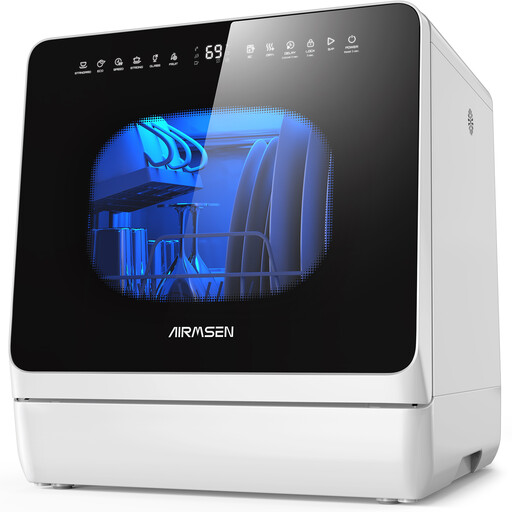 No image available
For supplying water without a permanent connection: the product name specifies an integrated water tank and says that no water connection is required.
The product name also specifies eight wash programmes, an integrated water softener, a delay start and a child lock.
 No image available
For flexible water supply: the product description specifies tank operation or a tap connection, with capacity for four place settings.
According to the product information, the integrated tank holds 5 litres and the dishwasher is 37 cm wide. A separately available adapter may be needed to connect it to a tap.
The product name specifies nine wash programmes.
 No image available
For a medium-sized load: the product description specifies three place settings and the option of tank operation or a tap connection.
The description lists a 5-litre tank, seven programmes and a separate drying function. The stated noise level is 56,3 dB.
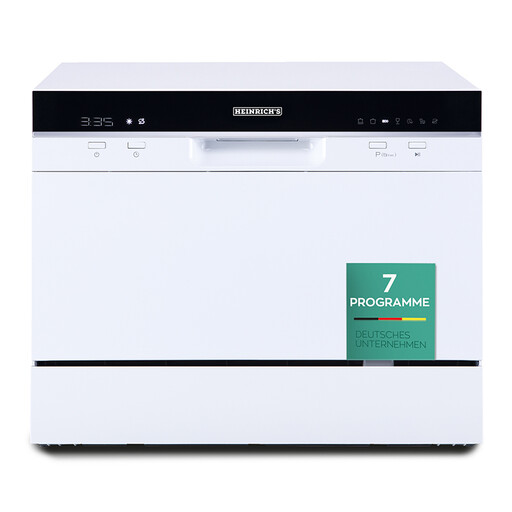 No image available
For more dishes per wash: the product name specifies a capacity of six place settings.
The product name lists seven programmes and an automatic door opening for drying. The stated noise level is 47 dB.
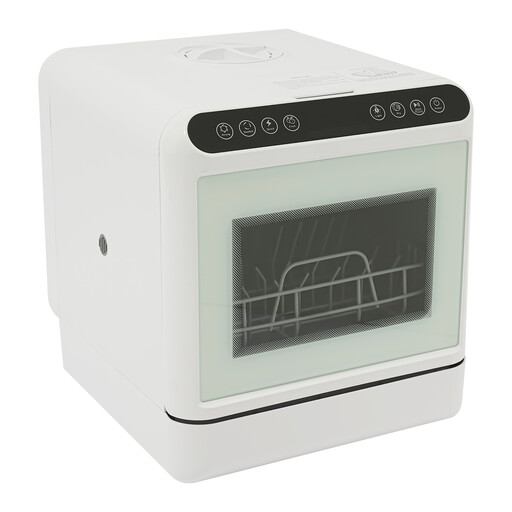 No image available
For supplying water without a permanent connection: the product information specifies an integrated water tank and a water outlet.
The product name specifies a 1.32Gal tank, hot-air drying and a 72-hour storage mode.
Compare the basket of the specific model with the dishes you usually use, including bowls and cooking utensils. The two-place-setting capacity of the Bomann TSG 5704 and the six-place-setting capacity of the Bomann TSG 7405 are stated capacities. For efficient use, the German Environment Agency recommends filling the dishwasher as fully as possible.
Not necessarily for the fresh water supply: Bomann describes the TSG 5704 as having a tank that can be filled by hand. You’ll still need a suitable drain for the wastewater; check the instructions for your chosen model.
The German Environment Agency recommends running the appliance as full as possible on the Eco programme and not rinsing dishes with hot water beforehand. The figures on the label refer to the Eco programme and don’t represent consumption on other programmes.
Your statutory rights against the seller are separate from any voluntary guarantee. The Verbraucherzentrale also notes that enhanced repair rights for dishwashers have applied since 31 July 2026. The purchase date, the fault and whether you meet the relevant conditions can all affect how a claim is handled.
The European Commission describes the EU energy label as showing an A to G scale and Eco figures. The German Environment Agency states that dishwashers have had to carry the new EU energy label since 1 March 2021. Check that the model name and the relevant label match.