Who might benefit from a tabletop dishwasher during a renovation?

Households without a fixed water supply

If there isn’t a suitable mains water connection where you plan to put the dishwasher temporarily, look for models specifically designed to use an alternative water supply. You’ll still need a safe way to drain the wastewater.

Households with a daily pile of washing-up

If you want to wash several place settings at once, compare the stated capacity and basket layout with your own plates, cups and cutlery. A stated number of place settings doesn’t guarantee that every size and shape of dish will fit.

Households short on worktop space

During a renovation, you’ll need to consider more than the dishwasher’s height, width and depth. Make sure there’s also room for the hoses and for the door to open at the temporary location.

What should you look for when choosing one?

What matters to you What to check Who is this most relevant to?
Water supply and drainage Check how the specific model is designed to receive water, and plan the hose route and wastewater drainage at the same time. If there’s no fixed water inlet at the temporary location, I need a suitable alternative water supply and a practical way to drain the wastewater. Around 36% of consumers put the lack of a fixed water inlet at the top of their list.
Room for everyday dishes Compare your usual daily load, plate sizes and basket layout with the stated capacity. If several place settings pile up during the day, I want to wash as many dishes as possible together. Around 29% of consumers prioritise a larger everyday load.
Space for the appliance Measure the height, width and depth, and allow room for the door and hoses. If only a small part of the kitchen is usable, the appliance and its connections need to fit into the available space. Around 21% of consumers say limited space is their main concern.
Consumption and running costs Compare figures for the same programme and on the same label basis. Eco figures can’t be directly applied to other programmes. If I want to weigh up the running costs, comparable figures for electricity and water use on the Eco programme are helpful. Around 14% of consumers put consumption and running costs first.

Which assumptions should you avoid?

  • ‘No water connection’ doesn’t mean ‘no water supply or drainage’

    An alternative water supply doesn’t automatically solve the problem of where the wastewater will go. At a temporary location, the water supply and drainage both need to work.

    Before deciding where to put the appliance, plan the water supply and drainage for the exact model using its instructions.

    If you fill the appliance manually and drain it into a container, allow for the extra effort and space needed for the wastewater solution.

  • Place settings don’t guarantee your dishes will fit

    The stated capacity doesn’t tell you whether large plates, bowls or your cutlery will fit in the baskets. A smaller load may also mean running extra cycles or washing some items by hand.

    Compare the sizes of your usual plates and bowls with the basket layout of the specific model.

  • Eco consumption figures don’t automatically apply to every programme

    Germany’s consumer advice centre, Verbraucherzentrale, explains that comparable energy-label figures for electricity consumption are based on the Eco programme. You can’t assume that quick or intensive programmes use the same amount.

    Compare figures on the same Eco basis, and consider your preferred programme separately.

Which brands are worth considering?

Bomann

The TSG 7405 is a tabletop model that connects to the mains and has a stated capacity of six place settings.

  • The manufacturer lists a cutlery basket, a cup rack, and inlet and drainage hoses.
  • The stated dimensions are 43,8 × 55,0 × 50,0 cm (H × W × D). This doesn’t confirm that it can run from a tank or that all your own dishes will fit.

Midea

The MDWMT0305EW-WE and MDWTT0602MW-WE tabletop models differ in their water supply and stated capacity.

  • Midea states that the MDWMT0305EW-WE holds three place settings and can be used with or without a water connection. The MDWTT0602MW-WE is listed as holding six place settings.
  • Before comparing the six-place-setting model, check the features and consumption figures on the datasheet for that exact version.

MEDION

The DWT51 (MD 37766) is designed for five place settings and offers an alternative water supply.

  • According to MEDION, the appliance can be supplied through a fixed water connection or using a bucket supplied with the product.
  • Even when using a bucket for the water supply, you’ll still need a suitable way to drain the wastewater at the chosen location.

Klarstein

According to the manufacturer, the Aquatica is a particularly compact tabletop model for two place settings.

  • Its low stated capacity may suit smaller loads if you can use a suitable tap connection.
  • You may need extra cycles if you have more washing-up each day. The description of the tap connection doesn’t confirm that it can run from a tank.

Joybuy products for washing up during a renovation

The tabletop dishwashers below offer different ways to manage the washing-up temporarily, including tank-fed models and models that connect to a water supply. Check that the water supply, drainage, available space and capacity suit your location.

AIRMSEN tabletop dishwasher with 5-L water tank

AIRMSEN tabletop dishwasher with 5-L water tank

For a location without a fixed installation; the description says wastewater can be drained through a hose into a container.

The title lists a 5-L water tank and 5+1 wash programmes. The description gives dimensions of 45,8 × 42,8 × 42,5 cm.

View at Joybuy
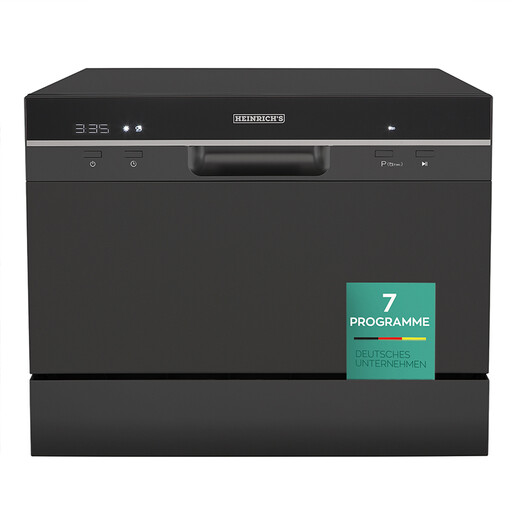
Heinrich's HTG 8840 tabletop dishwasher

Heinrich's HTG 8840

For a larger load, if suitable water supply and drainage connections are available at the chosen location.

This model is listed as holding six place settings, with seven programmes and inlet and drainage hoses.

View at Joybuy
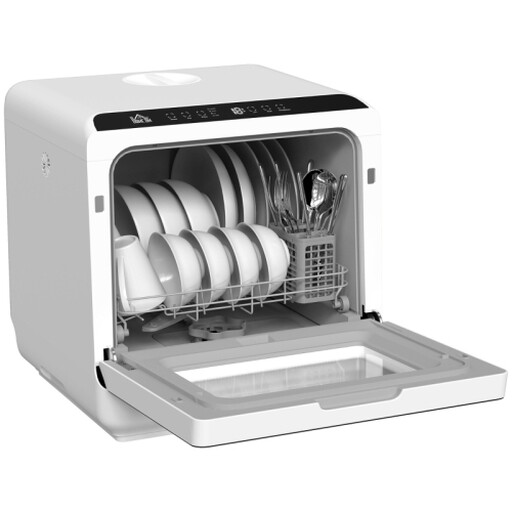
Tabletop dishwasher with 6-litre tank and four place settings

Tabletop dishwasher with 6-litre tank

For a modest load and a location where you can use the tank or a tap connection.

The description lists four place settings, five programmes, a drying function and dimensions of 45 × 44 × 45,8 cm.

View at Joybuy
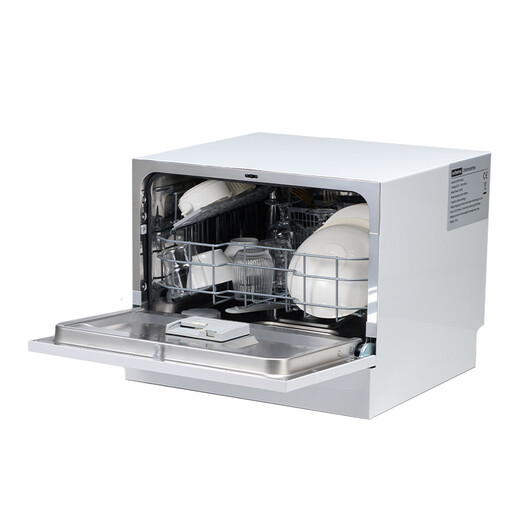
Ochama tabletop dishwasher for six standard place settings

Ochama tabletop dishwasher for six standard place settings

For a larger load, provided the stated capacity and required connections suit the temporary location.

The title lists six standard place settings; the description lists eight programmes and a 30-minute quick wash.

View at Joybuy

Comfee' CDWMTO201D(W) tabletop dishwasher with 5-L tank

Comfee' CDWMTO201D(W) with 5-L tank

For a temporary location where you can fill the tank by hand or use a tap connection.

The title lists an integrated 5-L tank and 6+3 programmes. If you use the tank, you’ll also need to plan how to drain the wastewater at the chosen location.

View at Joybuy

Frequently asked questions

Can a tabletop dishwasher work without a fixed water connection?

Yes, if the specific model is designed to use an alternative water supply. Midea says the MDWMT0305EW-WE can be used with or without a water connection; for the DWT51, MEDION lists a bucket supplied with the product as an option. You’ll still need to drain the wastewater in line with the model’s instructions.

Which energy-label figures should I use when comparing consumption?

Compare figures on the same basis, particularly electricity use per 100 Eco cycles and water use per Eco cycle. These label figures can’t be directly applied to quick or intensive programmes. Verbraucherzentrale and the European Commission explain the energy labelling requirements for dishwashers.

What should I bear in mind when setting up and maintaining the appliance?

Read the instructions for the exact model before use, and check the space available, hose routing and recommended care instructions. For the Bomann TSG 7405, the manufacturer lists inlet and drainage hoses and a water-softening system. These details don’t automatically apply to other tabletop models.

What rules apply to energy labels and disposal at the end of the appliance’s life?

Household dishwashers are subject to EU energy labelling and ecodesign requirements. According to the European Union, the label must also be visible when the appliance is sold online. End-of-life electrical appliances should be collected separately. Germany’s Federal Environment Agency (Umweltbundesamt) says that local-authority collection points are generally free to use; check which return options are available in your area.

What ongoing costs should I consider in addition to the price of the appliance?

Electricity and water use depend on the model, programme and how you use it. Compare the Eco label figures and think about how many cycles you’re likely to run. You’ll also need to arrange a suitable connection or allow enough space for wastewater drainage.