Lunchboxes for several days
If you prepare ingredients in advance and want to clean several boxes, lids or inserts, focus on the shape of the basket and whether your items will actually fit. The place-setting capacity alone won’t tell you that.


First, check the dimensions and number of your lunchboxes, including lids and inserts: the place-setting capacity alone won’t tell you whether everything will fit in the basket. A tank model may be a good option if there’s no fixed water supply; a larger model with a water connection may suit you better if you want to wash several items together and have the space and connections available. Whichever you choose, plan for a suitable drainage solution and check the care instructions for each lunchbox component.
If you prepare ingredients in advance and want to clean several boxes, lids or inserts, focus on the shape of the basket and whether your items will actually fit. The place-setting capacity alone won’t tell you that.
A tank model may suit smaller washing-up loads if you have limited space or can’t use a fixed water supply. You’ll still need a suitable drain for the wastewater.
If you wash up frequently, compare Eco consumption figures on a like-for-like basis. They don’t automatically apply to every other programme or to every number of wash cycles.
A good option if: you wash only a few boxes at a time, have limited space or can’t use a fixed water supply.
Things to consider: You’ll need to fill the tank, and basket space may be limited; you’ll still need a suitable drain.
A good option if: you regularly wash several boxes, lids and other dishes together, and have the water supply, drain and space available.
Things to consider: A higher place-setting capacity doesn’t automatically mean your boxes will fit. Measure the space needed when the door is open, too.
| What matters | What to check before buying | Who will find this especially important? |
|---|---|---|
| Fit and capacity | Measure your largest items and compare them with the basket, interior height and clearance for the spray arms. | If I prepare several boxes, including lids and inserts, for a few days, I want to fit as much as possible into one load. For around 36% of consumers, fit and capacity are the top priorities. |
| Water supply, drainage and space | Check whether a fixed water supply is possible, where the drain hose will lead, and whether there’s enough room for the appliance and its open door. | If I can’t use a fixed water supply, I need a flexible way to add water as well as a practical route for wastewater. Around 29% of consumers prioritise flexible connections in this situation. |
| Care instructions and programmes | Check the care instructions for the box, lid and inserts, and make sure they’re compatible with the available programmes. | I want to know whether each item is suitable for machine washing before choosing a programme. Around 21% of consumers prioritise material care and choosing the right programme. |
| Energy and water consumption | Compare kWh per 100 Eco cycles, litres per Eco cycle and programme duration across appliances of a similar size; factor in how many wash cycles you’ll need. The German Environment Agency and the consumer advice centre explain these Eco figures as comparison values. | If I wash up regularly, I want to compare consumption figures like for like and take the number of loads needed into account. For around 14% of consumers, comparing running costs is the top priority. |
Place settings describe a standardised capacity for crockery, not the shape and size of your containers.
Measure your largest items and check the basket, interior height and clearance needed for the spray arms on the specific appliance.
A water tank can replace a fixed water supply, but the used water still needs to drain away.
Plan the drainage in line with the appliance instructions and where you intend to install it.
The consumer advice centre explains that the glass-and-fork symbol indicates that an item is suitable for food contact, not that it can be washed in a dishwasher.
Check the care instructions for each individual item, then choose a suitable programme.
The stated energy and water figures refer to the Eco programme. Actual use may differ if you run extra loads or choose other programmes.
Compare the label figures with the number of wash cycles you’re likely to need for your boxes.
The models below show a range of capacities and water-supply options. The details relate to the specific models listed and aren’t recommendations for the brands as a whole.
Midea lists three place settings for the MDWMT0305EW-WE, which can be used with or without a water connection.
According to Bomann, the TSG 5702 is designed for three place settings and can be used as either a tank or a mains-connected model.
According to Exquisit, the GSP5206-030D schwarz is a freestanding tabletop model with six place settings.
The manufacturer describes the Amazonia 6 as a tabletop model or a version suitable for built-in installation, with six place settings.
Medion describes the LIFE DWT20 (MD37763) as a two-place-setting model that can be used with or without a fixed water connection.
The Joybuy options below include compact tabletop models with a water tank, as well as a model with six place settings. Whatever the stated capacity, check that your particular boxes, lids and inserts will fit inside.
 No image available
Tank operation may suit you if you can’t use a fixed water supply and wash smaller loads.
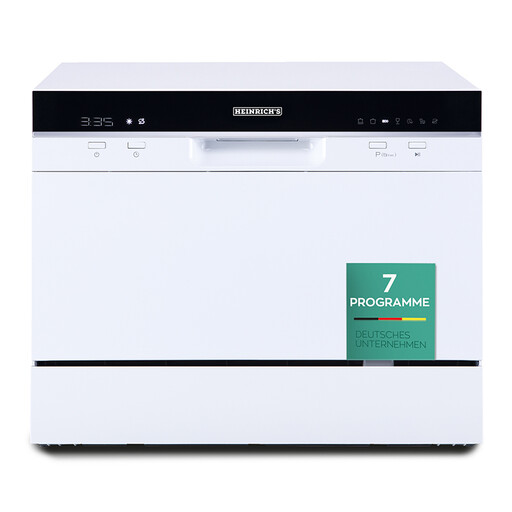
Joybuy lists this model as having 3 place settings, 7 programmes, a noise level of 56,3 dB and energy class C.
 No image available
The stated capacity may suit combined loads, provided your lunchbox components fit inside.
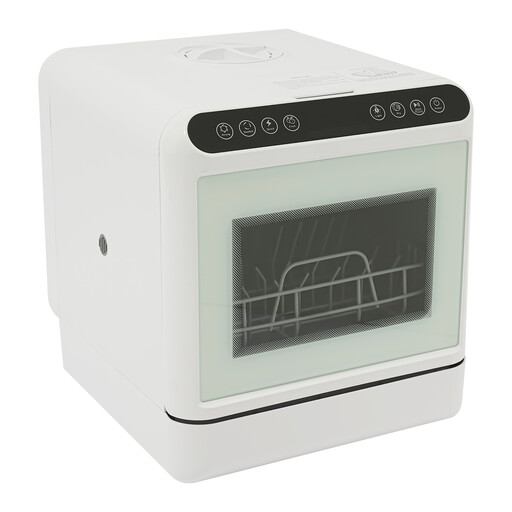
Joybuy lists this model as having 6 place settings, 7 programmes, a noise level of 47 dB and energy class D.
 No image available
An integrated tank may be useful if you want a flexible installation that doesn’t rely on a fixed water supply.
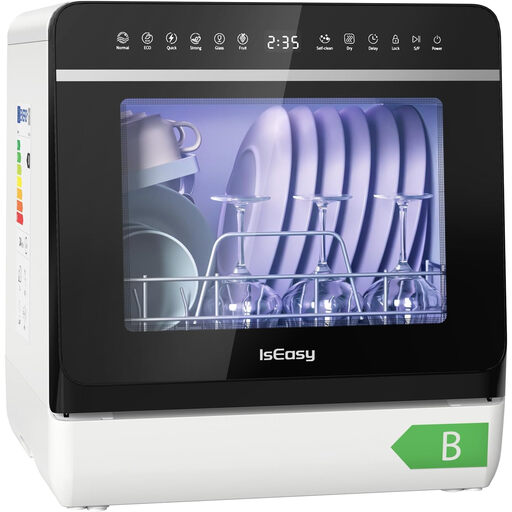
Joybuy lists a 1.32-gallon tank, hot-air drying and a 72-hour storage function.
 No image available
This model may suit smaller loads if you want to wash up without a fixed water connection.
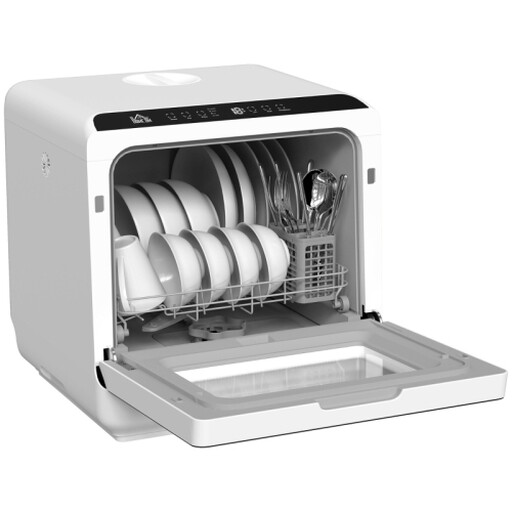
Joybuy lists a 5-litre water tank.
 No image available
The flexible water supply may suit you if you want to choose between tank operation and a tap connection.
Joybuy lists a 6-litre tank, 5 programmes, an LED display and a drying function.
No. The consumer advice centre explains that the symbol indicates an item is suitable for food contact. Check the separate care instructions for the box, lid and inserts.
On models with this feature, the tank replaces a fixed water supply, but you’ll still need a way to drain the wastewater. According to Bomann, a drain hose is included with the TSG 5702.
The label shows, among other things, energy consumption per 100 Eco cycles, water consumption per Eco cycle, Eco programme duration, capacity and noise level. The German Environment Agency and the consumer advice centre list these as comparison values; they don’t automatically apply to every other programme.
Follow the care instructions for each lunchbox component and the appliance instructions, including those for accessible filters. When preparing ingredients, you should also avoid transferring germs via your hands and kitchen utensils; a dishwasher programme doesn’t replace good kitchen hygiene.
For a new household dishwasher that must carry an energy label, the current EU energy label must be available on the online listing. Under EU requirements, the A to G scale is there to help you compare products; it doesn’t set a blanket minimum class for your purchase.