Which appliance is right for you?

Lunchbox users with bulky parts

If you want to put the container and lid in the basket separately, check their dimensions and make sure they won’t obstruct the spray arms. The place-setting capacity doesn’t tell you whether your particular lunchbox will fit.

People living alone without a fixed water supply

A model with a tank could be a good fit if there’s no suitable water supply where you plan to put it. Medion describes the DWT30 as a model that can be used with its tank, a fixed connection or a bucket. You’ll still need to plan how to fill it and drain the wastewater.

People living alone with connections and other dishes to wash

If you want to wash plates and cutlery as well as your lunchbox, a larger tabletop model may be suitable. Bomann lists the TSG 7405 as having capacity for six place settings, but the space available and the load you actually wash are still key considerations.

What should you look for when buying?

What matters when buying What to check Who is it most important to?
Lunchbox fit Measure the box and open lid; check the basket shape and make sure the spray arms have enough clearance. If I need to load the container and lid separately, fit and spray clearance matter more to me than the place-setting capacity. Around 36% of consumers prioritise whether their lunchbox parts will fit.
Water supply and drainage Check the operating modes of the exact model, as well as the space needed for filling it and routing the drain hose. If there’s no fixed water supply where I plan to put it, I need a practical solution for filling the tank and draining the wastewater. Around 29% of consumers put the lack of a fixed water supply first.
Space and capacity Check the appliance dimensions and the clearance needed to open it; consider what you usually wash. If worktop space is limited, the appliance needs to fit there and hold the load I typically wash. Around 21% of consumers prioritise a compact footprint and practical capacity.
Consumption and care Compare figures for the same Eco programme; factor in detergent and, where necessary, regeneration salt. If I want to weigh up electricity and water use alongside ongoing care, I need figures that can be compared like for like. Around 14% of consumers put consumption and care first.

Avoid common misconceptions

  • Assuming place settings mean your lunchbox will fit

    The capacity figure doesn’t prove that a particular box or its lid will fit in the basket. The parts could also obstruct the spray arms.

    Measure the container and lid separately, then check that you can load them without blocking the spray arms.

  • Taking “no water connection needed” to mean “no water or drainage to think about”

    A tank replaces the fixed water supply, but you’ll still need to fill it and drain the wastewater.

    Check the instructions for the exact model to see how tank filling, hose routing and drainage will work where you plan to put it.

  • Assuming Eco consumption figures apply to every wash

    The consumption figures are for the Eco programme. The German Environment Agency’s comparison with washing by hand is based on a fully loaded dishwasher; it doesn’t tell you the consumption per lunchbox or for a lightly loaded machine.

    Compare Eco figures on the same basis, and think about how often you can run a sensibly full load.

Useful brands to consider

Medion

Medion describes the DWT30 (MD370022) as a model for three place settings that can be used with its tank, a fixed connection or a bucket. This may be useful if there’s no fixed water supply where you plan to put it.

  • The manufacturer says it has fan-assisted drying, including for plastic items.
  • This manufacturer’s claim doesn’t guarantee that your particular lunchbox will dry; its dimensions and care instructions are still what matter.

Bomann

According to the manufacturer, the Bomann TSG 7405 is a tabletop model for six place settings, with a water inlet and drain hose. It may suit you if you have the necessary connections and want to wash other dishes as well.

  • Bomann lists dimensions of 43.8 × 55.0 × 50.0 cm (H × W × D), 6.5 l per Eco cycle and 49 kWh per 100 Eco cycles.
  • The external dimensions and fixed connections need to suit your available space; the consumption figures don’t tell you how much energy or water it uses per lunchbox.

Midea

Midea describes the MDWMT0305EW-WE as a freestanding mini dishwasher for three place settings, which can be used with or without a water connection.

  • The manufacturer lists dimensions of 435 × 420 × 465 mm (H × W × D) to help you plan where to put it.
  • The external dimensions don’t tell you whether a particular lunchbox will fit inside.

Exquisit

The Exquisit GSP508-030D is a larger tabletop model for eight place settings. It may be a better fit if you have other dishes to wash alongside your lunchbox parts and enough space for the appliance.

  • Exquisit lists dimensions of 55 × 59 × 50 cm (W × H × D) and a depth of 96 cm with the door open.
  • Make sure to allow space in front of the appliance too; its larger capacity doesn’t mean an individual box will fit.

Joybuy products at a glance

The Joybuy models below are compact tabletop dishwashers; several are listed as having an integrated water tank. For every model, check that your lunchbox parts will fit and that you have a practical way to supply water and drain the wastewater.

AIRMSEN tabletop dishwasher with integrated 5-litre water tank

AIRMSEN tabletop dishwasher with integrated 5-litre water tank

The tank may be useful if there’s no fixed water supply where you plan to put it; also check how you’ll drain the wastewater.

5-litre water tank; 9 programmes; 37 × 50 cm; energy efficiency class D.

View at Joybuy

Heinrich's HTG 8855 tabletop dishwasher

Heinrich's HTG 8855 tabletop dishwasher

The stated tank or tap-water operation may suit different connection options; plan how you’ll fill it and drain the wastewater where you intend to put it.

3 place settings; 7 programmes; 24-hour delay start; 56.3 dB; energy efficiency class C; operates with or without a water connection.

View at Joybuy
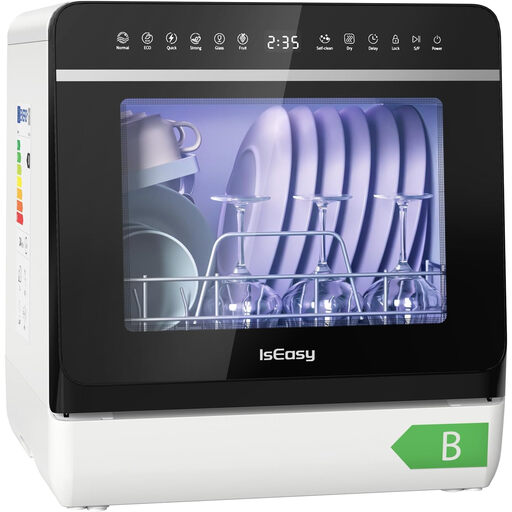
Tabletop dishwasher with 5-litre water tank

Tabletop dishwasher with 5-litre water tank

The stated tank operation may suit a spot without a permanent water connection; check how you’ll drain the wastewater and whether there’s room for your lunchbox parts.

5-litre water tank; operates without a permanent water connection.

View at Joybuy
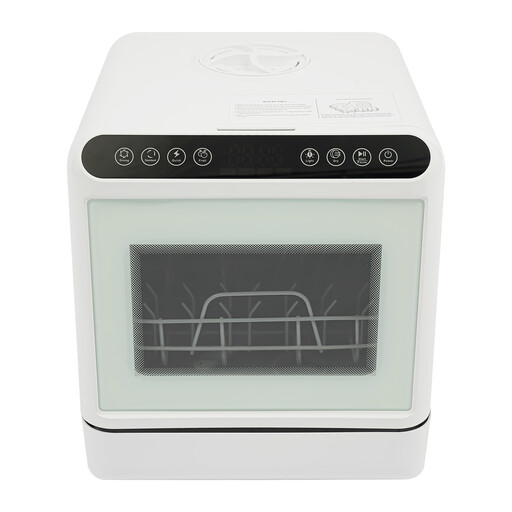
Tabletop dishwasher with 6-litre water tank and touch controls

Tabletop dishwasher with 6-litre water tank

The integrated tank may be useful if there’s no fixed water supply where you plan to put it; also check that your lunchbox parts will fit inside with the lid open.

6-litre water tank; touch controls.

View at Joybuy
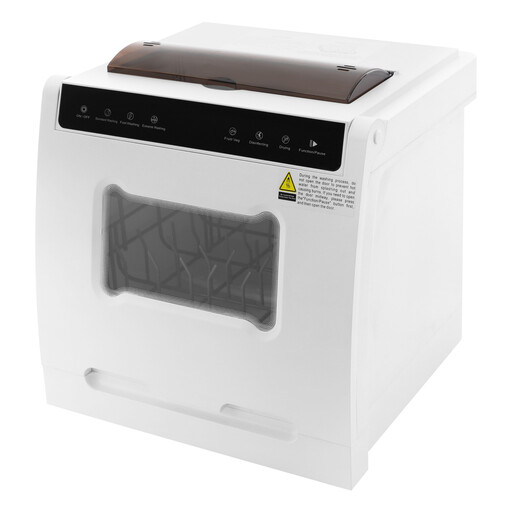
Tabletop dishwasher with 72°C programme and six wash modes

Tabletop dishwasher with 72°C programme

A programme is only suitable for lunchbox parts if it’s compatible with the care instructions for the container, lid and seal.

72°C wash cycle; 6 wash modes; hot air drying.

View at Joybuy

Frequently asked questions

Is the glass-and-fork symbol enough to tell me whether a lunchbox is dishwasher-safe?

No. According to the German consumer advice centre, the symbol indicates that an item is suitable for contact with food, not that it’s dishwasher-safe. Check the care instructions for the container, lid and, where applicable, seal separately.

Does a model with a tank need a water connection or a drain?

According to the manufacturer, the Medion DWT30 can operate using its integrated water tank without a fixed water supply. The wastewater still needs to be drained properly, so check the instructions for the model you choose.

How should I compare electricity and water consumption?

Compare the EU energy label figures on the same programme basis: electricity consumption per 100 Eco cycles and water consumption per Eco cycle. These figures describe the Eco programme; they don’t automatically apply to another programme or to washing just one box.

Do I need to allow for regeneration salt?

If your appliance has a water softener, how you care for it depends on your water hardness and the manufacturer’s instructions. The German Environment Agency explains that regeneration salt needs topping up regularly to keep the water softener working properly.