Choose a tabletop dishwasher based on whether your mugs, along with any other items you want to wash, will fit in the rack without blocking the spray arms. Models rated for six place settings offer a different starting point for washing a larger load together than compact three-place-setting models. However, the manufacturer’s rating isn’t a fixed mug count, and larger machines need enough space and the right connections. If you don’t have a fixed water supply, a model with a tank may be an option – but you’ll still need to plan for filling it and disposing of the wastewater.
Which option is right for you?
Mug collectors with larger loads
If you want to wash mugs from several planned servings together, the usable layout of the rack matters more than the place-setting rating alone. Some Bomann and Midea models include cup shelves or foldable cup holders.
People with tall or wide mugs
Your mugs’ fit may matter more than the stated capacity. Check that their height and shape work with the rack and cup holders, and that they don’t block the spray arms.
Households without a fixed water supply
A model with a tank may be an option if there’s no suitable water connection where you plan to put it. Bomann lists an integrated 5-litre tank for the TSG 5702; you’ll also need a workable drainage solution at the installation point.
What should you look for when buying?
Manufacturers’ place-setting ratings are a guide, not a guaranteed mug count: Bomann lists six place settings for the TSG 7405 and three for the TSG 5702; Midea lists six for the MDWTT0602MW-WE and three for the MDWMT0305EW-WE. What matters is whether your mugs actually fit in the rack.
| Priority |
What to check before buying |
Who is this particularly important to? |
| Washing several mugs together |
Use the place-setting rating as a guide only; take the rack layout and any additional crockery into account. |
If I want to wash mugs from several servings in one cycle, the usable capacity is what counts. Around 36% of consumers prioritise washing a larger load together. |
| Mug fit |
Compare the height and widest diameter of your mugs with the rack and cup holders; check their clearance from the spray arms. |
With tall or wide mugs, I want to make sure they stand securely without taking up space needed for other items. Around 29% of consumers prioritise how well their mugs fit. |
| Space and connections |
Check the external dimensions, door clearance, and water inlet and drainage at the intended location. |
If there’s no fixed water supply or worktop space is limited, I check whether a tank option and hose routing will work in that exact spot. Around 21% of consumers make installation and connections their main concern. |
| Consumption over several cycles |
Germany’s consumer advice centre uses figures such as kWh per 100 Eco cycles, litres per Eco cycle and programme duration for comparison; factor in how many cycles you expect to run. |
If mugs are regularly washed in several loads, I want to compare consumption using the same programme basis. Around 14% of consumers focus on running costs. |
Common misconceptions
-
Taking place settings to mean a fixed number of large mugs
The stated capacity doesn’t tell you how many mugs of a particular shape will fit. Tall or wide mugs may take up space needed for other crockery.
Compare your mugs’ dimensions with the rack and the loading guidance for the exact model.
If your mugs won’t all fit at once, you may need to run extra cycles.
-
Confusing ‘no water connection’ with ‘no drainage needed’
For models designed to use a tank, it can replace a fixed water supply, but it doesn’t remove the need to drain wastewater.
Plan both how you’ll fill the tank and where the drain hose will go at the intended installation point.
A tank model may need to be filled manually, and the drain hose must have a suitable outlet.
-
Comparing Eco figures as if they show consumption for the whole load of mugs
A figure per Eco cycle alone doesn’t tell you how many cycles you’ll need for the load you have in mind.
Compare models using the same Eco programme basis and factor in the likely number of cycles.
Running more cycles changes the total consumption for your load of mugs.
Key brands at a glance
Bomann
For washing mugs, Bomann offers both a model rated for six place settings and a more compact option with a tank.
- Bomann lists six place settings, a cup shelf, and inlet and drain hoses for the TSG 7405. For the TSG 5702, the manufacturer lists three place settings and an integrated 5-litre tank.
- The higher stated capacity doesn’t tell you how many of your particular mugs will fit. With the tank model, you’ll need to plan for filling and drainage.
Midea
The Midea tabletop models mentioned here differ in several respects, including stated capacity and water supply.
- Midea lists six place settings and foldable cup holders for the MDWTT0602MW-WE. The MDWMT0305EW-WE is listed with three place settings and the option to operate it with or without a water connection.
- Cup holders and place settings don’t guarantee that every mug will fit; you’ll still need to check your mugs’ dimensions and the space available.
Medion
The DWT60 (MD37496) is a tabletop dishwasher rated for six place settings and connected to a water supply.
- Medion lists six place settings and seven programmes for this model.
- The model specifications don’t say how many mugs of your particular shape will fit at once.
Klarstein
The silver Amazonia version is another option rated for six place settings.
- Klarstein lists six place settings and six programmes for this version.
- These specifications apply to the version mentioned; they don’t confirm that it will fit particular mugs.
Suitable products at Joybuy
The selection includes tabletop dishwashers for larger combined loads, as well as compact models with a tank option.
 No image available
AIRMSEN tabletop dishwasher, 5+1 wash cycles, 5-litre tank
Described as a tabletop model with a tank option, for locations without a fixed water supply.
The product title lists 5+1 wash cycles and a built-in 5-litre water tank; the description also mentions a glass programme. You’ll still need a suitable wastewater solution.
View at Joybuy
 No image available
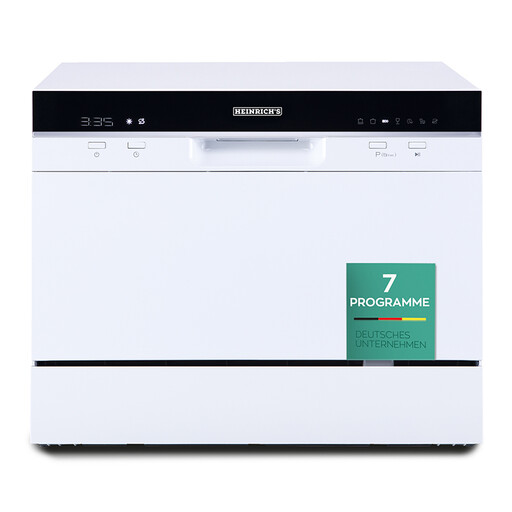
Heinrich's HTG 8840, 6 place settings, 7 programmes
The stated capacity provides a guide for combined loads if a water connection is available where you plan to put it.
This model is listed with six place settings and seven programmes. The place-setting rating doesn’t guarantee a certain number of mugs will fit.
View at Joybuy
 No image available
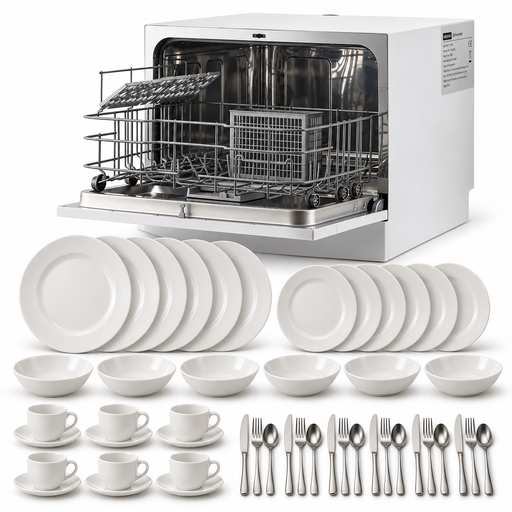
Ochama tabletop dishwasher, 6 standard place settings
The stated capacity can help you plan a combined load; check that your mugs fit in the rack.
The product title lists six standard place settings, a 30-minute quick wash cycle and eight functions.
View at Joybuy
 No image available
Heinrich's HTG 8855, 3 place settings, 5-litre tank
A compact model with a tank for smaller planned loads, if you don’t have a fixed water supply and are happy to run several smaller loads.
This model is listed with three place settings, seven programmes and a 5-litre tank; a direct water connection is also mentioned as an option. Three place settings don’t guarantee a certain number of mugs.
View at Joybuy
 No image available
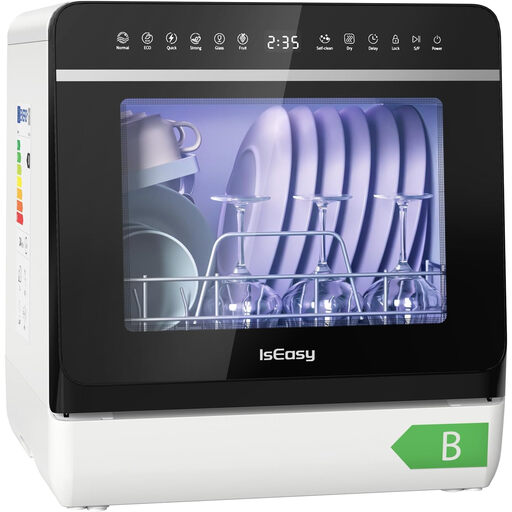
Tabletop dishwasher, 3 place settings, 5-litre tank
Described as a more compact model with a tank for smaller planned loads, where there’s no fixed water supply.
The product specifications list three place settings, a 5-litre tank and seven programmes. The stated capacity doesn’t tell you how many of your mugs will fit.
View at Joybuy
Frequently asked questions
Does the glass-and-fork symbol mean a mug is dishwasher-safe?
No. According to Germany’s consumer advice centre, the glass-and-fork symbol indicates that an item is suitable for contact with food. Also check the mug manufacturer’s specific dishwasher-safety and, where relevant, programme guidance.
Can a dishwasher with a water tank be used without any water inlet or drainage?
On models designed for it, a tank replaces the fixed water supply, but not the need to drain wastewater. Bomann lists an integrated 5-litre tank and a drain hose for the TSG 5702.
How can I wash mugs regularly without using more water than necessary?
The German Environment Agency recommends using the Eco programme with a full load and avoiding pre-rinsing. Also follow the loading guidance and care instructions for your particular appliance.
Which figures are useful when comparing consumption?
Compare figures on the same Eco programme basis: electricity use per 100 Eco cycles, water use per Eco cycle and programme duration. For your own planning, also consider how many cycles your load of mugs is likely to need.
Which energy labelling rules apply to household dishwashers in Germany?
EU energy labelling requirements for mains-operated household dishwashers under Regulation (EU) 2019/2017 have applied since 1 March 2021, as explained by the Federal Institute for Materials Research and Testing. The current scale runs from A to G; older A+++ ratings aren’t directly comparable with this scale.


