If you need your cups again soon, a suitable quick cycle matters. A model with three place settings may be enough for a few cups and limited space, while six place settings give you more room for other everyday crockery. The German Environment Agency recommends running full loads on the Eco programme to save energy and water, but this doesn’t tell you how much frequent quick cycles use. A manufacturer’s stated quick cycle doesn’t, by itself, tell you whether cups will be dry afterwards or how well a particular cycle will clean them.
Who is a tabletop dishwasher suitable for?
Get your cups ready to use again quickly
If you use cups at different mealtimes, check how long the quick cycle actually takes and whether you’ll need to leave them to dry after washing. Midea and Bomann list 30-minute quick cycles for some models, but that doesn’t prove the cups will come out dry or that cleaning performance has been independently tested.
A small kitchen without a fixed water supply
If space is limited or there’s no fixed water supply, consider the tank-filling process, the space needed to open the door and a suitable way to drain the water. Midea and Klarstein list options for running certain tabletop models without a fixed water supply.
Wash cups with your everyday crockery
If you want to wash cups, plates and cutlery together, weigh the stated capacity against the space available and your ability to run full loads. The number of place settings doesn’t guarantee that the rack will fit the number of cups you want to wash.
What should you look for when buying one?
If you need cups again between meals at different times, focus on the quick cycle, where you can position the machine, usable rack capacity and how consumption compares with the load you’ll actually wash.
| What you need |
What to check before buying |
Who is this important to? |
| Use your cups again soon |
Check the cycle time and purpose of the quick cycle in the manual; don’t assume the cups will be dry when the cycle ends. |
If I need the same cup again soon, the cycle time isn’t the only thing that matters: I also want to know whether it’ll be ready to use afterwards. Around 40% of consumers say being able to reuse their cups quickly is their main priority. |
| Positioning and water supply and drainage |
Check the appliance dimensions, including clearance for the door, cup height, water supply and a safe way to drain the water. |
With limited worktop space or no fixed water supply, the machine needs to work in everyday use, including filling it and draining the water. Around 30% of consumers prioritise finding a suitable place for the machine or avoiding the need for a fixed water supply. |
| Load cups and everyday crockery together |
Check how your cups and plates fit in the rack and cup holder of the specific model. |
If I want to wash cups with plates and cutlery, the usable rack space is what matters. Around 20% of consumers say that washing cups and everyday crockery together is their main priority. |
| Consumption per use |
Compare Eco figures on a like-for-like basis and consider how many cycles you’re likely to run; don’t apply Eco figures to quick cycles. |
If I can wait until I have a full load of cups, I want to compare the stated consumption with how I use the machine. Around 10% of consumers prioritise low running costs. |
Common buying and usage pitfalls
-
Assuming Eco figures show the consumption of frequent quick cycles
The EU energy label gives figures for the Eco programme. The German Environment Agency’s recommendation to run a machine efficiently applies to full loads; it doesn’t tell you how frequent, small quick cycles compare.
Only compare Eco figures for the same programme, and check the specific model’s details for quick cycles.
-
Confusing ‘no water connection’ with ‘no need to manage the water’
An integrated tank can replace a fixed water supply, but you’ll still need to fill it and find a suitable way to drain the water.
Before buying, check the water inlet and outlet, door clearance and how practical it will be to fill the tank where you plan to put the machine.
Using a tank may mean filling it repeatedly; you may also need suitable accessories to install the machine.
-
Assuming the place-setting capacity guarantees a certain number of cups
The stated capacity and a cup holder don’t tell you for sure how many cups of your preferred shapes and sizes will actually fit.
Check your cups’ height and diameter against the rack and cup holder of the specific model.
Key brands to consider
Midea
Midea offers tabletop models with three or six place settings. Depending on the model, you can choose between a water tank and a fixed water connection.
- Midea lists adjustable cup holders and a 30-minute quick cycle for the ST 3.6F wi. According to the manufacturer, the MDWMT0305EW-WE has three place settings and can be used with or without a water connection.
- The lower stated capacity of a three-place-setting model may mean running extra cycles. Manufacturer information about programmes and loading isn’t the same as independently measured cleaning results.
Bomann
According to Bomann, the TSG 7405 is a tabletop model with six place settings, making it an option if you want to wash other crockery along with your cups.
- Bomann lists a cup holder, inlet and drain hoses supplied with the machine, and a 30-minute quick cycle.
- The manufacturer’s dimensions are 43.8 × 55.0 × 50.0 cm (H × W × D). Also check there’s enough room to open the door and connect the hoses, and that your cups will fit.
Klarstein
According to the manufacturer, the Melville 3 is a tabletop model with three place settings and an integrated water tank, making it an option if you don’t have a fixed water supply.
- Klarstein lists seven programmes, including a quick wash and a 58-minute programme.
- The tank doesn’t remove the need to fill the machine manually or provide a way to drain the water. Manufacturer claims about cleaning performance or savings compared with washing by hand shouldn’t be taken as independently verified results here.
Tabletop dishwashers at Joybuy
This selection includes tabletop dishwashers, including models with water tanks and models with stated place-setting capacities. What matters is whether your cups, available space and water supply and drainage arrangements will work together where you plan to put the machine.
 No image available
AIRMSEN tabletop dishwasher with 5 L water tank
The integrated tank may be useful if you plan to position the machine somewhere without a fixed water supply.
Features listed in the product title: 9 programmes, dimensions of 37 × 50 cm, two spray arms and energy efficiency class D.
View at Joybuy
 No image available
Heinrich’s HTG 8855
The stated capacity of three place settings may suit a smaller household or a kitchen with limited space.
Features listed in the product title: 7 programmes and operation with or without a water connection.
View at Joybuy
 No image available
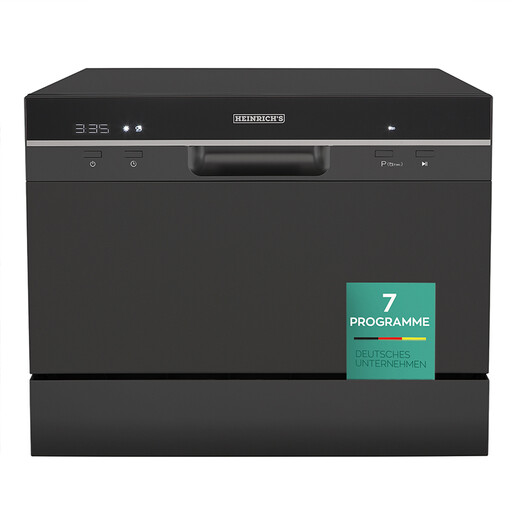
Heinrich’s HTG 8840 Black
The six-place-setting version may suit people who want to wash cups together with other everyday crockery.
Features listed in the product title: 7 programmes and automatic door opening for drying.
View at Joybuy
 No image available
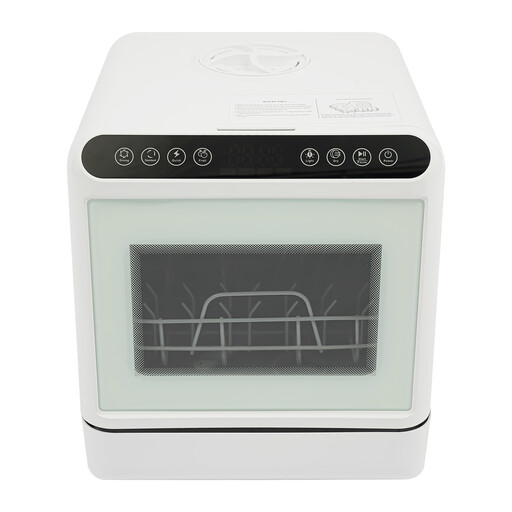
Tabletop dishwasher with 6 L water tank
A water tank may be useful if you don’t have a fixed water supply where you plan to put the machine; also check how the wastewater will drain.
Features listed in the product title: 6 L water tank and touch controls.
View at Joybuy
 No image available
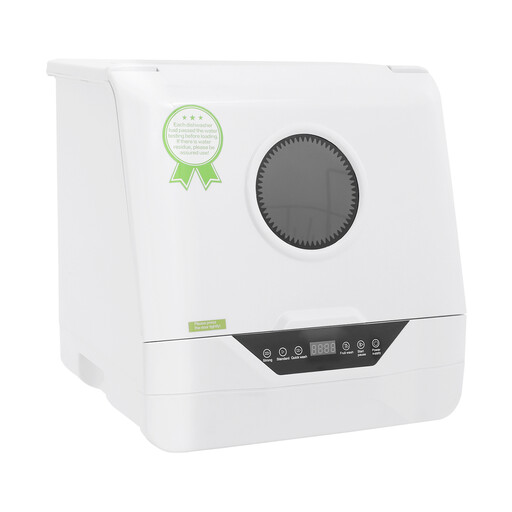
Tabletop dishwasher with four wash programmes
This tabletop model may suit a smaller space; check the actual dimensions of the machine and your cups before buying.
Features listed in the product title: 220 V, 800 W, four wash programmes and a self-cleaning function.
View at Joybuy
Frequently asked questions
Is a 30-minute programme enough for my cups?
Midea and Bomann list this type of programme for certain models, but that doesn’t mean a particular cup will come out clean and dry enough to use again straight away. Check the programme description and drying performance of the model you choose; the Eco consumption figures on the EU energy label don’t apply to the quick cycle.
Does a tabletop dishwasher with a water tank need a water connection?
An integrated tank can replace a fixed water supply, as Klarstein states for the Melville 3. You’ll still need a suitable way to drain the water and an electricity supply where you put the machine. Other models may have different connection requirements, so check their specifications.
How can I avoid unnecessary consumption and limescale marks?
The German Environment Agency recommends running full loads on the Eco programme and advises against rinsing dishes beforehand, particularly with hot water. If your chosen machine has a water softener, set the water hardness and add salt as directed in the manual; Bosch describes this as a set-up step for suitably equipped models.
What do the energy label and statutory rights in Germany tell me?
The EU energy label for dishwashers shows the efficiency class, as well as consumption and time figures for the Eco programme. The German consumer advice centre distinguishes statutory rights against the seller from a voluntary guarantee; this doesn’t tell you how an individual appliance or offer is labelled.


