
Lieferung heute & morgen

Qualitätsgarantie

Willkommens-Angebote freischalten: KOSTENLOSE Lieferung | Bis zu 80 % RABATT | Kostenlose 30-Tage-JoyPlus-Testphase
App herunterladen
A tablet organiser keeps medicines, vitamins and food supplements neatly arranged. In practice, however, common problems can arise: compartments may be too small, lids may open inside your bag or labels may be difficult to read. If you focus only on having lots of compartments or on terms such as “waterproof”, you may end up buying a product that does not suit your daily routine.
This guide from the Joybuy Product Recommendation Officer explains which features really matter when choosing a pill box, medicine box or tablet organiser.
A 7-day tablet organiser with several dosing times can be useful if you regularly take different medicines or supplements. For individual tablets or a small number of food supplements, however, it may be unnecessarily large. Conversely, small daily compartments may not have enough room for large capsules, fish oil capsules or several vitamins.
The key considerations are therefore not just the number of compartments, but also their internal dimensions and capacity.
Terms such as “waterproof”, “moisture proof” or “airtight lid” often come from the product description. They should not automatically be equated with a tested protection rating such as IPX. A tablet organiser may help limit splashes without being suitable for prolonged immersion.
For storage, medicines should be kept as dry and clean as possible, in line with the information on the packaging. A travel tablet organiser should also be carried in a sealed bag if it could come into contact with liquids or high humidity.
A tablet splitter can be practical for suitable tablets that are designed to be divided. However, it is not automatically suitable for capsules, softgels or every type of medicine. Whether a tablet may be split should be checked in the patient information leaflet or by consulting a doctor or pharmacist. The dosage of a medicine should not be changed independently.
When choosing a pill box with compartments, these questions can help:
A small medicine box is often suitable for a handbag, coat pocket or desk. A 7-day medicine organiser with several daily compartments is better suited to structured weekly planning at home.
The lid should open deliberately and close securely once filled. Very small catches can be impractical for older people or anyone with limited hand strength. At the same time, the lid must not spring open so easily that the compartments empty while you are out and about.
For plastic organisers, sturdy hinges, clearly visible markings and easy-to-clean surfaces are practical considerations. The box should be dry before new tablets are added. Harsh cleaning products can damage the material and labels.
A travel tablet organiser should be compact, lightweight and adequately protected. For flights or longer stays, it is advisable to carry prescription medicines in their original packaging wherever possible. The tablet organiser can then be used to organise each day, but it does not replace the medicine labelling.
If there are children in the household, it is also important to keep the box out of their reach.
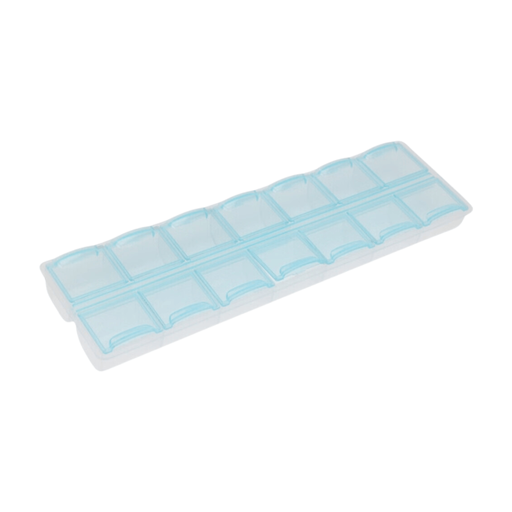
Why this product suits the profile: This straightforward medicine box with compartments is ideal for anyone looking for simple storage without a complex daily planning system.
Its simple design reduces the risk of buying a box with more compartments than you actually need.
The material is specified as PP, while the compartment layout supports separate storage.
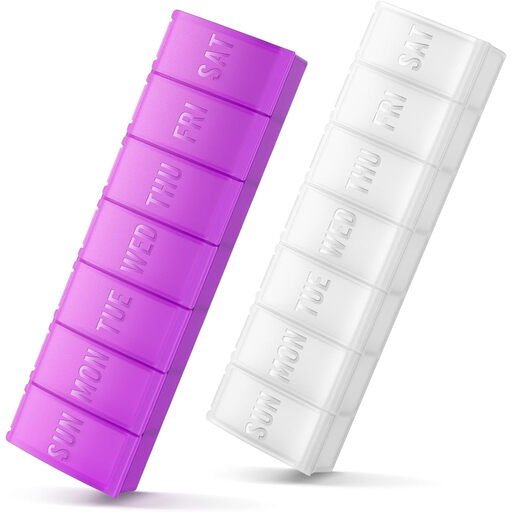
Why this product suits the profile: Its weekly layout and, according to the product information, generously sized compartments are designed for people who regularly organise several vitamins, supplements or medicines.
The stated daily compartments and permanently marked day names help avoid choosing a weekly organiser with hard-to-read labels or insufficient space.
The product is specified as featuring BPA-free plastic, 7 daily compartments and embossed day labels.
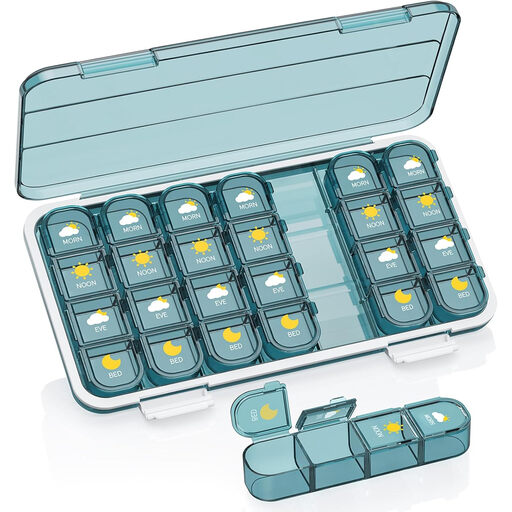
Why this product suits the profile: Four dosing times per day can be useful for people with a detailed daily medication routine.
Several clearly separated time compartments prevent different daily doses from being mixed together in one compartment.
According to the product name, it is designed for 7 days, 4 dosing times per day and separate containers.
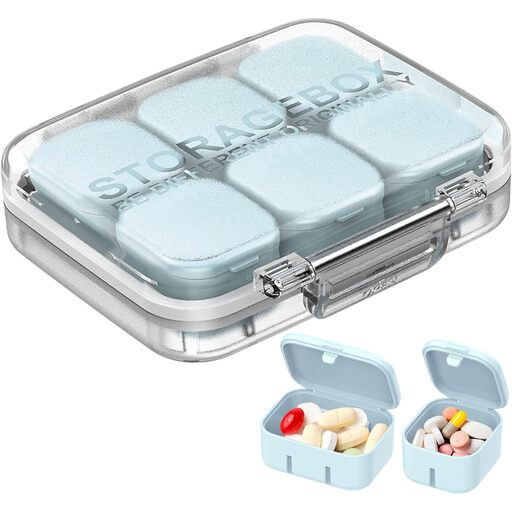
Why this product suits the profile: This portable design is intended for organising vitamins, fish oil and supplements over several days.
The stated 10-day layout can be an alternative to carrying several individual boxes. However, its advertised water resistance should not be confused with protection against immersion.
According to the product name, the model offers 10 days, 4/6 compartments and a portable design.
We have put together a complete, regularly updated list of products that fully meet these strict selection criteria and the safety regulations applicable in the EU.
Before filling the organiser, the compartments should be clean and completely dry. A set routine can help:
A tablet organiser is an organisational aid, not an additional outer package that automatically guarantees suitable storage conditions. The temperature, light and moisture instructions on the original packaging remain decisive.
Its lifespan depends on the material, hinges, closure and frequency of daily use. With regular checks, a box should be replaced as soon as the lids no longer close securely, the labels become illegible or cracks appear. Manufacturer information about durability or service life should be understood as product-specific guidance and should not be generalised.
For short trips, a compact travel tablet organiser with a few compartments is often sufficient. If you take several medicines, a weekly organiser with separate daily or time compartments may be easier to manage. For flights and prescription medicines, it is also advisable to carry the original packaging and relevant documentation.
For organising daily doses at home, it can make it easier to prepare individual doses. However, it does not generally replace the original packaging, patient information leaflet or the storage instructions provided there. If you are unsure about storing or splitting a medicine, your pharmacist is the right person to ask.