Tactical gamers who use lots of menus
If you want to make out units, maps and small text clearly over longer turns, consider the screen size and resolution alongside your viewing distance and the performance of your gaming device.


If someone occasionally reads along from the side, an IPS monitor with a clear, readable resolution is a good starting point. For mostly head-on gaming in low light, a VA or Mini-LED model may be a better fit. Your seating position, available space, connections and gaming device performance are what matter most – a high refresh rate alone won’t meet these needs. OLED is another option, but it carries a risk of burn-in if static game elements remain on screen for long periods.
If you want to make out units, maps and small text clearly over longer turns, consider the screen size and resolution alongside your viewing distance and the performance of your gaming device.
If you’re viewing the same game from different seats, viewing angles and monitor positioning are important factors in your choice.
If you often play in low ambient light, balance the display you want against the space available and the fact that you share the room.
Start by deciding on your seating position and available space. Then check the resolution and panel type, and only after that compare refresh rates and other features.
A good fit if: Someone else occasionally reads along from the side, or you don’t always sit directly in front of the screen.
The trade-off: RTINGS says IPS typically offers wider viewing angles than VA, while VA typically provides higher native contrast.
A good fit if: You usually play facing the screen in dim lighting and dark areas of the image matter to you.
The trade-off: Viewing angles are typically narrower than on IPS; RTINGS also observed black smearing and VRR flicker at varying refresh rates on the AOC Q27G3XMN.
A good fit if: Deep blacks matter to you and you’ve considered how the monitor will be used with static game elements on screen for long periods.
The trade-off: There is a risk of burn-in with static content displayed for long periods. It’s a factor to consider, not a claim that every tactical game will cause damage.
| Buying priority | What to look for | Who is it most important to? |
|---|---|---|
| Reading maps and menus | Consider screen size, native resolution, viewing distance and gaming device performance together; QHD at 27 inches is an option, not a requirement. | If I want to make out map tiles and small menus clearly over longer turns, I look at resolution, screen size and suitable scaling; around 33% of consumers put readability first. |
| Reading along from the side | Decide where people will sit and where to position the monitor; check the viewing angles and adjustment options of the specific stand. | If someone sits beside me, I want to be able to read maps and text from the side too; around 25% of consumers give this priority. |
| Dark game scenes | Balance low-light use against sharing the screen from the side; with OLED, also consider how long static content will remain on screen. | If I usually play alone in dim lighting, how dark areas look matters more to me than viewing the screen from several angles; around 25% of consumers prioritise this. |
| Space and running costs | Measure the space for the monitor and cable routing, check the stand, and compare EU energy label information for similar models. | If space is limited or the room is shared, I want to consider the setup and running costs too; around 17% of consumers focus on this. |
Philips explicitly describes 260 Hz as an overclockable refresh rate for the Philips 27M2N3501PA/00. Specifications may also vary depending on the connection used.
First decide on the resolution, seating position and connections you need, then check the conditions under which the stated refresh rate can be achieved.
VA typically offers higher native contrast, while IPS typically provides wider viewing angles. The panel choice therefore comes down to different usage scenarios.
Before deciding, consider whether you’ll usually play facing the screen or whether someone else will regularly read along from the side.
Static elements displayed for long periods carry a risk of burn-in. That doesn’t mean every game will cause damage.
Consider how long the same elements stay on screen for you, and check the terms of any manufacturer’s warranty on offer.
A shared model name alone doesn’t prove that all the product specifications refer to the same variant.
Check the full model code and the specifications that matter to you on the specific product page.
The QHD models listed include IPS and curved VA variants for different seating arrangements.
The Q27G3XMN/BK is a VA/Mini-LED option for mostly head-on gaming.
The Odyssey range includes various models, which should be considered separately by their model codes.
The GS27QA is a QHD IPS model with a flat screen.
The G2725D shows how the stated refresh rate can depend on the connection used.
The following 27-inch QHD monitors with IPS panels are options if you want to see maps and menus in detail and occasionally read along from a seat to the side. Before buying, check the connection requirements for your gaming device and the details for the specific model variant.
 No image available
The stated QHD resolution and 27-inch screen size are useful features if you want to see maps and menus in detail.
Listed specifications: 2560 × 1440 pixels, Fast IPS, 144 Hz, FreeSync, HDR10, height-adjustable stand, DP and HDMI.
 No image available
The QHD specification is useful for maps and menus; check the listed connection and refresh rate specifications against your gaming device.
Listed specifications: 2560 × 1440 pixels, HFS (IPS), 320 Hz, VESA DisplayHDR 600, 1 ms GTG and AMD FreeSync Premium.
 No image available
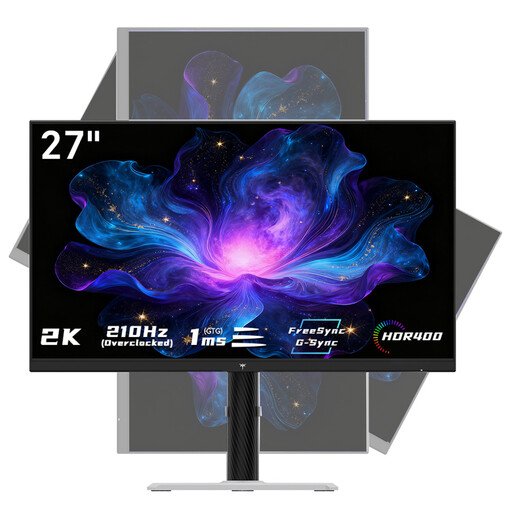
This QHD IPS monitor is an option if you want to display maps and menus in detail and adjust the screen position.
Listed specifications: 2560 × 1440 pixels, 200 Hz and overdrive up to 210 Hz.
 No image available
The stated QHD resolution is useful for detailed maps and menus; check that the refresh rate is compatible with your gaming device and connection.
Listed specifications: 2560 × 1440 pixels, HFS (IPS), 200 Hz, VESA DisplayHDR 600, 1 ms GTG and AMD FreeSync Premium.
 No image available
The stated QHD resolution and IPS panel are useful features if you want to display detailed maps and occasionally read along from the side.
Listed specifications: 27 inches, 1152 dimming zones, 275 Hz, 1 ms, Adobe RGB 99% (1931), sRGB 99%, FreeSync, HDMI and DP, plus integrated speakers.
The type of game alone doesn’t mean you need a particularly high refresh rate. Decide first based on readability, viewing angles and available space. If you also play fast-paced games, check the refresh rate and the connection required to achieve it on the specific model.
Check the connection you’re using against the model specifications, then set the supported refresh rate on your gaming device. Dell lists different maximum rates for DisplayPort and HDMI on the G2725D; don’t assume these figures apply to other monitors.
Compare the consumption figures on the EU energy label for monitors of similar screen sizes, and take your usage time and electricity tariff into account. The label also includes information about HDR use; without knowing your usage time and tariff, it isn’t possible to calculate a reliable cost in euros.
For online consumer purchases, you generally have a 14-day right to cancel, as explained by the Verbraucherzentrale. If a product is faulty, statutory rights against the seller are separate from a voluntary manufacturer’s warranty; EU rules provide at least two years of legal protection for new goods.
The EU rules discussed here cover requirements for electronic displays when they are placed on the market, and their energy labelling. They don’t require individual approval for ordinary use as a computer monitor. This doesn’t imply anything about different types of device or special uses.