
Lieferung heute & morgen

Qualitätsgarantie

Willkommens-Angebote freischalten: KOSTENLOSE Lieferung | Bis zu 80 % RABATT | Kostenlose 30-Tage-JoyPlus-Testphase
App herunterladen
Choosing a 55-inch television requires an analysis of technical specifications to find the model that best suits your individual needs. Particularly within the TCL 55-Inch QLED 4K TV segment, there are significant differences in areas like refresh rate, HDR support, and operating system. These factors are crucial for determining suitability for applications such as home cinema, streaming, or demanding gaming. The following guide breaks down the relevant parameters and presents two models with different specialisations.
The decision for a TV model should be based on an objective evaluation of its technical features. The following aspects are crucial when selecting a QLED 4K TV.
QLED (Quantum Dot Light Emitting Diode) technology uses a layer of nano-crystals to enhance the picture's colour purity and brightness. Compared to conventional LED TVs, this allows for the display of more intense and precise colours. A crucial quality indicator is the coverage of the DCI-P3 colour space, which is used in digital cinema. Values of 97% or higher indicate excellent colour reproduction. The 4K UHD resolution (3840 x 2160 pixels) ensures a high level of detail, which is clearly visible on a 55-inch screen.
The refresh rate, measured in Hertz (Hz), indicates how many frames the television can display per second.
High Dynamic Range (HDR) expands a picture's contrast range and colour spectrum. This results in brighter highlights, deeper blacks, and more vibrant scenes overall. The two leading dynamic HDR formats are:
A Dolby Vision TV that also supports HDR10+ offers maximum compatibility with streaming services and 4K Blu-rays, as it can always process the best possible HDR signal.
An immersive experience is completed by high-quality sound. Dolby Atmos is an object-based audio format that creates three-dimensional sound, acoustically placing the viewer inside the action. Some models feature integrated sound systems from audio specialists like Onkyo, which can replace the need for a dedicated soundbar.
The operating system determines the smart TV's user-friendliness and range of features. The most common systems are Google TV and Fire TV. Both offer access to a wide selection of apps but differ in their user interface and integration into smart home ecosystems. A 55-inch Google TV can be seamlessly controlled with Google Assistant, while a 55-inch Fire TV is deeply integrated into Amazon's Alexa ecosystem.
Based on the criteria mentioned, we present two TCL models that cater to different user profiles.
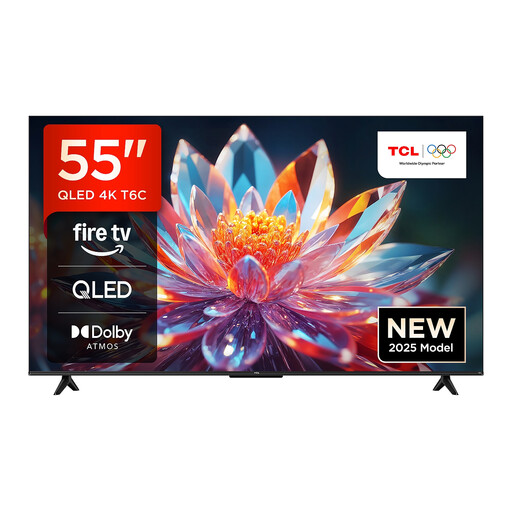
Why we recommend this product The TCL 55T6C is positioned as a high-performance 55-inch Smart TV for users who focus on watching films and series. The combination of a QLED panel with high colour gamut coverage and support for both Dolby Vision and HDR10+ ensures excellent picture quality for content from streaming providers. The integrated Fire TV operating system offers intuitive navigation and seamless Alexa voice control.
Pros
Who it's for This model is designed for home cinema enthusiasts and streaming users who value excellent picture quality and simple, voice-controlled operation. It represents a balanced solution for anyone who doesn't have a specific focus on high-end gaming.
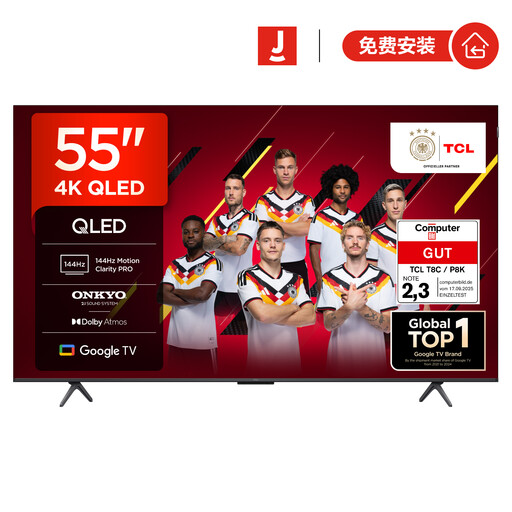
Why we recommend this product The TCL 55T8C is aimed at demanding users, especially gamers and sports fans. Its native 144Hz display, combined with Motion Clarity Pro, ensures exceptionally smooth motion handling. Features like HDMI 2.1, ALLM (Auto Low Latency Mode), VRR, and AMD FreeSync make it a high-performance Gaming TV. Furthermore, the Onkyo-designed 2.1 sound system with an integrated subwoofer delivers powerful audio playback without requiring additional hardware.
Pros
Who it's for This model is the top choice for gamers looking to fully leverage the performance of their current-gen consoles or PC. Home cinema enthusiasts who value superior out-of-the-box sound quality and extremely smooth picture playback will also find this to be an excellent fit.
Modern smart TVs are often the hub of a connected home. Voice control is becoming increasingly important. For those looking to expand their smart home system and use a central control unit for various devices, the Voice Control Device category offers suitable solutions that go beyond the TV's built-in assistants.
1. What is the difference between QLED and OLED? QLED TVs use an LED backlight in combination with a quantum dot layer to produce colours. They typically achieve higher peak brightness, which is advantageous in bright rooms. OLED TVs, on the other hand, use self-emissive pixels that can be turned on and off individually. This allows for perfect blacks and infinite contrast, which is especially noticeable in darkened rooms.
2. Do I need a special console or PC for a 144Hz Gaming TV? Yes, to take full advantage of a 144Hz refresh rate, you need a source device capable of outputting a corresponding frame rate. This includes modern gaming PCs with powerful graphics cards, as well as consoles like the PlayStation 5 and Xbox Series X, which support frame rates of up to 120 Hz on certain games via an HDMI 2.1 connection.
3. What are the advantages of Google TV compared to other smart TV systems? Google TV is distinguished by its content-centric user interface, which aggregates recommendations from various streaming services onto a single home screen. It offers deep integration with Google Assistant for voice search and smart home control. Additionally, the built-in Chromecast allows for easy streaming of content from smartphones and tablets.