Households where tea towels take a long time to dry
If you regularly need dry kitchen towels, consider whether the option of adding heat is worth the extra electricity and the space the airer takes up.


If you only have a few tea towels to dry, spaced out on an airer you already own, an unheated model will usually do the job. If your towels regularly take a long time to dry and you’d like the option of adding heat, a folding heated airer could be a good fit. Check the space it needs, its power consumption and the care instructions. The German Environment Agency recommends airing rooms regularly when drying damp laundry indoors. Heat is no substitute for fresh air or washing used tea towels.
If you regularly need dry kitchen towels, consider whether the option of adding heat is worth the extra electricity and the space the airer takes up.
If you want to hang tea towels separately and put the airer away afterwards, check both its dimensions when set up and its folded size.
Ventilation remains important when drying laundry indoors: the German Environment Agency recommends paying particular attention to airing rooms regularly when drying damp laundry.
| What matters | What to check before buying | Who is this important to? |
|---|---|---|
| Drying needs | Number and layout of the rails, switch, dimensions when set up and the care instructions for your towels. | If I regularly hang several tea towels to dry, I want enough space between them and a suitable operating mode. Around 33% of consumers mainly want their towels to be dry again between uses. |
| Humidity in the room | Whether you can air the room where the airer will stand and let damp air escape. The German Environment Agency advises taking particular care to ventilate when drying damp laundry indoors. | If I dry laundry in a home where damp can be a concern, I need to factor in how I’ll ventilate the area. Around 25% of consumers put room humidity at the heart of their choice. |
| Space and storage | Footprint and height when open, folded size and the layout of the drying rails in the intended spot. | If I have limited floor or storage space, it matters whether the airer fits where I want to dry laundry and can be put away afterwards. Around 25% of consumers prioritise space and storage above all else. |
| Power consumption | The power rating of the specific model and how long you’ll actually use it. A non-electric model uses no electricity. | If I want to use as little extra electricity as possible, I compare a non-electric airer with the powered alternatives. Around 17% of consumers focus mainly on power consumption and running costs. |
The airer’s heating function doesn’t replace washing used kitchen towels. The consumer advice centre recommends regularly washing towels that can harbour germs at a minimum of 60 °C; you should also follow the care label for each item.
Consider where to dry your towels separately from how you wash and care for them.
Even a heated airer won’t remove water from the air in the room. Damp laundry still adds moisture to your indoor space.
Choose a suitable place to dry your laundry and make sure to air the room regularly.
The EASYmaxx Elektro-Wäscheständer 900 is described as using cool air, while the Adler AD 7821 has heated rails. You can’t tell how an airer works just from the fact that it uses electricity.
Check the full model name and product description to find out how it works.
The manufacturer’s figures of 220 W for the Adler AD 7821 and 50–55 °C for the HOMCOM 850-048 aren’t comparable measurements taken with the same towels in the same room conditions.
Use these figures to compare features and power consumption, not as a promise of a particular drying time.
The folding AD 7821 is a heated winged airer. When comparing it with other models, consider both its dimensions when set up and its folded size.
The 850-048 is a two-tier heated clothes airer.
According to the product description, the Elektro-Wäscheständer 900 uses airflow rather than heated rails.
The Classic 100 Easy is a non-electric, folding alternative to consider if space is limited.
This selection includes wall-mounted and freestanding airers, as well as one model specifically described as heated.
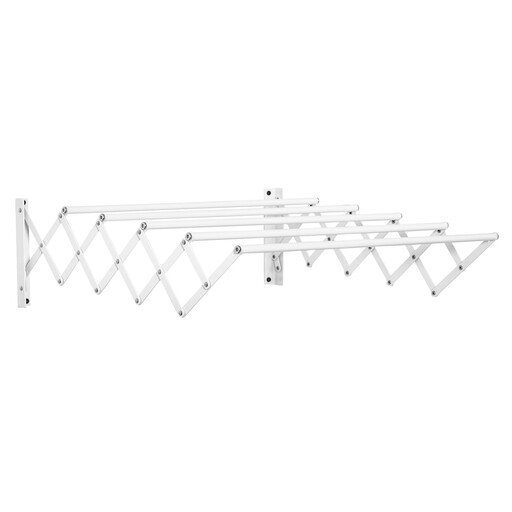 No image available
A wall-mounted option if you want to keep floor space clear and dry towels on several rails.
Five drying rails; according to the product details, each rail can hold up to 2 kg, with a total capacity of 10 kg. Install it securely on a suitable wall before loading it.
 No image available
A possible choice if you want the option of adding heat and folding the airer away once your laundry is dry.
The listed heating power is 230 W. The product details give a temperature of 45–55 °C, dimensions of 144 × 53 × 96 cm and a maximum load of 10 kg.
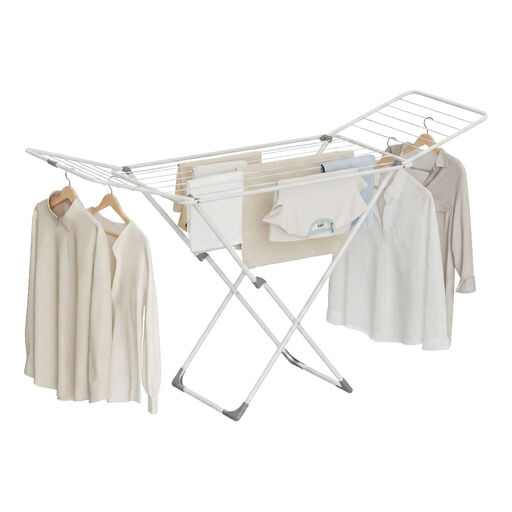 No image available
An option if you want to air-dry towels on several rails and fold the airer flat afterwards.
17 rails and 18 m of drying space; maximum load of 15 kg when distributed evenly.
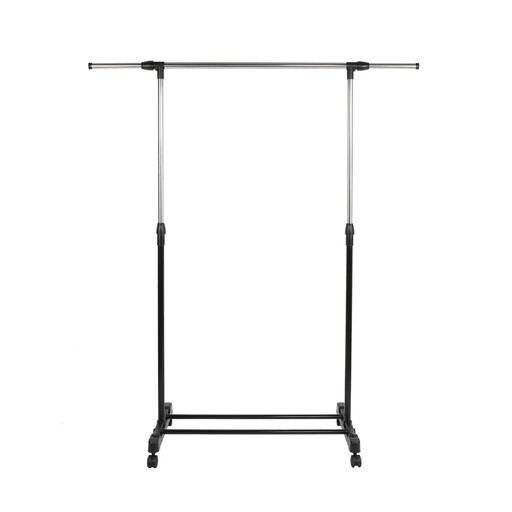 No image available
Could suit you if you’re looking for a single hanging rail that folds away for storage and can be moved on castors.
Height adjustable from 90–158 cm and, according to the description, width adjustable from 80–145 cm.
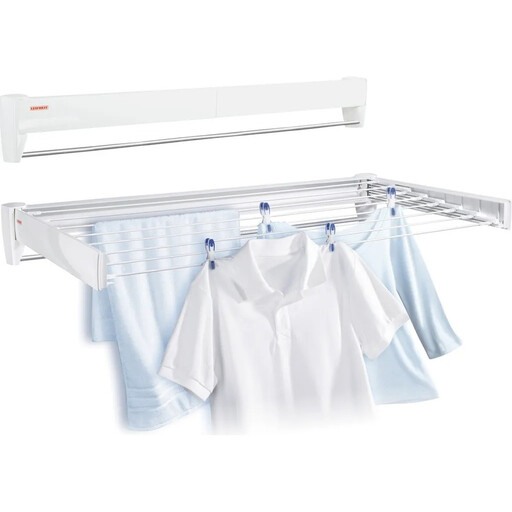 No image available
A wall-mounted option if you want to dry towels and free up floor space afterwards.
The product description lists 8.10 m of drying space and dimensions of 103 cm wide by 53 cm deep. Securely mount it on a solid wall before use.
No, the heating function doesn’t replace washing. The consumer advice centre recommends regularly washing towels that can harbour germs at a minimum of 60 °C. Also check the care label for each item.
Choose a spot with enough room for the airer when it’s open and where damp air can escape. The German Environment Agency recommends paying particular attention to ventilation when drying damp laundry indoors. Check the dimensions of the specific model to make sure it will fit.
Multiply the power rating in kilowatts by the actual running time in hours to calculate consumption in kilowatt-hours. At a constant 220 W, the airer would use 0.22 kWh per hour; Adler lists this figure for the AD 7821. This alone won’t tell you the actual drying time or cost.
For a fault, the seller is generally your point of contact for your statutory rights. A voluntary guarantee is separate. The consumer advice centre recommends checking who is selling the specific item before you buy.
If the appliance falls under harmonised EU rules that require CE marking, the manufacturer is responsible for meeting the applicable requirements and applying the mark. The European Union’s Your Europe website points out that CE marking is not a certificate from a central EU testing body and does not prove drying performance. Check the marking, model details and any available safety documents for the specific product.