Households with no spare floor space
If you want to dry tea towels without putting an airer on the kitchen floor, check that you have a suitable place to mount it and enough usable hanging space.


If you’re short on floor space all the time and have a suitable wall for mounting, a slim wall-mounted rail could be an option. A folding airer can be put away, but it still needs floor space while in use. For just a few towels, an unheated hanging airer may be enough and won’t need its own electricity supply. Whichever option you choose, ventilation and kitchen hygiene remain important.
If you want to dry tea towels without putting an airer on the kitchen floor, check that you have a suitable place to mount it and enough usable hanging space.
If you can put an airer up briefly for drying and store it away afterwards, consider both its dimensions when open and its folded size.
If you only dry a small number of items, consider whether an unheated hanging airer on a suitable door, railing or radiator would be enough.
Suitable if: You want to keep the floor clear at all times, have a suitable wall and only need to hang a few towels.
Things to consider: The appliance will remain on display, and both the mounting position and hanging space need to be suitable.
Suitable if: You have some floor space available while drying and can put the airer away afterwards.
Things to consider: Its folded size saves storage space, but not the floor space it needs while in use.
Suitable if: You regularly dry larger loads of washing as well as tea towels, and can install a mounted appliance.
Things to consider: The installation and size of the appliance may be excessive if you only need to dry a few towels.
Suitable if: You only have a few towels to dry and have somewhere suitable to hang the airer.
Things to consider: The airer has no heating function, so it can’t promise faster drying.
| What you need | What to check when buying | Who will find this important? |
|---|---|---|
| Floor space while in use | Check the dimensions when open and allow room to move around it. For wall- or ceiling-mounted models, plan for the mounting area and a power connection. | I want to keep the kitchen floor clear and can install a suitable appliance. Around 36% of consumers put keeping the floor clear first. |
| Hanging towels separately | Check the number and layout of hooks or rails against the size of your towels; don’t plan to hang them close together or directly on top of one another. | If I want to hang tea towels separately, I look for enough space between hanging points. Around 29% of consumers prioritise this arrangement. |
| Electricity use | Consider the rated power and expected running time together; you can work out the cost using your own electricity tariff. | I want to use as little extra electricity as possible when drying towels. Around 21% of consumers put electricity use first. |
| Additional washing | Work out how many towels you typically dry and whether you’ll regularly want to hang other washing as well. | If I regularly dry other washing as well as tea towels, I need more space. Around 14% of consumers prioritise this additional capacity. |
For the Adler AD 7821, the manufacturer gives folded dimensions of 113 × 52,5 × 8 cm. When open, the airer measures 148 × 52,5 × 90 cm.
Before buying, measure the space it will occupy when open and allow room to hang your towels.
Drying still releases moisture into the room. Heating elements also don’t prove that an appliance has a disinfecting effect.
Hang towels separately, follow the usual hygiene guidelines and ventilate the room properly.
The rated power alone doesn’t show how much electricity it takes to dry a tea towel; the running time matters too.
Compare the rated power with the expected running time, and consider an unheated option if you only have a few towels to dry.
Electric wall-mounted towel rails for households that want to hang a few towels without using a floor-standing airer.
Heated folding airers for households that can free up floor space while drying and put the airer away afterwards.
Heated winged airers for varying amounts of smaller textiles and additional washing.
A mounted ceiling or wall solution with airflow for households that dry larger loads of washing as well as tea towels.
Unheated hanging airers as an alternative for a few towels, provided you have somewhere suitable to hang one.
This selection includes EMKE electric towel radiators for wall mounting, including options with hooks or a shelf.
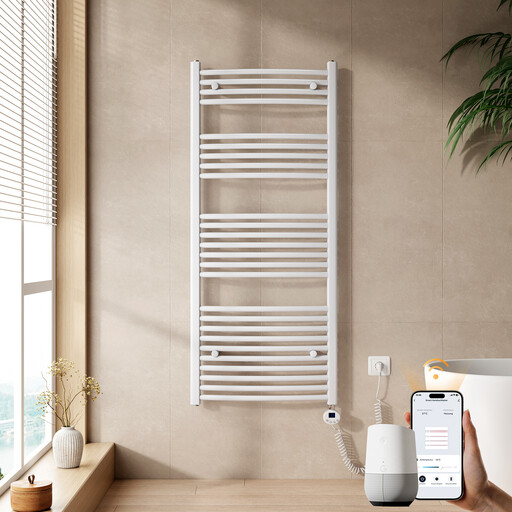 No image available
A wall-mounted option that doesn’t need a floor-standing airer. Check that the appliance will fit on the wall you have in mind.
The product title lists 600 W, a thermostat and a heating element.
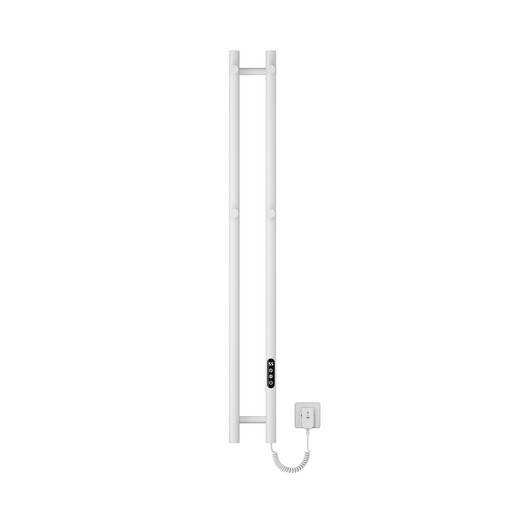 No image available
The four hooks give you several places to hang towels. Check that they suit the number and size of your tea towels.
The product title lists 145 W and a height of 120 cm.
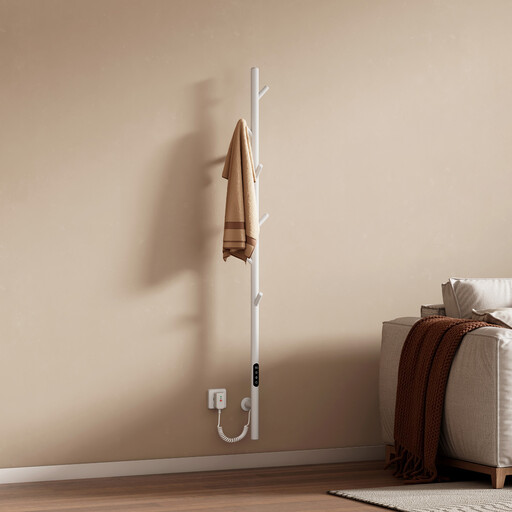 No image available
For drying several towels on one appliance with a rail and hooks. Make sure you have room for its full dimensions.
The title lists a rail and six hooks; the product specifications give a power rating of 100 W and dimensions of 1500 × 125 × 140 mm.
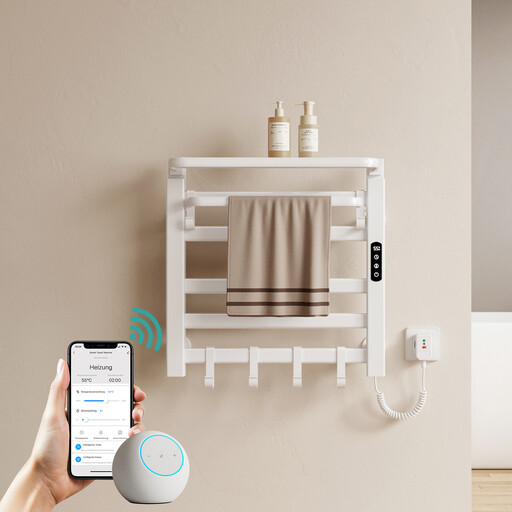 No image available
A compact appliance with an additional rail and shelf. Bear in mind that the product description says the six hooks aren’t heated.
The product title lists 140 W; the hooks aren’t heated.
 No image available
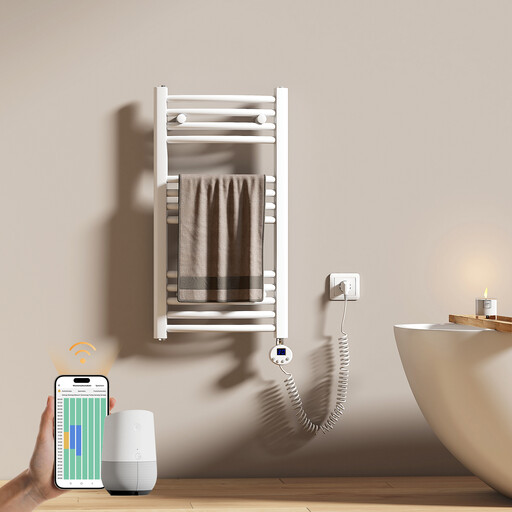
A wall-mounted drying option. Check the stated dimensions against the space you have available.
The product specifications list WiFi control, a timer, a thermostat and a heating element.
Yes. The German Environment Agency points out that drying washing adds moisture to the air, so good ventilation remains important. In kitchens and bathrooms, it recommends clearing excess moisture by opening the windows wide.
There’s no evidence that the models covered here have a disinfecting effect. The Federal Institute for Risk Assessment includes preventing the spread of germs as part of kitchen hygiene; heating doesn’t replace using towels properly or cleaning them.
Multiply the rated power in kilowatts by the running time in hours, then multiply that figure by your price per kilowatt-hour. At 220 W, the power is 0,220 kW; three hours running continuously at its rated power would work out at 0,660 kWh. Actual consumption may vary.
For the specific model, check its dimensions, installation instructions, suitability of the surface and access to an electrical connection. Foxydry says the Pro can be mounted on the ceiling or wall; EMKE specifies vertical wall mounting for the Orbrad PHR. This doesn’t mean either option is suitable for every kitchen or mounting surface.
The Federal Network Agency lists checks including correct CE marking, an identifiable product, manufacturer details and a German-language instruction manual with any necessary warnings. A CE marking alone doesn’t demonstrate the drying performance of a particular model.