
Lieferung heute & morgen

Qualitätsgarantie

Willkommens-Angebote freischalten: KOSTENLOSE Lieferung | Bis zu 80 % RABATT | Kostenlose 30-Tage-JoyPlus-Testphase
App herunterladen
By Joybuy Product Recommendation Officer, August 28, 2026
In many rental apartments, student dorms, or for those who move frequently, creating enough storage space is a recurring challenge. Installing permanent shelves or wardrobes is often not permitted or is simply impractical. A telescopic clothes rack offers a flexible, installation-free solution. However, not every system delivers on its promise. Before you make a decision, it's important to understand the common weak points that can quickly turn a practical idea into a purchase you'll regret.
Many users report three central problems with low-quality systems:
This guide will show you the crucial criteria to look for to find a durable and functional telescopic clothes rail system that meets your needs.
To avoid the problems mentioned above, you should carefully check three technical aspects before buying. These are the primary determinants of the functionality and longevity of your new no-drill wardrobe system.
Load capacity is the most critical factor. Manufacturer's specifications like "up to 65 kg" are an important guideline, but the material quality is what determines if this value is realistic.
An extendable clothes stand is only useful if it can be precisely adapted to your space.
The method used to clamp the system between the floor and ceiling is crucial for stability and for protecting your home.
Based on the quality criteria mentioned, we have identified several models that are suitable for different user profiles.
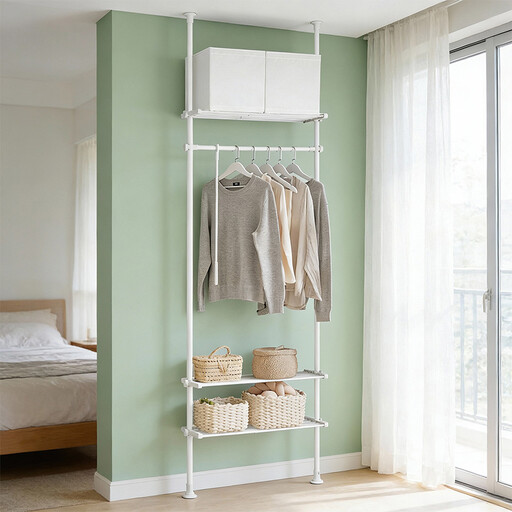
Why this model is a great fit: Ideal for small niches, corners, or student dorms. It combines a clothes rail with three practical shelves for folded clothes, shoes, or boxes, making optimal use of vertical space.
The clearly defined load capacity of 16 kg is tailored to its compact size and prevents overloading. The narrow, adjustable width (52–80 cm) is specifically designed for small spaces and avoids the problem of incompatibility.
Combines a clothes rail and three shelves with a minimal footprint. Perfect for utilising unused corners.
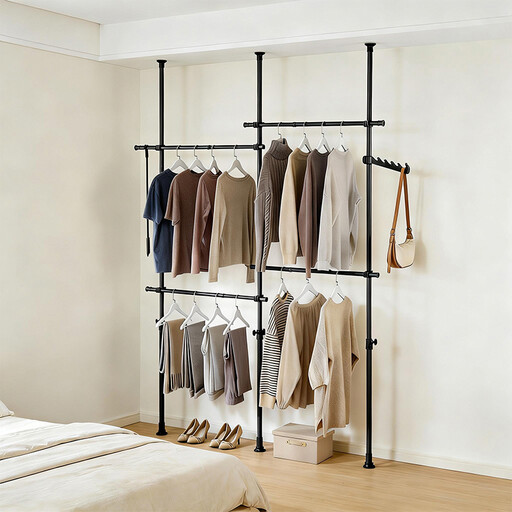
Why this model is a great fit: This system can replace a conventional wardrobe. Its wide adjustment range and high load capacity are suitable for a couple's wardrobe or an extensive collection of heavy winter clothing.
With a specified load capacity of up to 65 kg and a robust metal frame, it directly addresses the issue of wobbly constructions. The wide adjustment range (124–226 cm) ensures it fits even in larger rooms.
High load capacity (up to 65 kg according to the manufacturer) and a flexible layout with four separate clothes rails for clear, organized storage.
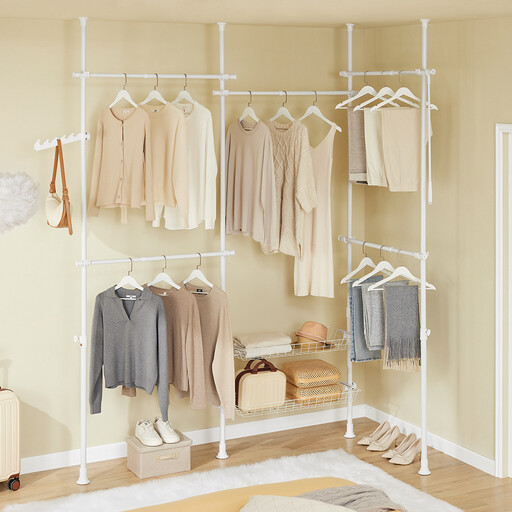
Why this model is a great fit: For anyone looking to build a complete, open wardrobe system. The integration of wire baskets and five clothes rails creates a comprehensive storage solution for a bedroom or a walk-in closet.
This system is designed for maximum capacity from the outset, bypassing the problem of buying a system that's too small. The wide tension range (209–311 cm) and high load capacity are designed for heavy use.
Maximum storage organization with 5 clothes rails and 2 integrated wire baskets for accessories, socks, or underwear.
We have compiled a complete, up-to-date list of products that meet these strict selection criteria.
Stability depends largely on two factors: correct assembly and product quality. A system with robust steel rods and a solid tension mechanism, when firmly installed between the floor and ceiling according to the instructions, is very stable. It is crucial to align the vertical poles perfectly straight and not to exceed the maximum load capacity.
High-quality systems are designed to prevent damage. Look for models with large, rubberized or silicone-coated end caps. These distribute pressure over a larger area and their non-slip properties prevent slipping and scratches. For very sensitive floors or ceilings (e.g., softwood or plaster), it may be advisable to place a thin felt or rubber pad underneath as an extra precaution.
The load capacity varies greatly by model and is specified by the manufacturer. Compact systems for niches often hold around 16 kg, while larger, multi-section systems can be designed for loads of up to 65 kg or more. It is important to distribute the weight evenly across all available rods and to hang the heaviest garments as close as possible to the main vertical poles.