
Lieferung heute & morgen

Qualitätsgarantie

Willkommens-Angebote freischalten: KOSTENLOSE Lieferung | Bis zu 80 % RABATT | Kostenlose 30-Tage-JoyPlus-Testphase
App herunterladen
As a Joybuy Product Recommendation Officer, I see the daily challenges faced by renters, students, and city dwellers: limited space and the need to create storage without damaging walls. A telescopic clothes rack offers a practical and adaptable solution. This article serves as a guide to understanding how these systems work and helps you choose the right model for your needs.
Before making a decision, you should evaluate a few key features. A well-considered purchase ensures the system is stable, fits your space, and securely holds your clothing.
The maximum load capacity is a crucial factor, especially if you plan to hang heavy garments like winter coats or numerous suits. Models designed as heavy-duty clothes racks are typically made from sturdy metal tubes and high-quality plastic connectors. Pay close attention to the maximum load capacity in kilograms specified by the manufacturer. This information is essential to prevent overloading and instability. The quality of the materials affects not only the load capacity but also the overall lifespan of the system.
The main advantage of a telescopic system is its flexibility. A good adjustable wardrobe system can be customised in both height and width. Carefully measure your available space—from floor to ceiling and from wall to wall. Compare these measurements with the product's minimum and maximum dimensions. An extendable clothes rack allows you to expand your storage space as needed or easily install the system in a new room if you move.
For renters, a no-drill installation is a critical feature. A no-drill clothes rail is secured using a tension system between the floor and ceiling. Rubberised end caps on the telescopic poles provide a secure grip while protecting surfaces from scratches. This design allows for a quick and straightforward tool-free installation, leaving no permanent marks on walls or ceilings. It is the ideal solution for a flexible clothes storage system in temporary living situations.
Based on the criteria mentioned, we have curated a selection of models that stand out for their functionality and adaptability.

Why it stands out: This model is a compact and efficient solution for smaller rooms or alcoves. With two vertical poles and two horizontal rails, it provides a clear structure for organising clothes.
Benefits:
Who is it for? Ideal for individuals, students, or as a supplement in a bedroom or dressing room where a basic yet sturdy hanging solution is needed.
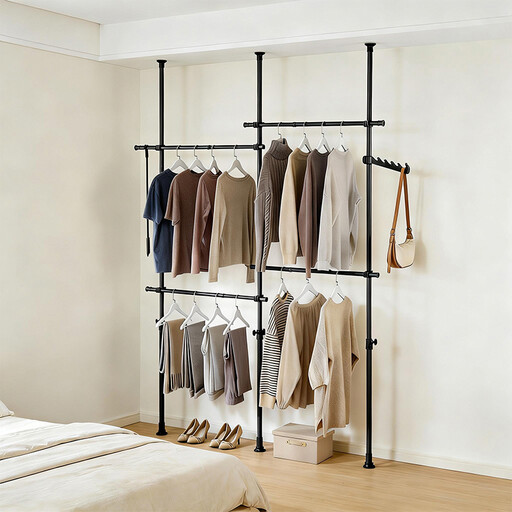
Why it stands out: This system is designed for a higher load capacity and more storage space. With three telescopic poles and four clothes rails, it is suitable for more extensive wardrobes.
Benefits:
Who is it for? Perfect for couples or individuals with a large clothing collection who are looking for a stable and spacious solution for an open-concept wardrobe.
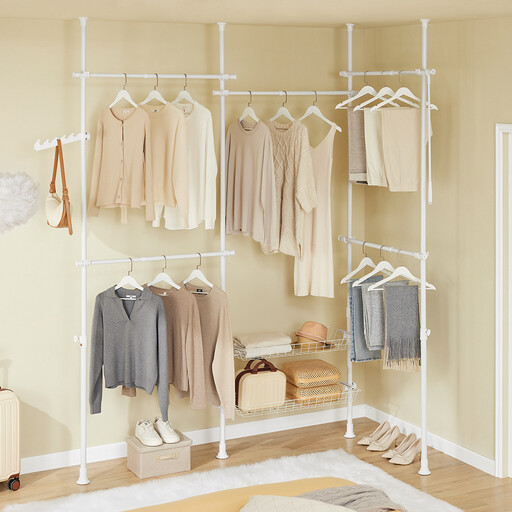
Why it stands out: This model combines hanging space with practical storage baskets, offering a complete clothes storage system. It is the most comprehensive option for maximum organisation.
Benefits:
Who is it for? For anyone looking to create a complete, walk-in closet solution without permanent installation. It completely replaces a conventional wardrobe and is suitable for large rooms or dedicated dressing areas.
A well-organised open-concept wardrobe is the first step towards a well-maintained clothing collection. To keep your clothes fresh and reduce wrinkles, specialised appliances can be a valuable addition.
Discover our selection of [garment refreshers] to optimally care for your wardrobe and extend the life of your favourite pieces.
The stability of a telescopic clothes rack depends on two main factors: correct installation and adherence to the maximum load capacity. When the system is tensioned firmly and straight between the floor and ceiling, and the weight limit is not exceeded, it provides a secure and stable hold for your clothes.
As a rule, telescopic systems are designed for installation between two parallel, flat surfaces (floor and ceiling). The tension poles require a vertical alignment to distribute pressure evenly and ensure stability. Installation on sloped ceilings is therefore usually not possible or safe.
The load capacity varies greatly depending on the model, material, and construction. More compact systems often support around 25 kg, while more robust heavy-duty models can be designed for up to 65 kg or more. Always check the specific manufacturer's specifications for the product to ensure it meets your requirements.