
Lieferung heute & morgen

Qualitätsgarantie

Willkommens-Angebote freischalten: KOSTENLOSE Lieferung | Bis zu 80 % RABATT | Kostenlose 30-Tage-JoyPlus-Testphase
App herunterladen
A telescopic clothes rack can create additional storage space without the need to drill into walls. A flexible solution is particularly useful in small flats, rented accommodation, bedrooms or walk-in wardrobes. However, systems vary considerably in terms of load capacity, dimensions and assembly.
If you focus only on a low price or a high stated load capacity, it is easy to overlook important details. Three common buying misconceptions are particularly relevant:
The stated maximum load capacity is a technical guide value and should not be exceeded. A smaller model may be sufficient for a few shirts and lightweight jackets. If you plan to store coats, suits or a large number of garments, you should allow for a sufficient safety margin.
Also check whether the stated capacity applies to the entire system or only to an individual rail or shelf. With a sturdy clothes rack featuring several levels, weight should be distributed as evenly as possible. Heavy items should be placed close to the floor to keep the centre of gravity low.
A telescopic clothes rail is only flexible if its adjustment range suits the room. Measure:
For a clothes rail between the floor and ceiling, the condition of the contact surfaces is crucial. The system should be aligned vertically and secured or tensioned in accordance with the assembly instructions. With delicate surfaces, check whether the intended contact points are suitable for the substrate.
Metal tubes provide a load-bearing basic structure, while plastic connectors also influence the overall weight capacity and stability of the system. Check whether the connections lock firmly into place or need to be readjusted regularly.
An open clothes rail has the advantage of keeping clothing visible and easy to reach. At the same time, it offers less protection from dust than a closed wardrobe. Models with shelves can be used to store shoes, bags and folded clothing separately. A clothes rack with wheels, on the other hand, is useful if you plan to change its position regularly. Lockable wheels are important for keeping it securely in place.

Why this product suits this profile: The compact design can be adjusted from 75 to 126 cm in width and from 200 to 295 cm in height. This makes it suitable for smaller bedrooms or narrow alcoves.
The stated adjustment range makes it easier to plan the available space. Its load capacity of up to 25 kg clearly defines how it should be used and helps prevent the model from being used unintentionally as a heavy-duty storage solution.
Two adjustable rails, a side hook and a design that does not require permanent wall mounting.
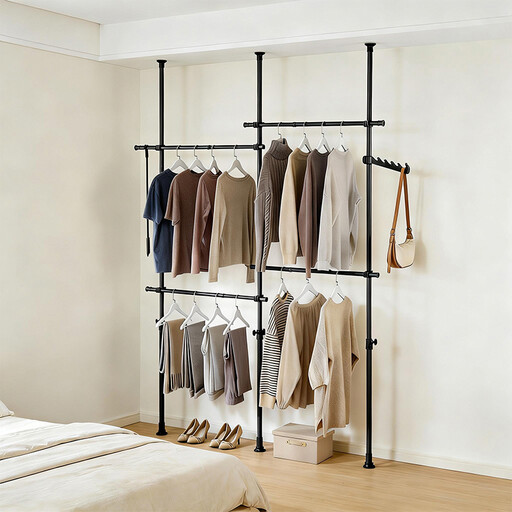
Why this product suits this profile: Three adjustable telescopic rails and four clothes rails provide multiple hanging levels. The range of 124 to 226 cm in width and 200 to 295 cm in height is suitable for larger bedrooms or walk-in wardrobes.
The load capacity of up to 65 kg is stated for the system as a whole. This makes it easier to plan for heavier clothing than with a model that does not provide a clear load rating.
Metal tubes, four clothes rails, side hooks and ten additional hooks according to the product description.
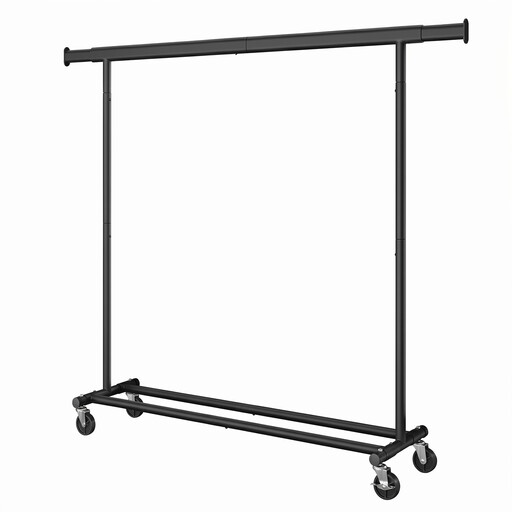
Why this product suits this profile: This freestanding model is designed for users who want to move clothing between the bedroom, utility room or storage room. The width can be adjusted from 160 to 200 cm.
The wheels offer greater flexibility than a permanently tensioned structure. Two lockable wheels help secure the rack in the desired position.
Steel frame, adjustable top rail, wheels and a stated static load capacity of up to 150 kg.
With a no-drill clothes rack, assembly should be not only quick but also carried out correctly. Align telescopic rails vertically and check all push-fit and screw connections before loading the rack. Distribute clothing evenly across the rails.
For a system with shelves, also:
A model with wheels should only be moved when the clothing is hanging securely and the wheels are suitable for the surface. The centre of gravity can shift when the rack is moved.
We have put together a complete, regularly updated list of products that fully meet these strict selection criteria and the safety regulations applicable in the EU.
Depending on the design, the system is either tensioned between the floor and ceiling or set up as a freestanding structure. With a tension-mounted solution, the height, alignment and contact surfaces must match the assembly instructions. “No drilling” therefore does not rule out careful installation and regular checks.
Its service life depends on the materials, load, assembly and care. If the stated load capacity is observed and the connections are checked regularly, a clothes rack can remain reliable for longer. Moisture, overloading and frequent repositioning can accelerate wear.
A clothes rack with wheels does not require electricity during normal use and therefore incurs no ongoing energy costs. Instead, the purchase price, the quality of the wheels and any replacement parts are relevant. If the rack is moved frequently, the wheels and brakes in particular should be checked regularly for correct operation and damage.