
Lieferung heute & morgen

Qualitätsgarantie

Willkommens-Angebote freischalten: KOSTENLOSE Lieferung | Bis zu 80 % RABATT | Kostenlose 30-Tage-JoyPlus-Testphase
App herunterladen
A telescopic clothes rail can create additional storage space without having to drill into the walls. It is suitable for bedrooms, dressing rooms, hallways or cellars, and depending on the model, it can either be clamped between the floor and ceiling or freestanding. However, a low price or the description “sturdy” are not the only things that matter. The dimensions, load capacity and type of installation determine whether the solution is genuinely suitable for your room and clothing in everyday use.
A clothes rail with a high load capacity does not automatically hold the same weight at every point. Manufacturer specifications such as “up to 65 kg” refer to the complete system and correct installation. Heavy winter coats, clothes hangers and bags should be distributed evenly. With a clothes rail positioned between the floor and ceiling, stability also depends on a firm, level surface and correctly adjusted tension.
A drill-free clothes stand requires either a freestanding design or a suitable tensioning mechanism. Delicate ceiling coverings, uneven floors and loose wallpaper can make installation more difficult. Before buying, check whether the model’s tensioning height suits your room and whether there is enough space at the intended location for the feet or tensioning poles.
A clothes stand with shelves can hold shoes, folded clothing and accessories. However, the additional shelf space says nothing about the total load capacity. For example, a narrow system with several shelves may only be designed for lighter textiles, while a wider metal frame can hold more hanging clothing. Therefore, pay attention to the total load capacity, not just the number of rails or shelves.
Measure the available space in several places. With an adjustable clothes rail, these dimensions are particularly important:
Models with a height of around 200 to 295 cm are suitable for many room heights in Germany. Nevertheless, measure the actual ceiling height before placing your order.
Compare the manufacturer’s stated maximum load with how you plan to use the product. A load capacity of 16 kg may be sufficient for a few shirts and jackets. For a substantial wardrobe containing coats, suits or several items of clothing, models with a higher stated manufacturer capacity are more suitable.
It is also important to check whether the specification applies to the complete system or just to one individual clothes rail. With several rails, baskets and shelves, the weight should be distributed across all levels.
Metal tubes provide a reliable basis for a sturdy frame. Plastic connectors are practical for tool-free assembly, but they must be properly clicked into place or firmly connected. After assembly, check all connections and regularly inspect them for signs of loosening.
A freestanding wardrobe does not require wall or ceiling fixings. A telescopic clothes-stand solution, on the other hand, is tensioned between the floor and ceiling. This option saves floor space, but requires suitable, solid contact surfaces. Drilling is not necessary, but the structure must not be subjected to loads exceeding the stated limit.
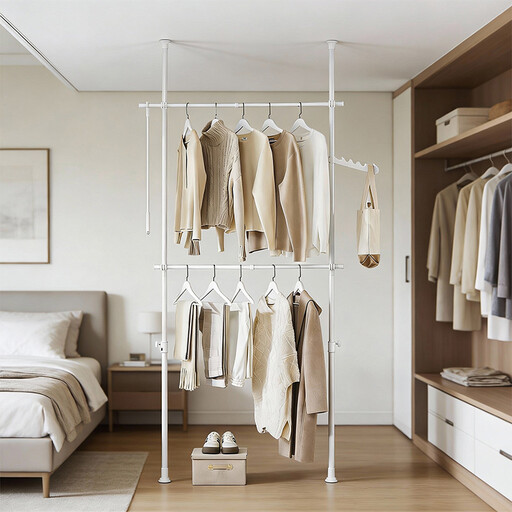
Why this product suits this profile: The width can be adjusted from 75 to 126 cm and the height from 200 to 295 cm. This makes the model suitable for smaller bedrooms, rented homes or individual alcoves.
The stated load capacity of up to 25 kg provides clear guidance for use. The included instructions support drill-free assembly.
Two adjustable rails, a side hook and compact dimensions. According to the product specifications, the system weighs 3.5 kg.
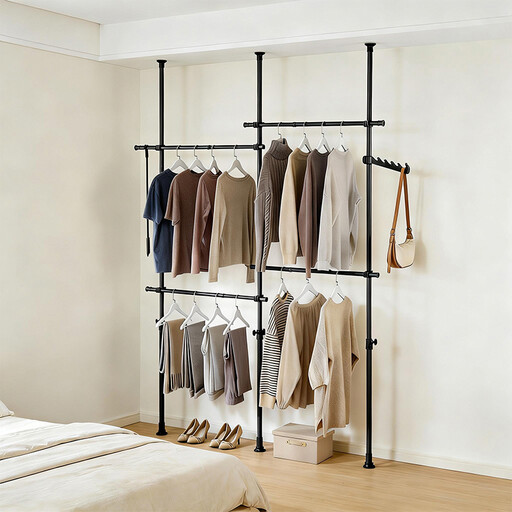
Why this product suits this profile: The wide system can be adjusted from 124 to 226 cm and in height from 200 to 295 cm. It is designed for more extensive clothes storage in the bedroom or dressing room.
The load capacity of up to 65 kg is clearly stated by the manufacturer. Before loading the system, secure all connections and distribute the clothing evenly.
Four usable clothes rails, side hooks and ten additional hangers. According to the specifications, the product weighs 5.6 kg.
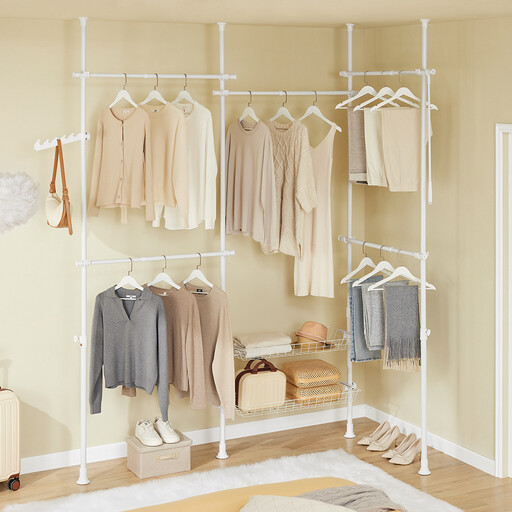
Why this product suits this profile: With a width of 209 to 311 cm, the system is designed for large wall areas, walk-in wardrobes or households with lots of hanging clothing.
The usable width and maximum load of up to 65 kg are clearly stated. Two baskets and side hooks complement the hanging space.
Four adjustable rails, two baskets and a height range of 200 to 295 cm. The product weight is stated as 9.1 kg.
Before assembly, the floor should be clean, dry and as level as possible. With a clothes rail positioned between the floor and ceiling, the telescopic poles must be aligned vertically and tensioned securely. Do not load the system until all connections have been checked.
Clean metal tubes and plastic connectors with a soft, slightly damp cloth, then dry the surfaces. Abrasive cleaners may damage the finish. For systems in regular use, it is advisable to check the connections and screws at suitable intervals.
We have compiled a complete, regularly updated list of products that fully meet these strict selection criteria and the safety regulations applicable in the EU.
Depending on the design, it is either set up freestanding or clamped between the floor and ceiling. With the tensioning version, the height, surface and alignment must match the product description precisely. No wall drilling is required for the systems mentioned.
This depends on the model. The product specifications in this selection range from up to 16 kg and 25 kg to 65 kg. The maximum load only applies when the rail is correctly installed and the weight is distributed evenly. Heavy coats should not all be hung in one place.
Yes, provided the room dimensions and installation surface are suitable. A narrow telescopic clothes-stand model can be a practical choice for small alcoves. For a large open wardrobe, you should also check that there is enough clearance from the bed, doors and walkways.