
Lieferung heute & morgen

Qualitätsgarantie

Willkommens-Angebote freischalten: KOSTENLOSE Lieferung | Bis zu 80 % RABATT | Kostenlose 30-Tage-JoyPlus-Testphase
App herunterladen
A telescopic clothes rail can create additional storage space without permanently drilling into walls. It is suitable for bedrooms, hallways, small flats and walk-in wardrobes. However, models vary considerably in load capacity, dimensions and assembly. A simple clothes rail will not automatically suit every room or volume of clothing.
Before buying, you should therefore look beyond claims such as “sturdy” or “space-saving”. The key factors are verifiable details such as adjustable width and height, maximum load, number of rails and installation method.
A stated total load does not always show how much each individual clothes rail or shelf can hold. Actual stability also depends on whether the clothing is distributed evenly and whether the surface is suitable.
So check the following:
A sturdy clothes rail should not simply be made from metal. It should also offer secure connections and a suitable adjustment range.
A clothes rail positioned between the floor and ceiling needs sufficient clearance for height adjustment. If the ceiling is too low, the system cannot be tensioned correctly. Installation can also be more difficult on sloping, delicate or uneven surfaces.
Before ordering, measure:
The product dimensions usually refer to the intended adjustment range. A model with a height of 200 to 295 cm is not suitable for rooms with a ceiling height outside this range.
A no-drill clothes stand is often clamped between the floor and ceiling. This reduces the installation effort, but does not eliminate the need to check the surface. Before loading the system, the rails must be aligned vertically and tensioned securely. The manufacturer’s instructions are the key reference here.
With delicate surfaces, check whether the contact areas are sufficiently protected. A tension system can slip or leave marks if installed incorrectly. Wall-mounted models, on the other hand, require suitable fixing materials, which are not always included depending on the wall type.
A height-adjustable clothes rail offers flexibility for rooms with different ceiling heights. Compact systems with a small width adjustment range are suitable for narrow alcoves. Wider versions can accommodate several parallel clothes rails, creating an open wardrobe.
Do not only look at the maximum width; check the smallest setting too. For example, a model measuring 124 to 226 cm wide will not fit into a 100 cm-wide alcove.
The load capacity should match the intended use. Lightweight clothing has different requirements from winter coats, suits or bags. With several rails, the load must be distributed evenly.
Metal tubes generally provide a robust frame structure. However, plastic connectors, hooks and shelves are also important components. An extendable clothes rail with several connections should be checked for a secure fit after assembly. Regular inspections may be advisable, particularly after moving home or significantly changing the load.
If you only want to store clothes on hangers, you mainly need sufficient clothes rails. For shoes, folded textiles and accessories, clothes stands with shelves are more practical. Hooks can hold bags, scarves or hats, but should not be overloaded with heavy items.
An open construction makes access easier and can be used as an open wardrobe in the bedroom or dressing room. At the same time, the clothing remains visible and is less protected from dust than it would be in a closed wardrobe.
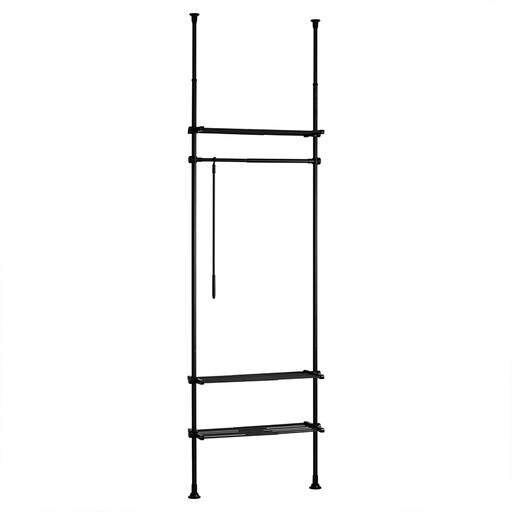
Why this product suits this profile: The system combines an adjustable clothes rail with three shelves and is designed for smaller areas in the bedroom, dressing room or cellar.
The product details specify dimensions of 52–80 × 27 × 233–295 cm and a maximum total load of 16 kg. This makes it easier to assess the capacity realistically.
Three adjustable shelves, one clothes rail and installation by clamping between the floor and ceiling; no drilling required.
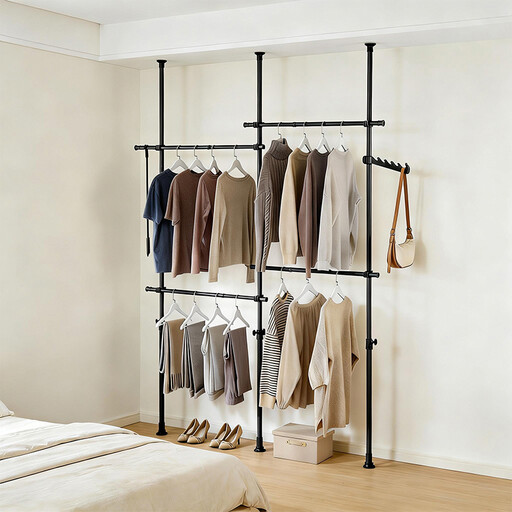
Why this product suits this profile: This version is designed for greater widths and a higher stated total load, and can be used as a clothes rail for a walk-in wardrobe.
With a width of 124–226 cm, a height of 200–295 cm and a total load of up to 65 kg, key selection details are clearly specified. Nevertheless, the load should be distributed evenly across the rails.
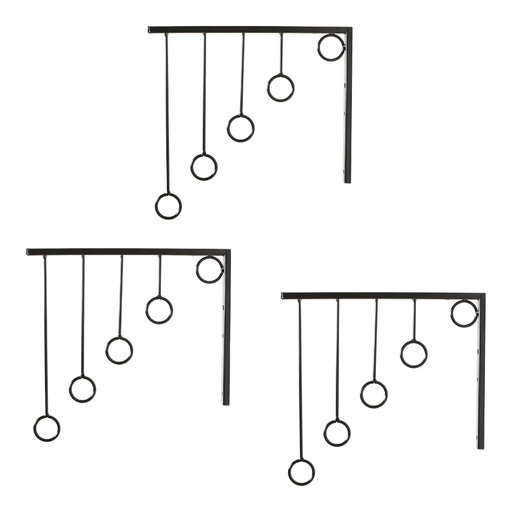
Why this product suits this profile: This set is aimed at households with suitable walls, as well as boutiques and commercial retail spaces that want to display clothing vertically.
The construction is specifically designed for wall mounting. As fixing materials are not included, the wall type and suitable wall plugs must be taken into account in advance.
Three metal holders, each with five descending rings; suitable for visibly organising shirts, jackets and accessories.
With a clothes rail positioned between the floor and ceiling, all telescopic rods should be aligned vertically. Tighten the connections according to the instructions and only load the system after checking its stability. Heavy garments should ideally be placed towards the bottom or distributed evenly across several rails.
Wall-mounted versions must be fixed in a way that suits the wall. In rented accommodation, a tension-mounted solution may be more practical, provided the floor and ceiling are suitable. For care, a soft, slightly damp cloth is usually sufficient for metal and plastic parts. Abrasive cleaners can damage surfaces.
We have put together a complete, regularly updated list of products that fully meet these strict selection criteria and the safety regulations applicable in the EU.
Depending on the model, it is either clamped between the floor and ceiling or mounted on the wall. With tension-mounted models, suitable room dimensions, a solid surface and vertical alignment are important. Wall mounting requires suitable fixing materials.
Its lifespan depends on the materials, installation, load and frequency of use. Do not exceed the stated load capacity and check the connections regularly. If you notice visible deformation, loose connectors or slipping rails, remove the load from the construction and inspect it.
For alcoves and narrow hallways, models with a small minimum width and shallow depth are a sensible choice. Shelves can provide additional storage space, but require more room than a clothes rail alone. Before choosing space-saving clothes storage, measure the available area, including doors and passageways.