
Lieferung heute & morgen

Qualitätsgarantie

Willkommens-Angebote freischalten: KOSTENLOSE Lieferung | Bis zu 80 % RABATT | Kostenlose 30-Tage-JoyPlus-Testphase
App herunterladen
Anyone who lives in a rented flat or moves frequently knows the problem: the desire for more clothes storage often clashes with a ban on drilling holes in the walls. A telescopic clothes rail offers a flexible and sturdy solution. These systems are simply tension-mounted between the floor and ceiling and can be adjusted to fit different room heights and widths.
This article serves as a guide. It explains the key features of telescopic clothes rail systems and presents various models to help you choose the right one for your individual living situation.
The right system depends on your available space and the amount of clothing you have. Three criteria are particularly important.
The maximum load capacity is a crucial factor and is specified in kilograms (kg). Check how much weight the system can support to ensure it is suitable for your wardrobe—from lightweight blouses to heavy winter coats. Most models use steel tubes for the vertical and horizontal rods, combined with plastic connecting parts. Pay close attention to the material and load capacity specifications provided by the manufacturer.
Measure the intended area precisely before making a decision. An adjustable clothes rail is defined by its customisable height and width. Compare the product's minimum and maximum dimensions with your room's measurements. This ensures the system will fit perfectly into a designated alcove, against a free wall, or as a room divider for an open wardrobe.
A clothes rail system can range from a single rod to a complex structure with multiple levels, storage baskets, and shelves. Consider what type of clothes storage you need. Will it only hold hanging garments, or do you also need space for folded laundry, shoes, and accessories? For setting up a complete walk-in wardrobe system, modular sets with additional elements are ideal.
Here is a selection of models that stand out for their different configurations and dimensions, designed for various applications.
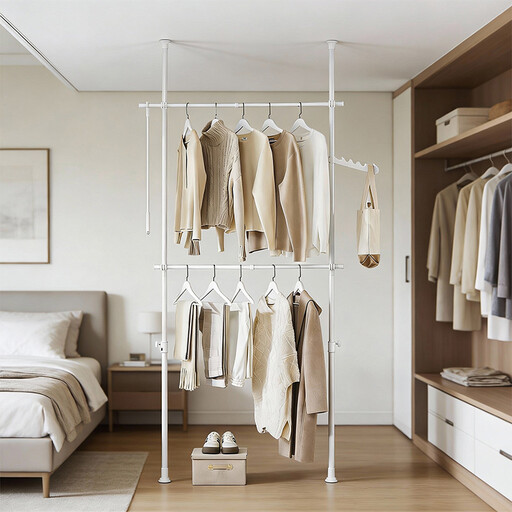
What Sets This Model Apart This system is a compact and straightforward solution for no-drill clothes storage. With two horizontal clothes rails, it offers space on two levels for shirts, jackets, and trousers. A side hook is included for storing accessories like bags or scarves.
Key Specifications
Who It's For? This model is suitable for individuals looking for a basic, space-saving hanging solution for an alcove or a smaller wall area in a bedroom or dressing room.
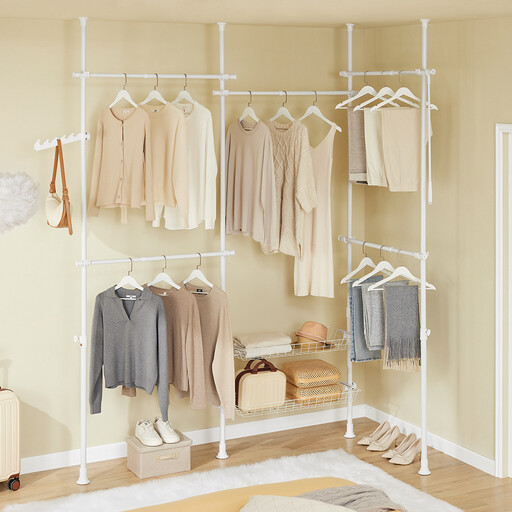
What Sets This Model Apart Designed as a comprehensive clothes rail system, this model offers a generous solution for creating an open or walk-in wardrobe. It combines five clothes rails with two wire baskets, creating versatile storage for both hanging and folded clothes.
Key Specifications
Who It's For? Ideal for users who want to outfit an entire wall or create a complete, heavy-duty walk-in wardrobe system without any permanent installation.
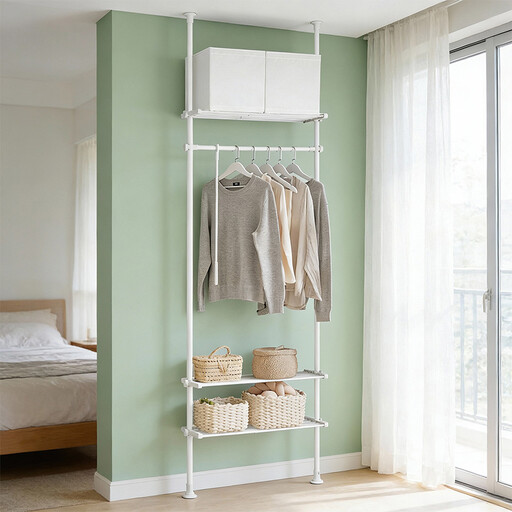
What Sets This Model Apart This narrow system is designed to make optimal use of unused corners and small alcoves. It combines one clothes rail with three shelves and a clothesline, making it a versatile solution for clothes, shoes, and other items.
Key Specifications
Who It's For? This model is a great choice for organising small spaces, narrow hallways, or as a supplement to an existing wardrobe to create additional storage.
If a permanent installation is an option for you after all, or if you're looking for even more dynamic solutions, other systems might be of interest. For space-saving options in corners or on narrow walls, it's worth taking a look at swivel models.
Discover more options in our category for Swivel Clothes Racks.
The load capacity varies significantly depending on the model, material, and construction. Simple systems often support between 15 and 25 kg, while larger, more robust clothes rail systems can be rated for 60 kg or more, according to the manufacturer. You will always find the exact specification in the manufacturer's product details.
Telescopic systems are designed to hold in place through tension. The end pieces that press against the floor and ceiling are usually fitted with rubber feet or plastic caps. These are intended to distribute the pressure evenly and prevent scratches or marks on the surfaces. With proper installation, damage is unlikely.
Assembly typically requires no tools and no drilling. The vertical rods are adjusted to the correct height and wedged between the floor and ceiling. Then, the horizontal rods and any accessories like shelves are attached at the desired height. Illustrated instructions are usually included with the products.