
Lieferung heute & morgen

Qualitätsgarantie

Willkommens-Angebote freischalten: KOSTENLOSE Lieferung | Bis zu 80 % RABATT | Kostenlose 30-Tage-JoyPlus-Testphase
App herunterladen
As a renter or student living in a dorm, you know the challenge: you need more storage for your clothes but aren't allowed to drill holes in the walls. An unused corner in the bedroom or a blank wall is crying out for a wardrobe, but a permanent installation isn't an option. The telescopic clothes rail was designed for this exact problem—a flexible, no-drill solution to create order quickly and easily.
This article serves as your practical guide. We'll explain which features to look for when making your choice and present a selection of models suited for different spaces and needs.
Before you decide on a model, there are a few functional aspects to consider. A well-designed telescopic wardrobe system adapts not only to your space but also to your wardrobe.
The most important feature is stability. Think about what you plan to hang. Lightweight summer blouses have different requirements than heavy winter coats. The load capacity is specified by the manufacturer in kilograms (kg). Look for robust materials like metal tubes for the rails and durable plastic connectors. An extendable clothes rack should be able to support its stated load even when fully extended, without bending.
The main advantage of a telescopic system is its flexibility. A good adjustable clothes rail can be adapted to your space in both height and width. Carefully measure the ceiling height and the available width of your niche or wall. Most systems are tension-mounted between the floor and ceiling and are suitable for standard room heights. The adjustable width allows you to make optimal use of the space and create a custom open-concept wardrobe.
Do you just need a single rail or a complete system for bedroom clothes storage? Some models offer more than just a wardrobe tension rod. Additional crossbars at different heights, wire baskets for accessories like scarves and socks, or side hooks for bags significantly expand its functionality, creating a comprehensive storage solution.
Based on the criteria above, we've put together a selection of telescopic clothes rail systems that meet a variety of needs.
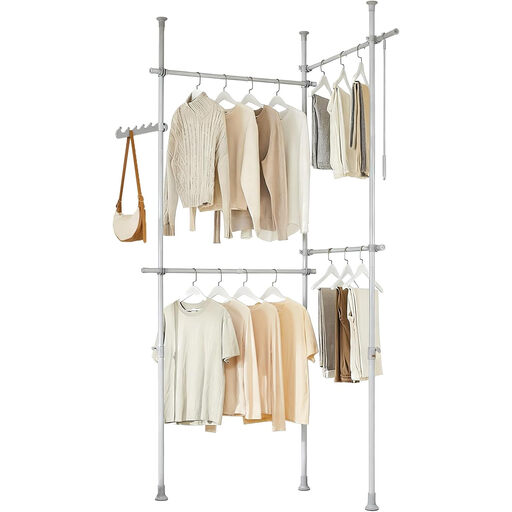
Why it stands out: This system is designed for users who want to transform an entire wall into a walk-in closet. With three vertical poles and four horizontal rails, it offers an immense amount of space.
Advantages:
Who is it for? Ideal for people with a large clothing collection or for couples who want to share a wardrobe system. It's perfectly suited for larger bedrooms or separate dressing rooms.
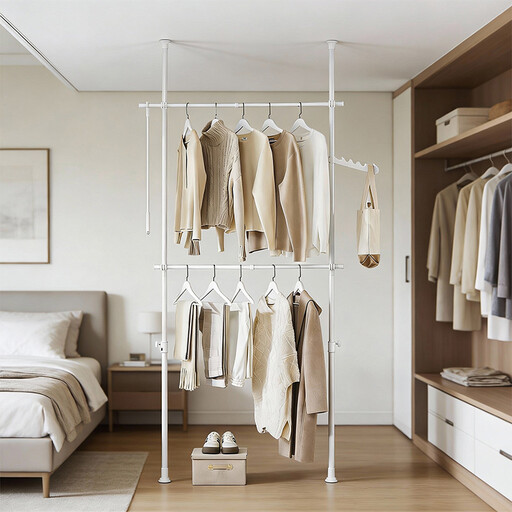
Why it stands out: A compact and minimalist solution that's perfect for smaller niches, hallways, or as a supplement to an existing wardrobe.
Advantages:
Who is it for? Perfect for students in dorms, for a first apartment, or as a coat rack in an entryway. Its load capacity of up to 25 kg (according to the manufacturer) is designed for everyday use.
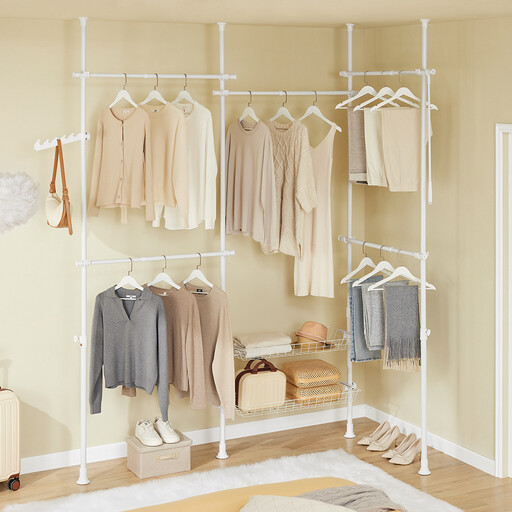
Why it stands out: This model is an all-in-one solution that offers not only hanging rails but also two wire baskets for folded clothes, shoes, or accessories.
Advantages:
Who is it for? For anyone looking for an alternative to a bulky wardrobe and who prefers an open, airy aesthetic. It can replace a complete closet, organising clothes, shoes, and accessories all in one place.
A no-drill clothes rail system is an extremely practical solution, but the variety of designs and sizes is vast. If the models presented here don't exactly match what you're looking for, there are other alternatives to discover.
Explore our full range of sturdy clothes racks to find the perfect solution for your needs.
The load capacity varies significantly depending on the model and construction. More compact systems are often designed for loads around 25 kg, while larger, sturdier systems can support up to 65 kg or more, according to manufacturer specifications. Always check the specific product details from the manufacturer before purchasing to ensure the system is suitable for your wardrobe.
When installed correctly, these systems are very stable. Their stability relies on the tension created between the floor and the ceiling. It is important that the floor and ceiling are solid and level. Most systems have rubberised end caps to prevent slipping and protect surfaces. Follow the manufacturer's assembly instructions carefully to ensure maximum stability.
Generally, telescopic clothes rails are designed for installation between a horizontal floor and a horizontal ceiling. Mounting on a sloped surface is not recommended, as the vertical tension cannot be properly established, which would severely compromise the system's stability. Sloped ceilings require special wardrobe systems designed for that purpose.