
Lieferung heute & morgen

Qualitätsgarantie

Willkommens-Angebote freischalten: KOSTENLOSE Lieferung | Bis zu 80 % RABATT | Kostenlose 30-Tage-JoyPlus-Testphase
App herunterladen
A telescopic clothes rail system promises a flexible and hassle-free solution for creating more storage space, especially in rental properties or for evolving spatial needs. Its drill-free installation is a key advantage. However, not every system delivers on its promise. Before you make a decision, it's important to understand the common weaknesses that often only become apparent after purchase.
Some models quickly turn out to be a poor investment. The most common problems include:
A well-considered purchase saves you the hassle of returns and the search for a replacement.
To find a durable and functional clothes storage system, you should check three core technical parameters. These are crucial in determining stability, longevity, and practical everyday use.
The foundation of any system is the material of the telescopic rods and the resulting load-bearing capacity.
The flexibility of a system is demonstrated by its adaptability to your space.
ceiling-mounted clothes rail without screws.A telescopic clothes rail system can be more than just a single rod. Depending on your needs, it can be expanded into a complete open wardrobe.
adjustable clothes rack. The ability to set the height of each extendable clothes rail individually is crucial for hanging long coats next to short jackets.Based on these objective criteria, we have identified several products that represent a smart choice for specific user profiles.

Why it's a great fit: Ideal for students, first-time apartment dwellers, or small alcoves. The more compact width (75–126 cm) makes efficient use of limited space without being overwhelming. It provides a basic yet stable solution for a daily wardrobe.
The system avoids false promises with a clearly defined load capacity of up to 25 kg. The iron rods are more resilient than basic aluminium tubes in this price range.
Compact dimensions and a very simple, tool-free assembly make it a practical starter solution.
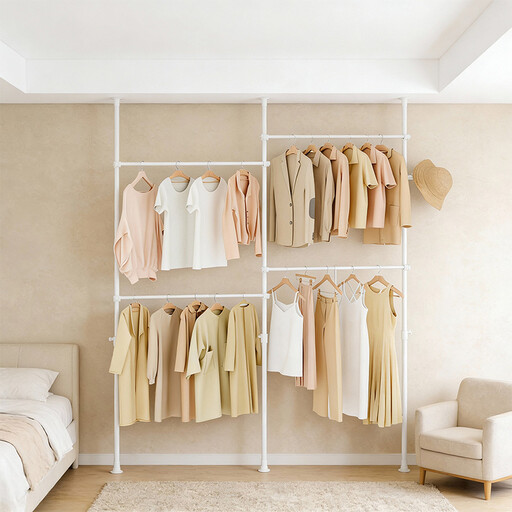
Why it's a great fit: For those with an extensive wardrobe or the desire for a walk-in closet solution. The three vertical rods and wide span (124–226 cm) allow for the creation of a complete open wardrobe.
Directly addresses the stability issue: the third telescopic rod ensures better load distribution. The manufacturer's specified load capacity of up to 65 kg is designed for a large amount of clothing, including heavy coats.
High capacity and maximum flexibility thanks to four individually positionable crossbars and a very wide adjustment range.
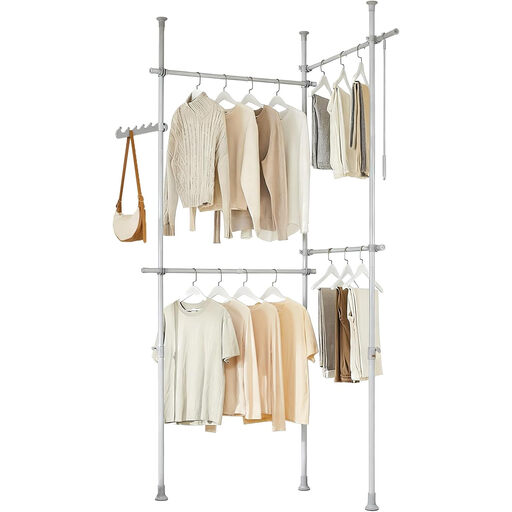
Why it's a great fit: Perfect for temporary uses, such as in a guest room, in the laundry room for seasonal clothing, or during a move. It can be quickly assembled and disassembled and reused in different rooms thanks to its wide adjustment range.
This system avoids the trap of poor adjustability. The wide adjustment range in height (200–295 cm) and width (124–226 cm) ensures compatibility with most standard room dimensions in apartments and houses.
High reusability due to tool-free assembly and disassembly, as well as excellent adaptability to different room sizes.
We have compiled a complete, up-to-date list of products that fully meet these strict quality and safety standards.
Stability depends on two factors: product quality and correct installation. A system with thick steel tubes and robust connectors is inherently more stable. However, it is crucial that the vertical rods are clamped with sufficient tension between the floor and ceiling. Additionally, the manufacturer's specified maximum load capacity must not be exceeded. When installed correctly, a good system is very stable.
No, as a rule, these systems are designed for use between a flat, horizontal floor and an equally flat, horizontal ceiling. The tension mechanism requires parallel contact surfaces to find a secure hold. Specialised shelving systems designated for sloped ceilings are required for such applications.
High-quality systems are equipped with end caps made of soft plastic or rubber. These serve to distribute the pressure evenly and protect the surfaces. With proper installation and tension, no permanent marks or damage should occur. It is still advisable to clean the contact surfaces before installation.