
Lieferung heute & morgen

Qualitätsgarantie

Willkommens-Angebote freischalten: KOSTENLOSE Lieferung | Bis zu 80 % RABATT | Kostenlose 30-Tage-JoyPlus-Testphase
App herunterladen
As a Joybuy Product Recommendation Officer, I see the challenges many people face when furnishing their living spaces every day. The demand for flexible yet sturdy clothes storage is especially high in rental apartments, student dorms, or for those who move frequently. Drilling is often not an option, and conventional wardrobes can be bulky and inflexible.
A telescopic clothing rack system offers a smart solution. It utilizes the vertical space between the floor and ceiling, can be assembled without tools, and adapts to various room heights and widths. This article will explain how these systems work, provide tips for choosing the right one, and present specific product recommendations to help you flexibly organise your wardrobe.
To find the right system for your needs, several objective criteria are crucial. These will help you evaluate the functionality and durability of different models.
Stability is a key factor. A clothes rack must be sturdy enough to safely support the weight of jackets, coats, and other garments. Pay close attention to the maximum load capacity in kilograms specified by the manufacturer. Systems made from metal tubes, such as steel or coated iron, generally offer a higher load-bearing capacity than all-plastic designs. The connectors should also be made of robust plastic or metal to ensure long-term stability.
The main advantage of a telescopic system is its flexibility. Check the minimum and maximum adjustment ranges for both height and width. A good wardrobe system is adjustable, allowing it to fit perfectly into alcoves, under sloped ceilings, or even serve as a room divider. Measure your available space carefully before purchasing to ensure the system will fit. For creating an open or walk-in wardrobe, a modular walk-in wardrobe system is ideal, as it can be expanded as needed.
Most systems work as a tension-mounted clothing rack. The vertical rods are secured by tension between the floor and ceiling, enabling a no-drill clothes rail installation. Rubberised or plastic-capped ends protect your floor and ceiling and prevent slipping. Assembly should be possible for one person without any special tools. Clear, easy-to-follow instructions are invaluable here.
Based on the criteria mentioned above, we have curated a selection of models for flexible clothes storage.
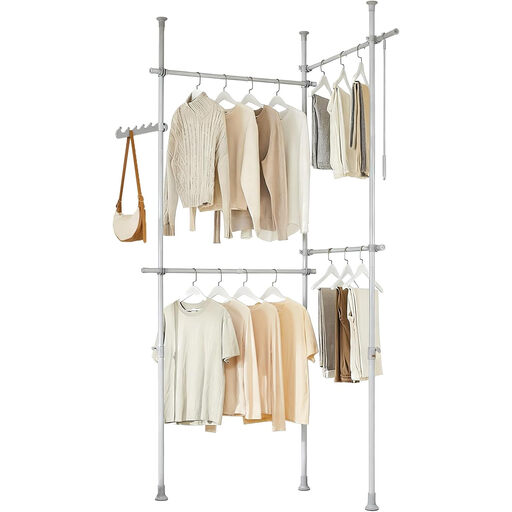
Why it stands out: This comprehensive system, with three vertical rods and four horizontal rails, offers ample space and excellent adaptability. It's perfect for transforming an entire wall into an open wardrobe. The open design ensures good air circulation and quick access to your clothes.
Advantages:
Who it's for: Individuals who need to store a large amount of clothing and want to use an entire wall or a large alcove as a wardrobe. Ideal for setting up a walk-in closet.
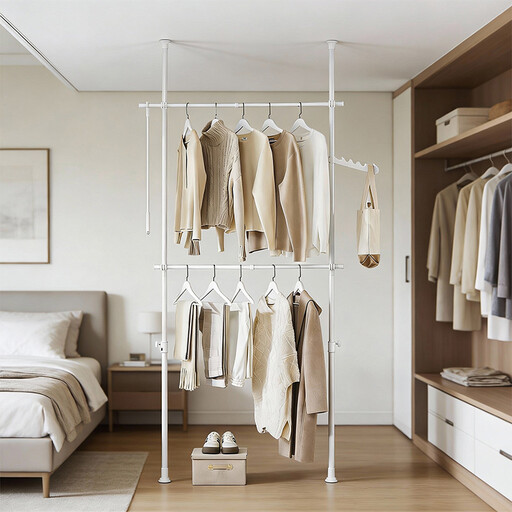
Why it stands out: This more compact model is an excellent choice for smaller rooms, hallways, or as a supplement to existing furniture. It offers the same drill-free tension function in a slimmer format and can be quickly adapted to different room situations.
Advantages:
Who it's for: Students, residents of studio apartments, or anyone looking for a space-saving wardrobe solution for an entryway or a small corner of the bedroom.
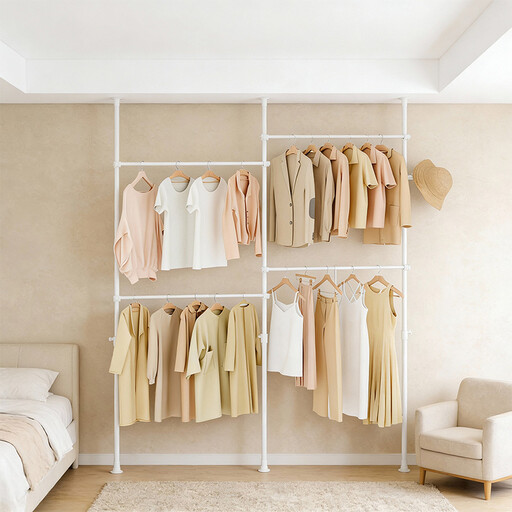
Why it stands out: This model combines the high capacity of the first system with a bright, white finish that blends discreetly into many interior design styles. It is a robust and flexible solution for anyone who needs a lot of storage space and prefers an alternative to dark furniture.
Advantages:
Who it's for: Ideal for users with an extensive wardrobe who are looking for a bright, open storage solution for a bedroom, dressing room, or large hallway.
The models featured here cover a wide range of use cases. However, if you are looking for different sizes, configurations, or specific designs, there are many other variations to discover.
Browse our entire range of flexible storage solutions to find the perfect system for your individual needs.
Discover More Telescopic Rods on Joybuy.de
Stability depends on two factors: correct assembly and adherence to the manufacturer's specified maximum load capacity. When the system is tensioned firmly and straight between the floor and ceiling, and the weight limit is not exceeded, it provides a very stable storage option for clothing.
Most systems are designed for solid, flat surfaces like concrete, screed, wood, or tile. Caution is advised with suspended ceilings (e.g., plasterboard) or very soft carpeted floors, as the pressure points could cause damage or compromise stability. Always check the condition of your ceiling and floor before installation.
The load capacity varies depending on the model, material, and construction. More compact systems often support around 20–30 kg, while larger, more robust systems can be designed for loads of 60 kg or more. You will always find the exact specifications in the manufacturer's product details. Distribute the weight evenly across the rails to maximise stability.