
Lieferung heute & morgen

Qualitätsgarantie

Willkommens-Angebote freischalten: KOSTENLOSE Lieferung | Bis zu 80 % RABATT | Kostenlose 30-Tage-JoyPlus-Testphase
App herunterladen
As a Joybuy Product Recommendation Officer, I see daily how the right equipment can be the difference between a tedious, unsafe task and an efficient, secure solution. A telescopic pole is a prime example. Whether for cleaning fa?ades, pruning high branches, or washing skylights, it promises to make ladders obsolete. But the market is flooded with products of dramatically varying quality. A bad purchase is not just annoying; it can also be a safety hazard.
Before you make a decision, it's crucial to understand the most common pitfalls, which often only become apparent after the purchase:
To avoid these problems, you should base your selection on a few fundamental technical parameters.
An informed purchasing decision isn't based on marketing promises, but on objective features. Pay close attention to the following three points to get a durable and safe product for working at height.
The material is the primary factor determining stability and weight. Aluminum is the most common material—it's lightweight and corrosion-resistant. However, the crucial details here are the wall thickness and the profile. Higher-quality poles often use thicker-walled or oval-shaped tubes to minimize flexing. For professional demands, there are models made of Fiberglass (GFRP) or Carbon Fiber (CFRP), which offer greater rigidity at a lower weight.
Equally important is the locking mechanism. While simple twist-locks are common, external clamp locks (similar to those on camera tripods) often provide a more secure and user-friendly way to lock the segments. They can also be tightened precisely and firmly, even while wearing work gloves.
Manufacturer specifications for length can be misleading. What's relevant is not just the maximum extended length, but the stable working length. A rule of thumb is that the segments should overlap by at least 15-20 cm for sufficient stability. A pole extended to its absolute limit will drastically lose rigidity. Calculate your required reach realistically: your height plus arm length, plus the usable length of the pole. For cleaning first-floor windows (cleaning high windows), a shorter, lighter window cleaner extension is often sufficient, whereas pruning high branches or fa?ade cleaning on a two-story house will require longer models.
The connector at the end of the pole determines which tools you can use. There are three common systems:
Instead of making a one-size-fits-all recommendation, we have identified products that are particularly well-suited for specific user profiles and their requirements.
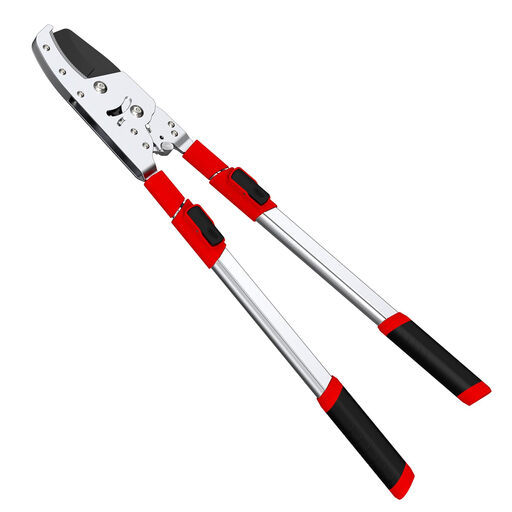
Why This Fits Their Persona: Ideal for gardeners who need to regularly cut thick, dry branches on fruit trees or shrubs. The focus is on maximum cutting power with minimal effort, without having to climb a ladder.
This tool is an integrated unit, combining a telescopic lopper with its handles. This eliminates the problem of incompatible attachments. The robust construction of aluminum and carbon steel prevents instability during use.
The 4-stage ratchet mechanism multiplies the force applied, allowing it to cut branches up to 50 mm in diameter. The anvil blade is designed for dry and hard wood.
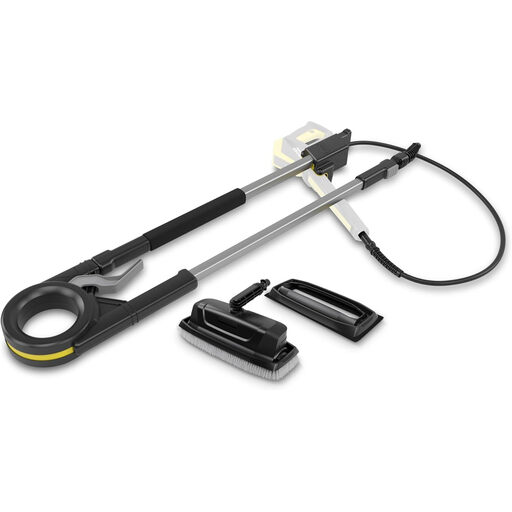
Why This Fits Their Persona: Perfect for owners of a K?rcher pressure washer (K 2 to K 7) who want to safely and thoroughly clean high fa?ades, conservatories, or canopies from the ground. Safety and system integration are the top priorities.
As an original accessory, it completely solves the compatibility problem. The bayonet connection guarantees a secure, pressure-tight seal. The high-quality construction is designed for high-pressure operation and remains stable.
Infinitely adjustable from 1.20 m to 3.70 m. The 180° adjustable joint allows for cleaning in hard-to-reach areas. It is a specialized fa?ade cleaning tool within a proven system.
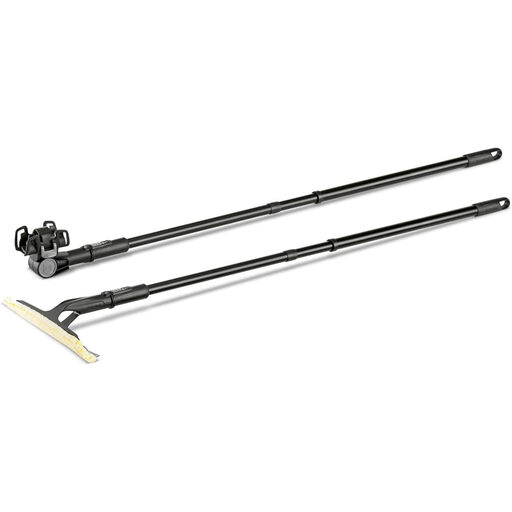
Why This Fits Their Persona: For users who already own a K?rcher Window Vac (WV series) or the vibrating wiper (KV 4) and now want to effortlessly reach high windows, skylights, or conservatories.
This window cleaner extension is specifically designed for lightweight devices, thus avoiding the problem of an oversized, heavy pole. Compatibility is guaranteed within the K?rcher system.
Lightweight and extendable from 0.6 to 1.5 m, enabling a working height of approx. 3.5 m. The flexible joint allows the working angle to be adjusted for streak-free cleaning, even in difficult-to-access spots.
We have compiled a complete, up-to-date list of products that fully meet these strict selection criteria and rigorous safety standards.
The optimal length depends on the intended working height. Measure the highest point you need to reach and then factor in your own height and arm length. Don't just buy the longest pole available by default. Longer poles are heavier, more cumbersome, and less stable when fully extended. For most jobs on one- to two-story homes, a pole with a maximum length of 4 to 6 meters is usually sufficient.
No, universal compatibility is not the norm. Pay close attention to the connection type. The so-called Euro tapered cone is a de facto standard for many cleaning tools, but there are numerous variations. Proprietary systems, like K?rcher's bayonet lock, offer a very secure connection but tie you to that brand's accessories. Always check before buying that the pole's connector fits your existing or planned tool heads.
Maintenance is straightforward but crucial for longevity. Clean the pole with a damp cloth after each use to remove dirt and moisture. Let the segments dry completely before collapsing them to prevent internal corrosion. Regularly check the function of the locking mechanisms and keep them clean. Storing it in a dry, protected place will significantly extend its lifespan.