
Lieferung heute & morgen

Qualitätsgarantie

Willkommens-Angebote freischalten: KOSTENLOSE Lieferung | Bis zu 80 % RABATT | Kostenlose 30-Tage-JoyPlus-Testphase
App herunterladen
A thermal blackout curtain promises a lot: more restful sleep, enhanced privacy, and significant savings on your energy bills. But the market is flooded with products whose labels promise more than they deliver. Many buyers only realise after installation that the room doesn't get truly dark, or the supposed thermal protection is barely noticeable.
As your Joybuy Product Recommendation Officer, I'll help you identify the crucial features and avoid common purchasing traps. This guide focuses on the objective criteria that define a truly functional thermal blackout curtain.
Before you make a decision, you should be aware of the most common issues that lead to disappointment and unnecessary expense:
privacy curtains merely shield from prying eyes. They filter daylight but don't darken the room enough for deep sleep. A genuine 100% blackout curtain requires a special material construction.thermal insulation. Without a dense weave, a high fabric weight, or a special coating, the insulating effect is negligible.eyelet curtain on the wrong kind of rod, can also severely limit its functionality.To avoid these traps, you should base your selection on three verifiable criteria. These will help you objectively assess a curtain's performance.
The fabric weight, given in grams per square metre (g/m?), is one of the most important indicators of a thermal blackout curtain's quality.
cold-protection thermal curtains and good sound insulation. Materials like a dense velvet curtain with a weight of 300 g/m? or more are an excellent choice here. They not only block light but also help stabilise room temperature and dampen outside noise, making them perfect for a bedroom blackout curtain.The ability to black out a room depends on the weave and construction of the fabric. Look for the following features:
Installation is crucial for effectiveness. An eyelet curtain is easy to install and creates uniform, deep folds that contribute to insulation. Alternatives include curtain tape for track systems.
Measure Correctly:
Here are some recommendations tailored to different needs and living situations, all of which meet the criteria mentioned above.
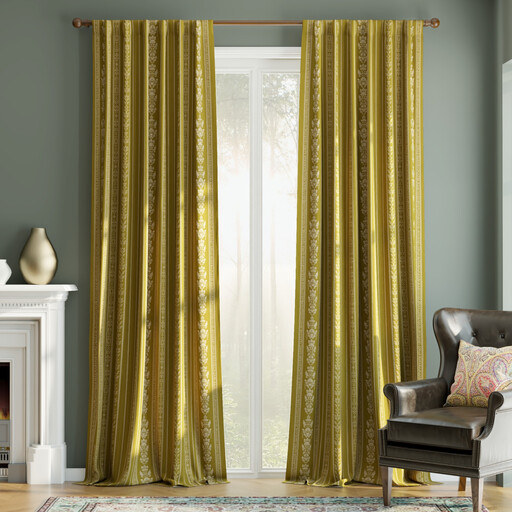
Why This Fits Their Persona: Ideal for those seeking a functional curtain that doubles as a stylish decorative element in the living room. The luxurious velvet fabric and classic pattern create an elegant atmosphere without compromising on blackout performance. A perfect blend of a modern living room curtain and timeless style.
This curtain bypasses the trap of purely decorative fabrics. Its dense velvet naturally provides good blackout and insulation properties that go beyond mere aesthetics.
Combines heavy velvet fabric for thermal insulation with an elegant floral design. The concealed back tab suspension creates a clean, polished look.
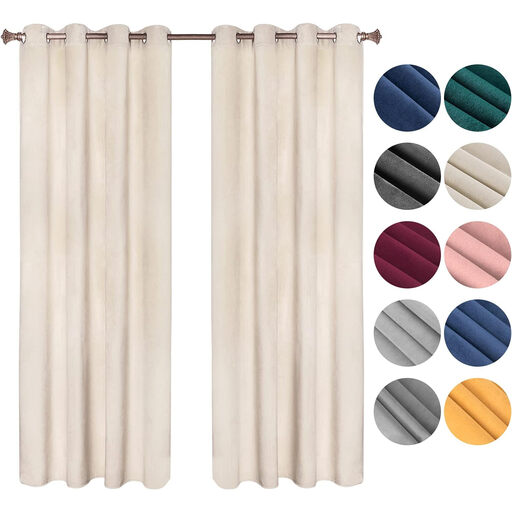
Why This Fits Their Persona: Engineered for maximum functionality in the bedroom. Ideal for light-sensitive individuals, shift workers, or families looking to create a dark and quiet sleeping environment. The high density of the material also contributes to sound dampening.
This curtain avoids the trap of vague "thermal" promises with a clear specification: its fabric weight of 300 g/m? and black silk backing are objective proof of high insulation and blackout performance.
High blackout level (90-95% according to the manufacturer) and effective thermal and acoustic insulation due to the heavy fabric. The material is certified according to OEKO-TEX Standard 100.
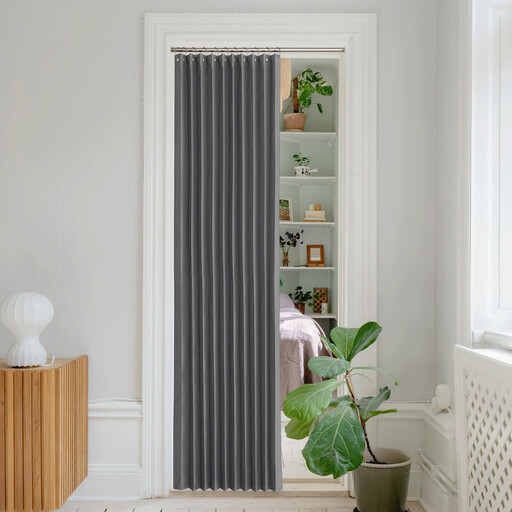
Why This Fits Their Persona: A utilitarian solution for renters or for areas where a curtain rod is impractical, such as doorways, hallways, or as a room divider. The simple hook installation makes it versatile.
This product prevents the mistake of buying an unsuitable standard curtain for special use cases. It is specifically designed for doorways and as a room divider, offering a fitting and straightforward installation solution.
Specialised design for doorways and as a room divider. Installation is simple with hooks, allowing for flexible, drill-free mounting. Provides good blackout and thermal insulation.
We have compiled a complete, up-to-date list of products that fully meet these strict selection criteria.
Measure the width of your curtain rod (excluding finials) and multiply it by 1.5 to 2.5 to determine the total curtain width needed. For the length, measure from the top of the rod to where you want the curtain to end. For optimal thermal insulation, the curtain should ideally reach the floor and extend 15–20 cm beyond the window on each side.
Fabric weight indicates how many grams one square metre of the fabric weighs. For a thermal blackout curtain, a higher weight is a good indicator of a denser weave. A dense fabric blocks more light, insulates sound better, and has more mass to trap heat in the room or block it from entering. Values over 250 g/m? suggest good thermal performance.
Yes, a high-quality thermal curtain can help reduce energy costs. In winter, it forms an additional insulating layer in front of the window, reducing heat loss. In summer, it blocks solar radiation and helps keep rooms cooler, which can lower the need for air conditioning. The actual savings depend on the quality of the curtain, its fit to the window, and the building's overall insulation.