
Lieferung heute & morgen

Qualitätsgarantie

Willkommens-Angebote freischalten: KOSTENLOSE Lieferung | Bis zu 80 % RABATT | Kostenlose 30-Tage-JoyPlus-Testphase
App herunterladen
A consistent water temperature while showering isn't a luxury; it's a fundamental aspect of comfort and safety in the bathroom. Yet, ill-considered purchases often lead to frustration: fluctuating temperatures, limescale-encrusted fixtures, or the constant worry of scalding. A high-quality thermostatic shower mixer can solve these problems, but the market is flooded with products whose quality is difficult to assess. This guide will help you identify the crucial features and sidestep common purchasing traps.
Before deciding on a model, it's important to understand the most common issues that can arise with inferior products.
To make an informed decision, you should focus on a few crucial technical features. These define the durability, safety, and functionality of your new shower mixer tap with anti-scald protection.
The heart of a durable fixture is its main body. Ensure that it is crafted from solid brass. Brass is extremely resistant to corrosion and robust against the thermal and mechanical stresses of the bathroom. A multi-layer chrome plating not only protects against scratches and ensures a long-lasting shine but also makes cleaning significantly easier, as limescale and soap residue are less likely to adhere.
The real "engine" in a shower thermostat is the thermostatic cartridge. It automatically mixes hot and cold water to keep the set temperature constant. High-quality cartridges, often featuring ceramic disc seals, react to pressure or temperature fluctuations in a fraction of a second. The integrated safety lock at 38°C reliably prevents scalding, making it an indispensable feature, especially in households with children or elderly individuals.
For a straightforward installation as a wall-mounted shower thermostat, adhering to standard dimensions is critical. In the UK and much of Europe, the standard distance between wall connections (pipe centres) is 150 mm. The connections for the shower hose typically use a G 1/2 inch thread. Check these measurements before purchasing to ensure the fixture will fit your existing water pipes without complex adjustments.
Instead of presenting an overwhelming list, we have matched models to specific user profiles and their requirements.
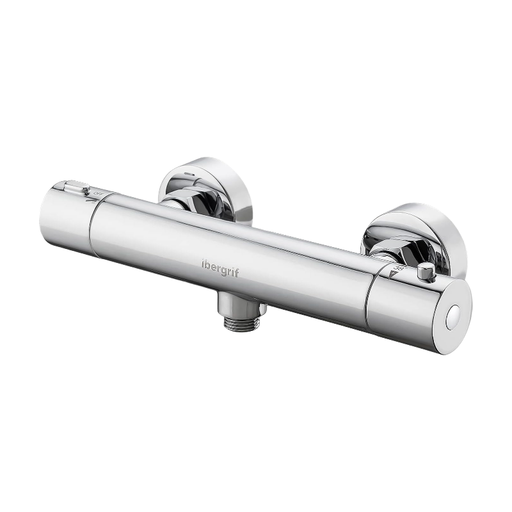
Why This Fits Their Persona: This model is designed for maximum safety. The physical 38°C safety lock must be actively overridden with a button press, which prevents children from accidentally setting the temperature too high. The thermostatic control ensures a stable water temperature, even when a toilet is flushed.
The solid brass core resists corrosion and limescale (Trap 1). The precise 38-degree lock provides reliable anti-scald protection that goes beyond simple markings (Trap 2).
Automatic balancing of hot and cold water for a constant temperature. Standard connections (150 mm centres, 1/2" BSP) for easy installation.
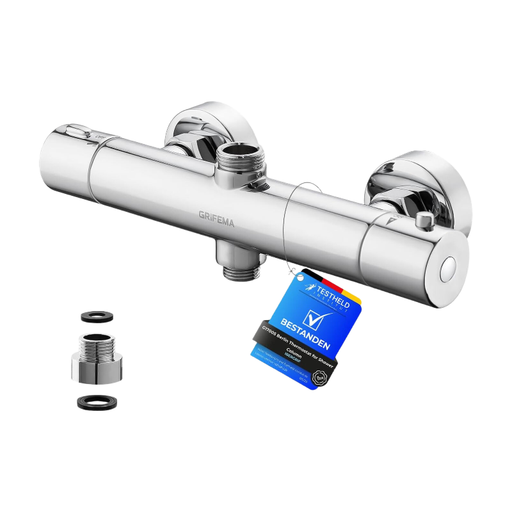
Why This Fits Their Persona: Ideal for renovators looking for a functional and straightforward solution. This model offers two outlets (top 3/4" for a rainfall shower, bottom 1/2" for a handheld shower), providing flexibility in designing the shower area. Installation is manageable for DIYers thanks to standard dimensions and an included mounting kit.
The use of standard connections prevents compatibility issues during installation (Trap 3). The solid brass construction ensures durability (Trap 1), while the 38-degree lock meets the essential safety standard.
Two outlets for flexible shower systems (e.g., overhead and handheld shower). Simple operation with one handle for temperature and one for water flow/diverter.
We have compiled a complete, up-to-date list of products that fully meet these strict selection criteria and safety regulations.
The lifespan of a thermostatic shower mixer heavily depends on the material quality and water hardness. A model with a solid brass body and a high-quality ceramic cartridge can remain functional for 10 to 15 years or more with regular maintenance. In regions with very hard water, occasional descaling of the cartridge can extend its life.
If the temperature control isn't working, it's often due to incorrect installation. Check that the hot water inlet is connected on the left and the cold water inlet on the right—this is the standard configuration for the thermostat to function correctly. Another cause could be clogged filters in the connections, which block water flow.
In most cases, yes. If your old fixture was a surface-mounted mixer tap with a standard pipe centre distance of 150 mm, the replacement is usually straightforward. A surface-mounted thermostat for the shower uses the same connections. You just need to turn off the water supply, unscrew the old fixture, and mount the new one. Always check the connection compatibility before you buy.