
Lieferung heute & morgen

Qualitätsgarantie

Willkommens-Angebote freischalten: KOSTENLOSE Lieferung | Bis zu 80 % RABATT | Kostenlose 30-Tage-JoyPlus-Testphase
App herunterladen
By the Joybuy Product Recommendation OfficerUpdated July 28, 2026
A narrow hallway or entryway presents a challenge for many households: where to put shoes without creating tripping hazards or making the space feel even smaller? A narrow shoe rack seems like the obvious solution. However, the market is flooded with models whose real-world usability only becomes apparent after purchase. Many products turn out to be unstable or are impractically sized for common shoe sizes. This guide will help you identify the crucial features and find the right shoe storage for your entryway.
Before choosing a model, it's important to know the typical pitfalls that often only surface during everyday use.
To make an informed decision, you should examine three key aspects: material, dimensions, and type.
The longevity of a shoe rack is directly linked to its material.
A space-saving shoe rack is characterised by its intelligent use of available space.
The type of entryway shoe storage should suit your daily habits.
Here are some recommendations tailored to different needs and spatial situations.
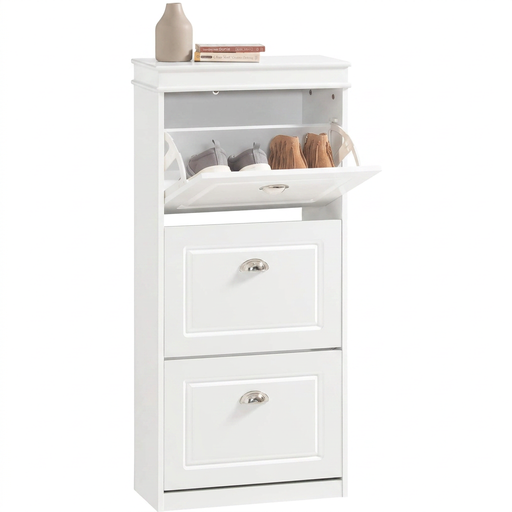
Why This Fits Their Persona: Ideal for households seeking a space-saving and visually calm solution. The closed front conceals shoe clutter, ensuring a tidy appearance, especially in narrow entryways.
At just 24 cm deep, this tip-out cabinet is specifically designed for tight spaces, solving the problem of protruding shoes. The MDF (E1) construction and included anti-tip kit directly address stability concerns.
High capacity with three tip-out drawers; dust-free storage; simple, modern design in white.
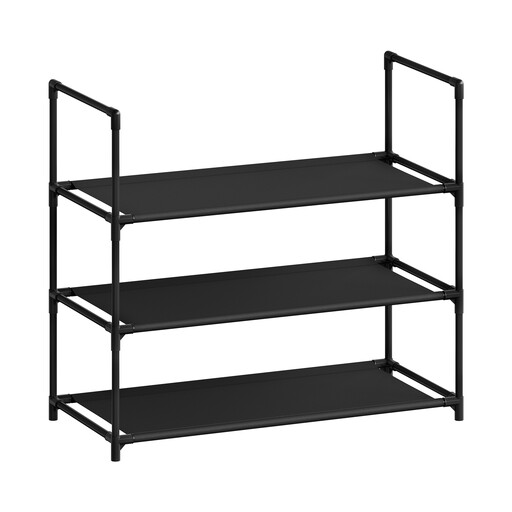
Why This Fits Their Persona: A straightforward and affordable solution for students, young couples, or as a secondary rack in the basement. It quickly creates order without breaking the bank and is tool-free to assemble thanks to its push-fit system.
The design uses thickened metal tubes and specifies a load capacity of 5 kg per tier, promising better baseline stability than no-name products. The 28 cm depth is a realistic compromise for an open rack.
Very lightweight, tool-free assembly, tiers can be removed for boots, low-maintenance non-woven fabric shelves.
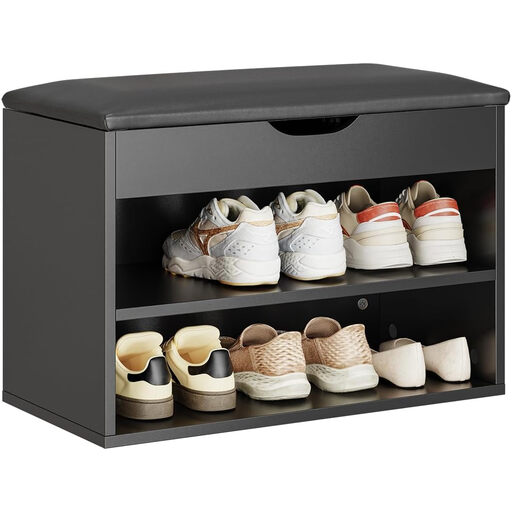
Why This Fits Their Persona: Perfect for anyone who needs not only shoe storage in their entryway but also a comfortable seat and a spot for small items like keys or shoe polish. It combines three functions in a minimal footprint.
The specified static load capacity of up to 113 kg and the reinforced particleboard frame ensure the bench can be safely used for seating—a key advantage over flimsy, low-cost benches.
Combines seating, open shoe storage, and a hidden compartment; compact dimensions (60x30x43 cm); padded seat.
We've compiled a full, up-to-date list of products that fully meet these strict selection criteria and rigorous safety standards.
1. How deep should a narrow shoe rack be? For an extremely narrow hallway, tip-out cabinets with a depth of 17 to 24 cm are a great choice. For open racks, you should plan for a depth of at least 28 cm to prevent shoes up to size EU 45 (UK 10.5 / US 11) from protruding. Always measure your largest pair of shoes before buying.
2. Is an open or closed shoe rack better for the hallway? It depends on your priorities. An open rack provides good ventilation for shoes and quick access. A closed shoe cabinet or tip-out unit protects shoes from dust and creates a tidier, calmer look in the entryway, which is especially beneficial in small apartments.
3. How many pairs of shoes fit in a narrow shoe cabinet? Capacity varies widely. A narrow, 3-drawer tip-out cabinet can hold about 9-12 pairs of flat shoes. A tall, narrow 8-tier rack can hold 16 pairs or more. Manufacturer specifications are often based on smaller shoe sizes, so plan realistically and use one compartment's capacity with your actual shoe size as a reference.