
Lieferung heute & morgen

Qualitätsgarantie

Willkommens-Angebote freischalten: KOSTENLOSE Lieferung | Bis zu 80 % RABATT | Kostenlose 30-Tage-JoyPlus-Testphase
App herunterladen
A three-wheeled children's scooter can be suitable outdoor equipment for many children from around the age of three. The additional wheel at the front or rear supports a steadier ride than two-wheeled models. However, children's scooters vary considerably in terms of steering, deck, height adjustment and portability.
If you focus only on light-up wheels or an eye-catching colour, it is easy to overlook important details. The following tips will help you choose a three-wheeled scooter for children that suits their age, height and intended use.
A note such as “from 3 years” does not replace checking the child's height, handlebar height and weight limit. Handlebars that are too high make the scooter harder to control, while handlebars that are too low can lead to an unnatural posture. The specific adjustment positions and maximum load are therefore crucial.
For example, the Beleev V2-Pure is listed with three handlebar heights, ranging from approximately 61 to 81.5 cm. According to the product description, the model is intended for children aged 3 to 12 and for heights of up to 157.5 cm. These details should be compared with the child's individual growth.
With a scooter with LED light-up wheels, the lights may be activated by the movement of the wheels. This does not automatically mean that the deck has battery-powered lighting. According to the description, the wheels on the Beleev model light up without batteries, whereas the LED lighting in the deck requires two AA batteries, which are not included.
You should therefore check the following before buying:
LEDs are not a substitute for suitable lighting on public roads. The Beleev scooter's product warning expressly states that the model must not be used in traffic.
A folding children's scooter can be stored or transported more compactly. However, the folding mechanism should be easy to understand and lock securely once the scooter has been unfolded. With younger children, adults should handle the folding process.
Weight is also relevant: a model may fold down yet still be awkward for a child or accompanying adult to carry. The Beleev V2-Pure product description states a weight of 6.1 lb, or around 2.8 kg. This can be an important consideration if the scooter is frequently used on the way to the playground.
Many three-wheeled models use lean-to-steer children's scooter technology. The child steers by shifting their weight rather than simply turning the handlebars. This system can make the scooter easier to operate, but it does require a short period of familiarisation.
A stable stance does not depend solely on having three wheels. The following features are also important:
A scooter should be tried out on a flat, dry surface. Uneven ground, kerbs and wet surfaces can affect handling regardless of the model.
A children's scooter with an anti-slip deck should have a clearly textured or coated standing surface. An extra-wide deck provides more room for the foot, but that does not automatically make it more comfortable for every child. The key question is whether the child can stand securely while still having enough freedom of movement.
A rear or foot brake must be easy to reach. The Beleev V2-Pure is listed with a rear foot brake featuring an integrated stainless-steel component. Before the first ride, parents should explain how the brake works and initially practise using it at low speed.
An adjustable-height scooter can be used for longer if its adjustment range suits the child. Always check the maximum load against the manufacturer's information. The Beleev V2-Pure is listed with a maximum load of 110 lb, or approximately 50 kg. Other models in the selection have a maximum load of 30 kg.
The weight limit does not only relate to body weight. Additional loads on the handlebars or deck can affect stability and steering and should be avoided.
The following models are matched to different requirements. Product names and technical details correspond to the relevant product information. Before buying, check the latest dimensions, contents, warnings and availability on the product page.
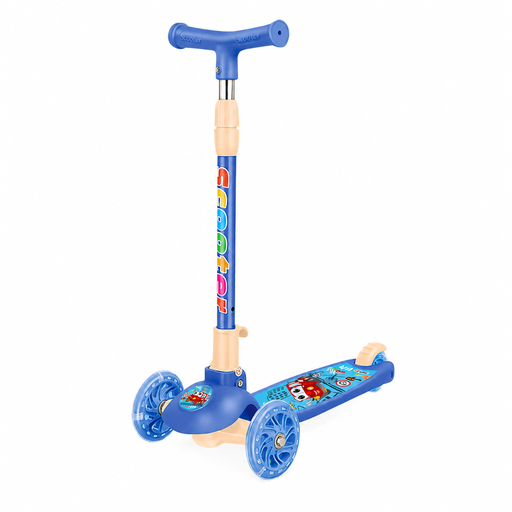
Why this product suits this profile: This model combines three wheels and light-up wheels with a folding, height-adjustable design. It is suitable for families looking for a simply equipped children's scooter for play, gifting and leisure time. According to the product title, the style is selected at random.
The product description explicitly mentions foldability and height adjustment. This makes it easier to assess transport and adjustability before buying. The dimensions and weight limit should also be checked on the product page.
Three wheels, light-up wheels and a folding, height-adjustable design; supplied as one piece.

Why this product suits this profile: This model provides several clearly specified features: three handlebar heights, a wide anti-slip deck, lean-to-steer control, a folding function and a rear foot brake. It is aimed at families who want to compare technical details before buying.
The product description distinguishes between wheel lighting and deck lighting and specifies the AA batteries required. The age range, height, weight limit and warnings are also clearly listed.
Three handlebar heights from approximately 61 to 81.5 cm; stated load capacity of around 50 kg; foldable and fitted with a foot brake.
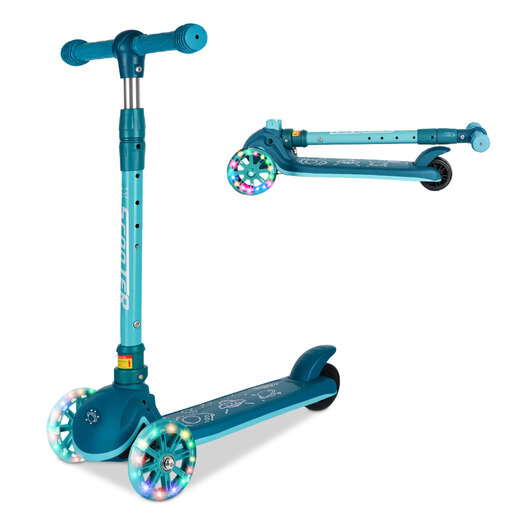
Why this product suits this profile: This folding children's scooter is described as suitable for children aged 3 to 10 and combines light-up wheels, an adjustable handlebar, an anti-slip deck and lean-to-steer control. It is suitable for regular outdoor rides, provided that the surface and use comply with the manufacturer's instructions.
The key features are not described solely in terms of the lighting: foldability, handlebar adjustment and the anti-slip deck are listed separately. This makes it easier to assess the scooter's everyday practicality.
Adjustable handlebar, folding design, light-up wheels and anti-slip deck according to the product details.
We have put together a complete, regularly updated list of products that fully meet these strict selection criteria and the safety regulations applicable in the EU.
A scooter for girls and boys should only be used under supervision and with suitable protective equipment. This should include at least an appropriate helmet, as well as knee and elbow pads depending on the riding environment. For younger children, a clear, level area away from traffic is advisable.
A quick check before every use is recommended:
After playtime, the children's scooter should be stored somewhere dry and clean. Moisture, sand and road salt can put strain on moving parts and surfaces. Small components and batteries should be kept out of the reach of younger children.
Many models are designed as scooters for children from 3 years. However, the age at which a child can actually ride depends on their height, coordination and the manufacturer's instructions. The age recommendation should always be considered alongside the handlebar height, weight limit and warnings.
This depends on the handlebar's adjustment range, the weight limit, the child's growth and how well the scooter is cared for. An adjustable-height scooter can remain suitable for longer if both its lowest and highest settings meet the child's needs. Wear parts such as wheels, brake surfaces and folding joints should be checked regularly.
With many LED light-up wheels, the light is generated by movement, so no batteries are needed. Additional LED lighting in the deck, however, may require batteries. The relevant product description should therefore be checked carefully before buying.