Formation-flying practice with a joystick
If you already have a joystick and want to control the throttle separately, the feel and resistance of the lever are important factors. Extra axes matter less if you don’t need them.


If you already have a suitable joystick, a standalone throttle is a natural place to start. Check that its travel and resistance suit the throttle adjustments you want to practise. A compact twin throttle, a desk-mounted model or a connectable HOTAS set each solves different space and handling challenges. However, manufacturers’ descriptions of their mechanisms are no proof of better flight performance.
If you already have a joystick and want to control the throttle separately, the feel and resistance of the lever are important factors. Extra axes matter less if you don’t need them.
You’ll need to position or secure both the throttle and joystick on a limited surface. Check whether the model is freestanding, needs to be mounted to the desk or can be connected to the joystick.
If you don’t have a joystick either, compare a complete set with buying individual devices. Check that the platform version on offer is compatible with your simulator.
Suitable if: You already have a joystick and want to control the throttle with your left hand along a linear path.
Consider: Allow space for the base and the lever’s full range of travel. Thrustmaster specifies 80 mm for both the TWCS and Sol-R 6. The TWCS has adjustable resistance, while the Sol-R 6 has configurable detents.
Suitable if: You can make use of two throttle axes or adjustable detents, and have room for the intended setup or mounting method.
Consider: “Mini” doesn’t automatically mean the device can sit unsecured on your desk. VKB describes the STECS Mini (Mk.II) as requiring desk mounting, while the Mini Plus (Mk.II) has a steel base plate with anti-slip pads.
Suitable if: You need a joystick as well as a throttle and want to arrange both as one unit when space is limited.
Consider: According to Thrustmaster, the T.Flight Hotas One throttle can be used separately or attached to the joystick. Check that the platform version and the controls on both parts suit your setup.
Suitable if: You want to assign separate levers to multiple engines or other aircraft functions.
Consider: More levers aren’t automatically more useful for formation practice. Logitech G specifies adjustable mounting clamps; check the space at the edge of your desk and the axis assignments in your simulator.
| Criteria | What to check before buying | Who it matters to most |
|---|---|---|
| Precise throttle control | Check the lever travel, adjustable resistance and any detents across the range you need. | When I practise making small throttle adjustments repeatedly, I want to be able to move the lever with control throughout the relevant range. Around 29% of consumers put precise control first. |
| Footprint and mounting | Measure the available desk space and room at the desk edge; check the intended mounting method. | At a small desk, I need a setup that leaves room for both the throttle and joystick. Around 29% of consumers prioritise space and a secure base above all else. |
| Compatibility with existing controls | Check whether it’s a standalone device or a set, the platform version and the axis assignments in your simulator. | If I already own a joystick, I don’t want to buy another one unnecessarily, and I need a device that works with my setup. Around 24% of consumers prioritise compatibility with their existing controls. |
| Setup effort | Check the mounting requirements, what’s included and how to assign the axes you want in your simulator. | When setting things up, I only want to deal with the functions and add-ons I’ll actually use. Around 18% of consumers prioritise an easy start and a straightforward setup. |
For desk use, VKB recommends mounting the STECS Mini (Mk.II) through its designated holes. The Mini Plus (Mk.II), by contrast, is described as having a steel base plate and anti-slip pads for use on a desk.
Before buying, decide whether you can and want to secure a base to your desk.
Manufacturers’ specifications describe different axes and detents, not their independently measured effect on formation flying.
Choose the number of levers to suit the aircraft you’re simulating, and check that detents won’t interrupt the throttle range you use most.
The TWCS is sold as a standalone throttle, while the T.Flight Hotas One combines a joystick and throttle.
First check which flight controls you already own and whether you need a standalone device or a set.
The models mentioned include standalone sliding throttles and a HOTAS set.
The STECS Mini (Mk.II) and Mini Plus (Mk.II) are configurable throttles with different requirements for desk use.
VIRPIL describes the CDT-VMAX as a PC throttle with two throttle axes and an adjustable mechanism.
The Flight Throttle Quadrant is designed for users who want to assign several levers to different axes.
The products below are flight controls with an integrated throttle function. They are yokes or joysticks, not standalone throttles, so choose one only if this type of design suits your setup.
 No image available
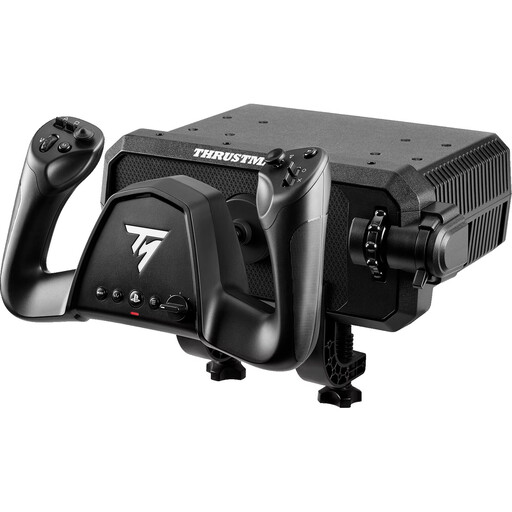
A yoke with an integrated throttle lever, not a standalone throttle; suitable if you’re looking for this type of flight control.
Listed in the product title: 7 axes, 24 action buttons, 180° rotation, and PS5 and PC compatibility.
 No image available
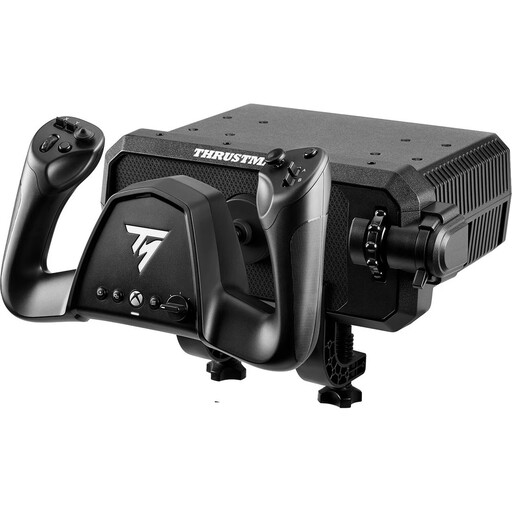
A yoke with an integrated throttle lever, not a standalone throttle; check that this type of design and platform version suit your setup.
Listed in the product title: 7 axes, 24 action buttons, 180° rotation, and PC and Xbox Series X compatibility. It needs to be placed in a stable, secure position.
 No image available
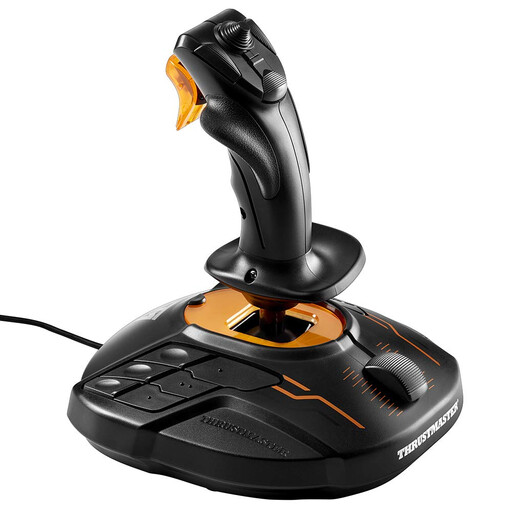
A flight joystick with throttle control, but not a standalone throttle. Choose it only if an integrated throttle control suits your setup better than a separate lever.
Not necessarily. If you already have a joystick and want to control the throttle separately, you can choose a standalone device. If you don’t have a joystick either, a HOTAS set is another option. Check that the controls work with your simulator.
For desk use, VKB recommends securing the STECS Mini (Mk.II) through its designated holes. The Mini Plus (Mk.II) is described as having a steel base plate and anti-slip pads for use on a desk.
First assign the throttle axis in your simulator and check its full input range. If your model offers these settings, adjust the resistance or detents to suit the range you want to use. This doesn’t establish any proven training benefit.
For goods bought from traders in the EU, Your Europe describes a legal guarantee of at least two years from the date you receive them. This is separate from any additional manufacturer’s warranty; purchases from private individuals are treated differently.
No. The Federal Network Agency explains that by applying the CE marking, the manufacturer declares, under its own responsibility, that the relevant legal requirements have been met. It doesn’t demonstrate independently measured precision or suitability for formation practice.