Practising crosswind landings without rudder controls
If you want to practise virtual crosswind landings, first work out how you control the ailerons and rudder. Check your whole control setup before adding just a throttle quadrant.


A throttle quadrant adds thrust control for virtual crosswind landings, but it doesn’t automatically replace aileron and rudder inputs. If you already have the right control axes, choose a quadrant to suit your aircraft and preferred lever layout. If not, a set with additional flight controls may be a better option. Set up the multi-monitor view in your simulator, not on the throttle quadrant.
If you want to practise virtual crosswind landings, first work out how you control the ailerons and rudder. Check your whole control setup before adding just a throttle quadrant.
If your aileron and rudder controls are already set up, you can choose an additional throttle quadrant based on the functions you want to assign to it for the aircraft you fly most often.
If you want to set up your approach view across several screens, plan a separate space for the throttle quadrant. The monitor view and the input device are two separate decisions.
First, check whether your existing devices cover all the control axes you need. Then you can coordinate the lever layout, simulator settings and space requirements.
These figures relate to consumers choosing a throttle quadrant or a system that includes one for this multi-monitor setup; each figure reflects their main consideration.
| Priority | What to check before buying | Who should pay particular attention |
|---|---|---|
| Aileron and rudder controls | Check which control axes you already have and how they’re assigned. If you’re buying a set, check which additional rudder inputs it includes. | If you don’t yet have suitable aileron or rudder controls, you’ll need to plan your entire control setup. Around 33% of consumers focus above all on covering these inputs for their practice scenario. |
| Levers and aircraft assignments | List the functions you need for the aircraft you fly most often, then check the number of levers, detents and simulator assignments. | If you switch between aircraft types, the levers and their assignments should suit the way you prefer to operate them. Around 27% of consumers prioritise throttle assignments that suit their aircraft. |
| Multi-monitor view | Check the guide for the simulator version you use: Microsoft Flight Simulator 2020 describes additional render windows as an experimental feature, while the X-Plane 12 manual explains settings for monitor offsets. | If you want to set up your approach across several screens, you’ll need suitable views regardless of your throttle quadrant. Around 20% of consumers prioritise a multi-monitor setup. |
| Space and mounting | Check your desk space, desk edge, clamp, and the room needed for your hands and levers to move. When checking the manufacturer’s dimensions, find out whether the mounting plate and clamp are included. | If your monitors and existing controls limit the space available, the quadrant should fit your setup and remain within easy reach. Around 20% of consumers focus first on desk space and mounting. |
Throttle levers don’t automatically replace the aileron and rudder inputs you need for your practice scenario.
Before buying, make a note of the control axes you already have and how you want to operate them. Only then decide between an additional quadrant and a set with more flight controls.
The Thrustmaster TCA Quadrant Airbus Edition has two throttle levers. Disengageable detents don’t change the number of levers; according to Thrustmaster, additional components are available separately.
First decide which functions you need for the aircraft you fly most often, then compare the number of levers, detents and assignments.
The Bravo dimensions given by Honeycomb Aeronautical — 273 × 382 × 198 mm — don’t include the mounting plate or metal clamp.
Also measure the clamp, desk edge, cables and the space needed to move the levers.
The Flight Sim Throttle Quadrant is a separate three-lever add-on for an existing flight control setup.
The TCA Quadrant Airbus Edition is designed for Airbus-style throttle control, while the TWCS Throttle is a different, sliding-style throttle controller.
The Bravo Throttle Quadrant combines configurable levers with an autopilot control panel for a range of simulated aircraft types.
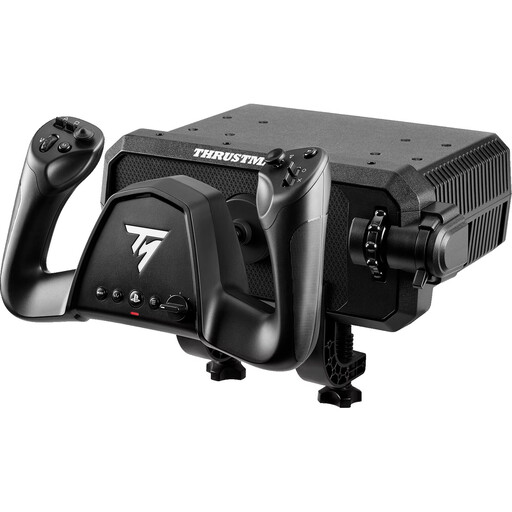
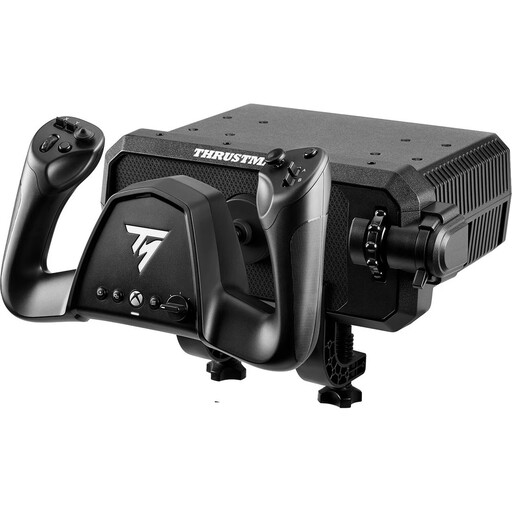
VelocityOne Flight combines a yoke, modular throttle levers and integrated rudder controls.
Integrated yoke and throttle systems for setups where you want to add more flight controls alongside throttle control.
 No image available
This integrated system combines a yoke and throttle levers with rudder controls, making it a good choice if you want to add several flight controls together.
7 axes; 24 action buttons; yoke with 180° rotation.
 No image available
This integrated system combines a yoke and throttle levers with rudder controls, making it a good choice if you want to add several flight controls together.
7 axes; 24 action buttons; yoke with 180° rotation.
No. A throttle quadrant on its own doesn’t automatically cover the aileron and rudder inputs you need. Before adding throttle controls alone, check your existing devices and their assignments for the aircraft you’ve chosen.
No, you set up the multi-monitor view in your simulator. The Microsoft Flight Simulator 2020 documentation describes additional render windows as an experimental feature, while the X-Plane 12 manual explains settings for monitor offsets. Check the guide for the simulator version you actually use.
Check the assignment of every required axis in your simulator, and look for any conflicts. In PC mode, the yoke base and quadrant appear as separate devices according to Turtle Beach Support, so you’ll need to check both profiles.
For a distance purchase of goods that is generally eligible for cancellation, you have a 14-day withdrawal period in the EU from the date of delivery; statutory exceptions apply. The EU’s Your Europe guidance also explains that faulty goods bought from a trader are covered by a statutory guarantee of at least two years from receipt. These rights are separate from any additional manufacturer’s warranty.
No. Buying a throttle quadrant or setting up a home simulator doesn’t automatically mean the time will count towards your training. EASA covers Flight Simulation Training Devices in the context of regulated training. If you want your practice time to count, check the requirements for your specific training goal with your approved training organisation.