
Lieferung heute & morgen

Qualitätsgarantie
App herunterladen
A timer switch is a practical device for automating the power consumption of electrical appliances. By scheduling when outlets turn on and off, it provides precise control over lighting, home appliances, and garden systems. This not only enhances home comfort but can also help reduce energy consumption by selectively eliminating standby power draw from devices. Choosing the right model depends on the specific requirements of the application and the desired level of programming flexibility.
The decision to purchase a plug-in timer should be based on an analysis of its technical parameters. The key distinguishing features are the operating principle, the intended location, and the available programming options.
The most fundamental distinction lies in the time-setting technology.
The planned location of use is a critical criterion that determines the material composition and safety features.
The complexity of the control task defines the requirements for the programming options. While a mechanical timer is limited to a daily repeating 24-hour cycle, a programmable digital version allows for the configuration of up to 20 or more individual on/off times per week.
The maximum switching capacity, specified in watts (W), is a safety-critical feature. It indicates the maximum electrical load the timer can handle. A common value is 3680 W at 16 A, which is sufficient for most household appliances like coffee makers, lamps, or pumps. For high-power appliances such as space heaters or large tools, compatibility must be checked to prevent an overload.
Based on an analysis of technical specifications and practical benefits, we present two models that cater to different user profiles.
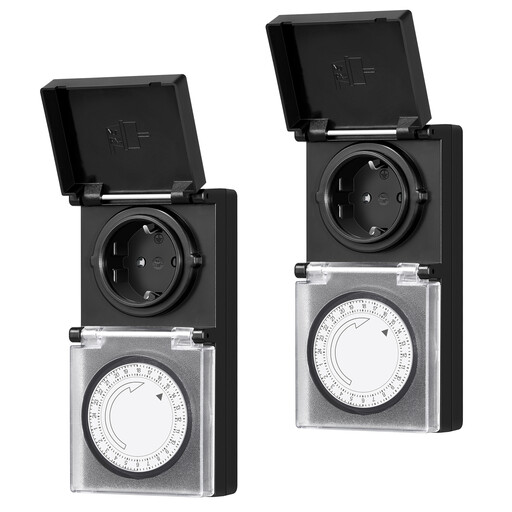
Why we recommend this product: This model combines the simplicity of mechanical operation with the robustness required for outdoor use. The weather-resistant plastic construction and the waterproof cover with a rubber sealing ring (protection class IP44) ensure reliable performance in gardens and on patios. The operation is purely analogue and therefore intuitive.
Advantages:
Who it's for: Users looking for a straightforward and durable solution for recurring daily tasks outdoors, such as for garden pumps, pond filters, or seasonal lighting.
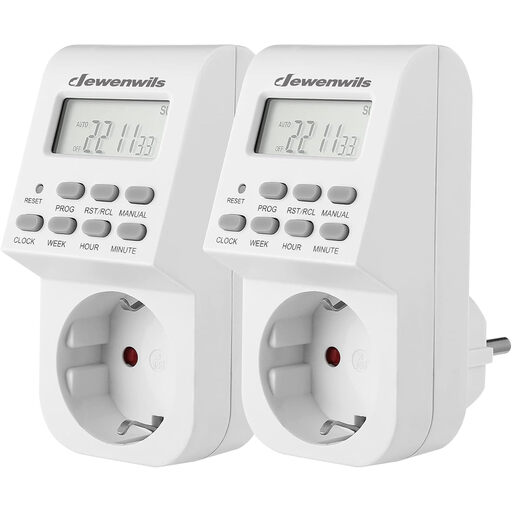
Why we recommend this product: This digital timer offers a high degree of precision and flexibility for indoor automation. With up to 20 programmable on/off schedules per week, it enables complex and day-specific timing. Features like automatic daylight saving time (DST) adjustment enhance user convenience.
Advantages:
Who it's for: Users who need precise, to-the-minute, and day-specific control for various indoor devices and value advanced features.
Automating the home with timer switches is one aspect of preparing for different seasons, such as controlling Christmas lights in winter. As part of seasonal preparations, appropriate gear for the family is also relevant. For example, a warm kids' scarf can provide comfort during the colder months.
1. What is the difference between a mechanical and a digital timer? A mechanical timer is set manually using a dial and pins for a 24-hour cycle. It is simple and robust. A digital timer is programmed via a display and buttons, allowing for to-the-minute settings and often complex weekly schedules.
2. How much power does a timer switch itself consume? The own power consumption of a plug-in timer is very low. Mechanical models typically consume about 1 watt during operation. Digital models also require a small amount of power, under 1 to 2 watts, to supply the display and internal memory. This consumption is negligible compared to the savings achieved by avoiding standby power losses.
3. Can I use any timer switch outdoors? No. Only timers explicitly marked for outdoor use should be used in open-air environments. These models must have at least an IP44 rating to be protected against splashing water. Using an indoor timer outdoors poses a significant safety risk.