For one quick portion
If you mainly want to eat a tin of ready-cooked beans soon, it’s worth asking whether you really need an extra appliance that cooks slowly.


For a single tin of ready-cooked butter beans that you want to serve soon, a saucepan or microwave you already own is usually more practical than a slow cooker. The US Department of Agriculture’s Food Safety and Inspection Service (USDA FSIS) advises against reheating chilled leftovers in a slow cooker. Germany’s Federal Institute for Risk Assessment (BfR) recommends heating food to at least 70 °C throughout for at least two minutes. A slow cooker is a better fit if you regularly make whole dishes using slow cooking, or want to keep food warm once it has been heated. In that case, consider portion size, cleaning and maintaining a safe temperature while keeping food warm.
If you mainly want to eat a tin of ready-cooked beans soon, it’s worth asking whether you really need an extra appliance that cooks slowly.
If you regularly slow-cook meals for one or two people, a smaller pot capacity and somewhere to keep the appliance in a shared kitchen are important considerations.
If you eat with others or want to serve a fully heated meal at different times, choose a suitable pot size and make sure the food reaches the required temperature while being kept warm.
A good fit if: You want to heat one tin soon and eat it straight away.
Consider: You won’t need another appliance, but the food still needs to be heated thoroughly enough.
A good fit if: You regularly slow-cook small stews or other meals for one or two people.
Consider: A smaller model has less capacity than a 3.5-litre appliance, but it still heats slowly and needs space on the worktop and in storage.
A good fit if: You regularly make several portions of a slow-cooked dish.
Consider: The extra capacity takes up more room in a shared kitchen and isn’t necessarily useful for heating a single tin.
A good fit if: You regularly use other cooking functions as well as slow cooking.
Consider: More functions and a larger appliance don’t guarantee that the slow-cook programme will reheat cold leftovers quickly or safely.
| What matters | What to check when buying | Who this matters to |
|---|---|---|
| Heating food soon | Check whether a saucepan or microwave is enough for a single portion. The USDA FSIS advises against using a slow cooker to reheat chilled leftovers. | If I only want to eat one tin of beans, I want to heat it thoroughly without having to buy an appliance for slow cooking. Around 36% of consumers say heating food promptly is their main concern. |
| Small portions and storage space | Compare the pot capacity with the meals you actually make, and check the appliance’s dimensions and where you’ll store it. | In a shared kitchen, I need an appliance that can be stored away and suits the small portions I cook regularly. Around 29% of consumers prioritise small portions and limited storage space. |
| Cleaning | Check the cleaning instructions for the pot, lid and accessories separately. Removable doesn’t automatically mean dishwasher-safe. | When I share an appliance with others, I want to be able to clean and put away the parts easily. Easy cleaning is the main concern for around 21% of consumers. |
| Serving later | A keep-warm setting is no substitute for heating food thoroughly. The BfR recommends keeping food at a minimum of 60 °C throughout while it is being kept warm. | If housemates eat at different times, I want a meal that has already been heated to stay warm until it’s served. Around 14% of consumers prioritise serving food at different times. |
A keep-warm setting doesn’t prove that previously cold food has been heated quickly enough or thoroughly throughout. The USDA FSIS advises against reheating chilled leftovers in a slow cooker.
Heat cold leftovers thoroughly first in a saucepan, microwave or oven. Use the keep-warm function only for food that has already been heated, and check its actual temperature.
The long heating-up time can tie up the appliance and shared worktop for longer.
Russell Hobbs lists a 2-litre capacity for up to two portions for the 25570-56, while Tristar lists a 3.5-litre capacity for up to four portions for the VS-3915. More capacity doesn’t automatically make it more practical to heat a single portion promptly.
Choose a size to suit the meals you cook regularly, and check the available worktop and storage space before buying.
A larger appliance takes up more room in a shared kitchen.
Russell Hobbs describes the 25570-56 as having a removable ceramic pot, but doesn’t state that its accessories are dishwasher-safe. For the 22740-56, the manufacturer describes the cooking pot as dishwasher-safe.
Check the manufacturer’s instructions for the exact model and each individual part before putting anything in the dishwasher.
Depending on the model, some parts may need to be washed by hand.
The slow cookers mentioned range from a 2-litre model for smaller meals to a 3.5-litre version for larger portions.
The VS-3915 is a 3.5-litre slow cooker for several portions, not a model specifically designed to heat a tin quickly.
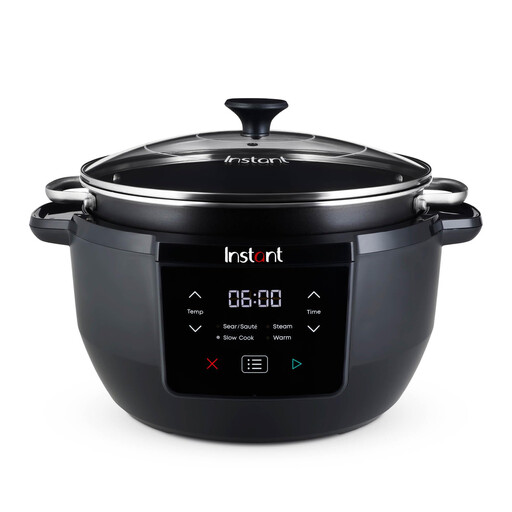
The 5.7-litre Duo Plus WhisperQuiet is a multicooker option for anyone who regularly uses other cooking functions as well as slow cooking.
This selection includes slow cookers and multicookers for smaller and larger meals, as well as appliances with additional cooking functions. For heating a single tin quickly, a saucepan or microwave you already own is still the more straightforward choice.
 No image available
An option if you’d like to use a mode described as being for quick cooking, as well as slow cooking.
2.6 litres; two manual heat settings; non-stick inner pot. The description also lists a 1,000 W quick-cook mode and a detachable power cord.
For chilled leftovers, the USDA FSIS advises against using the slow-cook function to reheat them. Check the specific listing for the CE mark and the required product documentation.
 No image available
This set may suit you if you want to prepare several dishes. Its stated total capacity is on the large side for a single tin.
According to the product description, the set includes a 2.5-litre main pot and four 0.4-litre inner pots. Steaming and soup-making are also listed.
For chilled leftovers, the USDA FSIS advises against using the slow-cook function to reheat them. Check the specific listing for the CE mark and the required product documentation.
 No image available
An option if you regularly prepare larger quantities or meals in advance and want to use additional cooking functions.
7 litres; described as serving up to ten portions. Steaming, searing and keeping food warm are also listed.
A keep-warm function is no substitute for safely reheating cold leftovers. Check the specific listing for the CE mark and the required product documentation.
Use suitable cookware for heating food, rather than the tin itself. For any contents left in an opened tin, the consumer advice organisation Verbraucherzentrale recommends transferring them to a food-safe container with a lid.
No. Keeping food warm and reheating it aren’t the same thing. The USDA FSIS advises against reheating chilled leftovers in a slow cooker; heat them thoroughly first. The BfR recommends heating food to at least 70 °C throughout for two minutes, then keeping it at a minimum of 60 °C throughout while it is being kept warm.
Before buying, check that you have enough worktop space, an accessible socket and the instructions for the specific model. Tristar’s user manual warns that surfaces can get hot and says not to immerse the cord, plug or appliance in water. This doesn’t mean the appliance has general approval under your household rules.
Appliances within the scope of EU Low Voltage Directive 2014/35/EU must meet safety requirements. Before making them available for sale, retailers must check, among other things, the CE mark and the required documentation. This is set out in the consolidated version published on EUR-Lex on 30 May 2026. It doesn’t mean that a particular appliance for sale meets the requirements, so check the details for the specific listing.