Batch cooks preparing several meals
You make a bean stew with other ingredients for several portions, so you need to consider both the right pot size and how to cool the finished food.


For pre-cooked butter beans in a tin, you generally don’t need a slow cooker just to heat them up. The Federal Centre for Nutrition explains that pulses in tins or jars are already cooked and can be eaten straight away. If you regularly make a stew for several meals, a slow cooker could be a good fit, provided the full recipe fits in the pot. Cooling and reheating the finished portions later are considerations whatever cooking method you use.
You make a bean stew with other ingredients for several portions, so you need to consider both the right pot size and how to cool the finished food.
You mainly want to heat pre-cooked beans quickly and are weighing up whether an extra appliance is worthwhile for this simple task.
You often batch cook and want to organise the cooking time, cleaning and safe storage of finished portions.
First decide whether you simply want to heat pre-cooked beans or regularly slow-cook a whole stew. For larger batches, it’s worth taking a closer look at pot capacity, timer settings and how you’ll organise the finished portions.
Suitable if: you simply want to heat pre-cooked tinned beans for a meal you’ll be having soon.
Things to consider: You don’t need an extra slow cooker for this. A slow cooker’s longer, largely hands-off cooking process isn’t needed for this task.
Suitable if: you regularly slow-cook smaller stews and the recipe quantity fits the pot and its fill guidelines.
Things to consider: The capacity in litres alone doesn’t tell you how much finished butter bean stew will fit in the pot.
Suitable if: you cook beans with other ingredients for several meals and need to set the cooking time.
Things to consider: A timer or keep-warm function doesn’t prove that the food has reached the recommended temperatures throughout. Larger quantities also need room to cool in shallow containers.
| Buying consideration | What to check | Who should consider this? |
|---|---|---|
| Batch size that suits your needs | Compare the total amount of beans, liquid and other ingredients with the usable capacity and fill guidelines. For example, manufacturers list a capacity of 3.5 l for the Tristar VS-3915, 4.5 l for the VS-3920 and 6 l for the Russell Hobbs MaxiCook 22750-56. | If I’m cooking for several meals, the pot needs to hold the full quantity of ingredients. For around 33% of consumers, batch size is the top priority. |
| Quick heating | Before buying, decide whether you’re really going to cook a whole dish for longer or simply heat pre-cooked beans. | If I just want to heat a tin quickly, I don’t want to buy another appliance with a long cooking cycle. Around 27% of consumers prioritise quick heating. |
| Storing food and eating it later | For larger quantities, the Federal Institute for Risk Assessment (BfR) recommends cooling them to below 7 °C in shallow containers within a few hours. When reheating, heat to at least 70 °C for two minutes throughout; when keeping food hot, maintain at least 60 °C throughout. | If I’m preparing several portions, I need to plan space for cooling and refrigeration. Around 27% of consumers prioritise safe storage and reheating later. |
| Ease of use and cleaning | Check the exact model number to see whether you can set the cooking time and which parts are dishwasher-safe according to the instructions. | I want the cooking time and cleaning to fit into my routine, rather than choosing features that only look good on paper. Around 13% of consumers put ease of use and cleaning first. |
Tinned beans are already cooked. A slow cooker’s longer cooking process is usually unnecessary if you just want to heat them up.
Before buying, decide whether you simply want to heat beans or regularly batch-cook a whole stew.
An extra appliance takes up worktop and storage space, without offering any proven benefit for simply heating food.
A function button doesn’t measure the temperature throughout a portion. Keeping food warm is no substitute for cooling it properly or reheating it thoroughly.
Cool prepared portions safely. When reheating later, check the temperature of the food and only use the keep-warm function for food that is already hot enough. The BfR recommends reheating food to at least 70 °C for two minutes throughout, and keeping it hot at a minimum of 60 °C throughout.
A general description such as ‘digital slow cooker’ doesn’t give you the exact model number, which may mean important variations are unclear.
Compare the full model number, intended use, electrical specifications and country of sale before choosing a specific listing.
The manufacturer lists models in different sizes: the Compact Home 25570-56 has a 2 l capacity, while the MaxiCook 22750-56 holds 6 l and has an adjustable cooking time.
According to the manufacturer, the manual VS-3915 holds 3.5 l, while the digital VS-3920 offers 4.5 l and a timer.
The manufacturer describes the digital CSC113X as a 3.5-l model with an adjustable cooking time. The product page viewed is for the UK market.
The manufacturer describes the Superior Slow Cooker as a 7.1-l model with slow cooking, steaming, sautéing and keep-warm functions. The manufacturer’s page refers to the UK version.
The products below cover everything from smaller to larger slow-cooker batches. They’re mainly worth considering if you regularly slow-cook whole stews; you generally don’t need an extra slow cooker just to heat a tin.
 No product image available
For a smaller, slow-cooked stew: this model has a 2.6 l capacity and two manual heat settings.
With a steaming function and non-stick finish.
 No product image available
For dishes in different portion sizes: the total capacity is 4.1 l, with a 2.5-l main pot and four 0.4-l pots.
The appliance has two heat settings and a rotary control. It can release a lot of steam during use, so wait before opening it to avoid scalds.
 No product image available
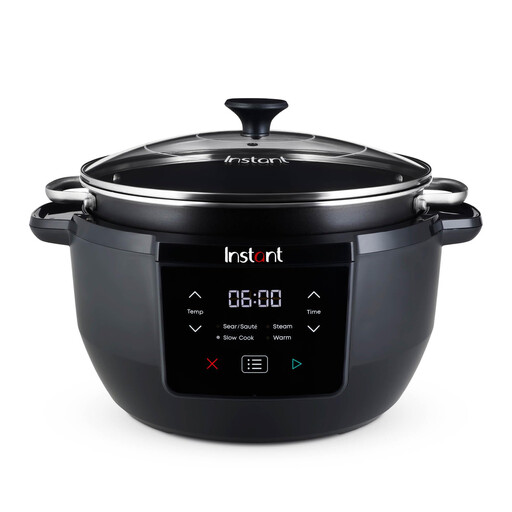
For larger slow-cooked batches: this model has a 7 l capacity, with adjustable time and temperature settings.
According to the product description, the removable inner pot isn’t suitable for use in an oven or on a hob. Temperatures above 175 °C may damage the coating.
No. The usual pre-cooked beans in tins or jars don’t need to finish cooking in a slow cooker. The Federal Centre for Nutrition explains that these pulses can be eaten straight away; this isn’t guidance for raw or dried beans.
Divide larger quantities between several shallow dishes to cool. The Federal Institute for Risk Assessment recommends cooling leftovers to below 7 °C within a few hours, storing them in the fridge and eating them within two to three days.
A keep-warm function doesn’t prove that chilled food has been thoroughly reheated. The BfR recommends heating food to at least 70 °C for two minutes throughout; to keep it hot afterwards, maintain at least 60 °C throughout.
The relevant regulations apply to new electrical equipment that falls within the applicable voltage range and is made available on the German market. Check the labelling and manufacturer’s information for the specific version being sold. According to the EU, the CE mark is the manufacturer’s declaration that the relevant requirements have been met; it is not an independent safety test of the specific appliance.
No. Statutory warranty rights are against the seller, while a guarantee is an additional voluntary service subject to its own terms. The consumer advice centre recommends keeping the two distinct and checking spare parts and service information when considering a specific purchase.