
Lieferung heute & morgen

Qualitätsgarantie

Willkommens-Angebote freischalten: KOSTENLOSE Lieferung | Bis zu 80 % RABATT | Kostenlose 30-Tage-JoyPlus-Testphase
App herunterladen
A narrow hallway and scattered shoes are a common challenge in many homes. Not only does the clutter look messy, but it can also become a tripping hazard. A tip-out shoe cabinet is often the ideal solution for creating order without sacrificing valuable space. As a Joybuy Product Recommendation Officer, my role is to give you objective information and practical criteria so you can make an informed decision for your shoe storage. This article introduces various models and their features to help you with your selection.
Before you decide on a model, a few considerations are important. The right choice depends on your available space, the number of shoes you own, and your interior design style.
The key advantage of a tip-out shoe cabinet is its shallow depth. Precisely measure the intended space in your hallway or entryway. Consider not only the width and height but also the depth when the compartments are open. A narrow shoe cabinet should not obstruct the walkway. Standard models often have a depth of just 17 to 25 cm, making them ideal for tight areas.
Consider how many pairs of shoes you need to store. Capacity is usually stated in pairs of shoes but is often based on a standard size. Large shoes or boots will require more space. Some models offer adjustable or removable dividers in the tip-out compartments. This allows you to accommodate taller footwear like ankle boots. A slim shoe chest with multiple compartments helps organize shoes for the whole family.
The material affects not only the durability but also the aesthetic. Models made from MDF or particleboard are often more cost-effective and available in many colours and finishes, making them a great choice for a modern shoe cabinet. Solid wood is more robust and gives the room a warmer, more high-end feel. Ensure the design matches the rest of your hallway furniture to create a cohesive look.
Here is a selection of different solutions, each suited for various needs due to their specific features.
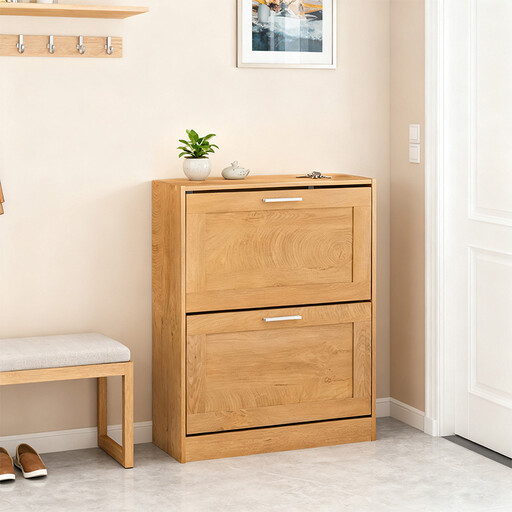
Why it stands out: This model is a classic example of a tip-out shoe cabinet. With a depth of just 23 cm, it fits into even the narrowest hallways. The closed front creates a tidy look, and the top surface provides extra space for keys, mail, or decor.
Advantages:
Who it's for: Individuals looking for a classic, unobtrusive, and highly space-saving solution for their entryway who want to keep their shoes completely out of sight.
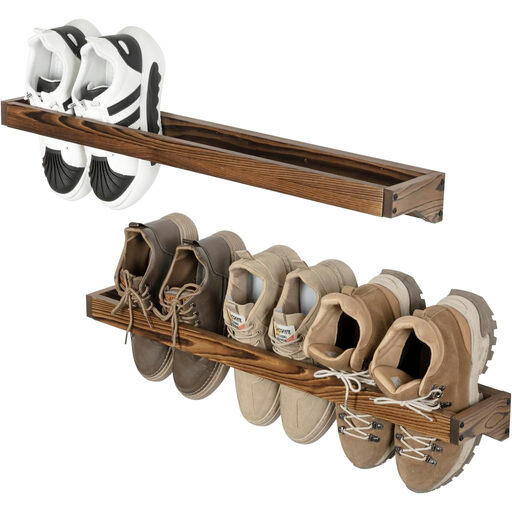
Why it stands out: This solution takes a different approach. Instead of hiding shoes, it displays them in style. The wall-mounted design frees up all your floor space, making the room feel larger and easier to clean. The solid wood with a rustic finish adds a warm, homely accent.
Advantages:
Who it's for: Users who prefer a decorative solution and want to keep their hallway floor completely clear. Ideal for lovers of natural materials and rustic design.
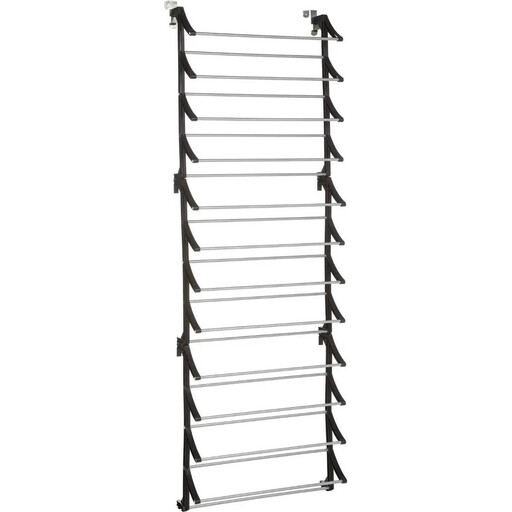
Why it stands out: When maximum capacity in a minimal footprint is what you need, this over-the-door rack is an interesting option. It utilizes the often-unused space on the back of a door, offering room for up to 36 pairs of shoes.
Advantages:
Who it's for: Families or individuals with a large number of shoes who are looking for a purely functional and space-saving storage solution for a utility closet, wardrobe, or the inside of a bedroom door.
The products featured here cover a range of needs—from the classic tip-out shoe cabinet to creative wall and door solutions. If you'd like to compare more options that differ in size, material, or design, you might find the perfect model in our broader selection.
Discover Our Entire Range of Shoe Racks
A defining feature of tip-out shoe cabinets is their shallow depth. Most models are between 15 cm and 30 cm deep. This makes them an ideal solution for very narrow hallways where a conventional shoe cabinet would take up too much space. For example, the featured SoBuy model has a depth of 23 cm.
That depends on the specific model. Standard tip-out cabinets are primarily designed for flat shoes like sneakers, ballet flats, or dress shoes. However, some models, like the SoBuy cabinet shown here, feature removable or adjustable dividers. This allows you to customize the storage space to fit ankle boots or shoes with a higher shaft. For tall boots, open rack systems are often a better fit.
The term shoe cabinet is an umbrella term for furniture designed for shoe storage. A tip-out shoe cabinet is a specific type of shoe cabinet. Its main feature is the namesake tip-out compartments (or flaps) where shoes are stored at an angle or vertically. This design is what allows for its exceptionally slim construction. In contrast, a general hallway shoe rack might have open shelves or classic doors and is typically deeper.