
Lieferung heute & morgen

Qualitätsgarantie

Willkommens-Angebote freischalten: KOSTENLOSE Lieferung | Bis zu 80 % RABATT | Kostenlose 30-Tage-JoyPlus-Testphase
App herunterladen
Correct tire pressure is crucial for driving safety, fuel economy, and the lifespan of your tires. However, the market for tire pressure gauges is crowded and confusing. Many devices promise more than they can deliver. As your Joybuy Product Recommendation Officer, I'll help you identify the common pitfalls and find the right device for your needs.
Before you make a decision, you should be aware of the three most common problems that lead to unsatisfactory results:
To avoid these mistakes, focus on three essential features that define a reliable automotive pressure gauge.
Precision is the most important criterion. Look for information on calibration standards. One example is the ANSI B40.7 standard, which is divided into various accuracy grades. A device calibrated to such a standard provides a more reliable basis than a product with no information on its measurement accuracy. A digital tire pressure gauge often offers the advantage of a clear display, accurate to one decimal place, which minimizes reading errors.
The connector that attaches to the tire valve must be robust and create a tight seal. Connectors made of brass are generally more durable and seal better than those made of plastic. Also, check for compatibility with your valve. Most vehicles in the US and Europe use Schrader valves. Bicycles or some motorcycles occasionally use Presta valves. A good air pressure gauge for your car should ideally come with adapters for different valve types.
Define your exact needs before you buy:
Here are some product recommendations tailored to specific user groups that meet the quality criteria mentioned above.
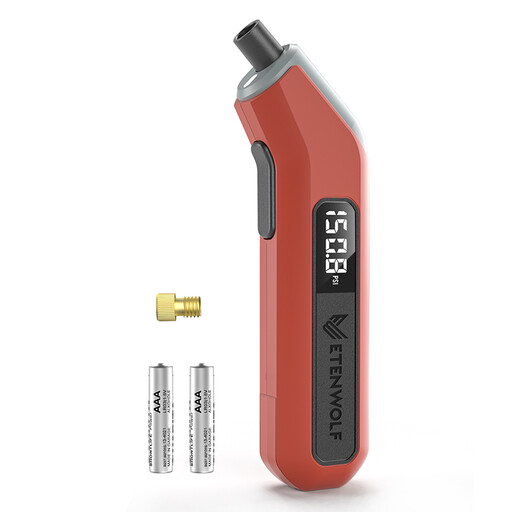
Why This Fits Their Persona: Ideal for drivers looking for a simple yet reliable tool for regularly checking the tire pressure on their car or motorcycle. Fits in any glove compartment and is ready to use instantly.
The digital display provides a clear, unambiguous reading and avoids the parallax errors common with analog gauges. Its compact design focuses on one function: precise measurement.
Bright LED display for excellent readability even in low light. Includes a Presta valve adapter, making it suitable for many types of bicycles as well.
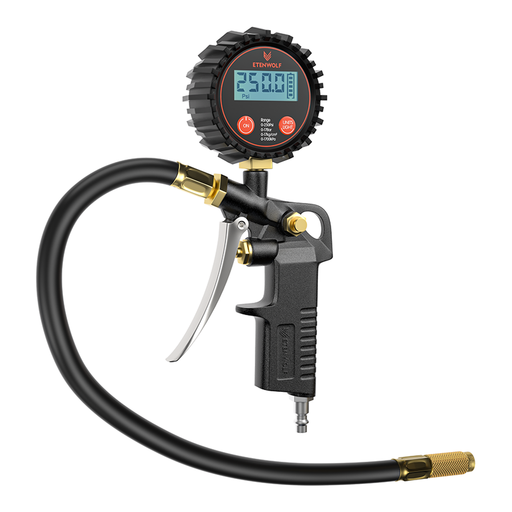
Why This Fits Their Persona: Perfect for users with their own compressor who want to not only measure but also directly and precisely correct tire pressure. Suitable for regular use in the home garage.
Calibration to ANSI B40.7 Grade 2A promises high measurement accuracy. The material combination of brass, rubber, and stainless steel ensures durability and a reliable seal.
Combines measuring and inflating functions in one robust device. The wide measuring range up to 250 PSI (approx. 17 bar) also makes it suitable for vans or RVs.
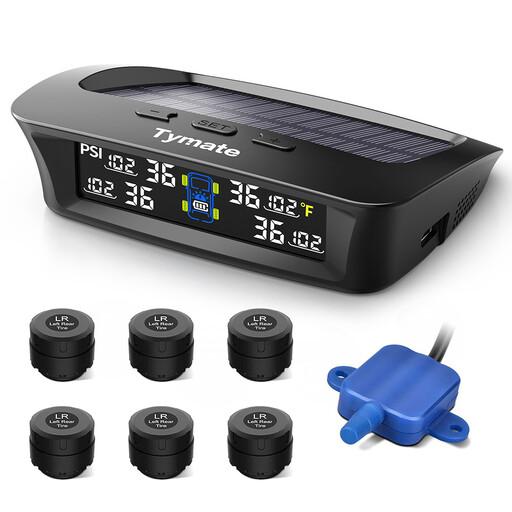
Why This Fits Their Persona: A comprehensive solution for owners of RVs, trailers, or trucks where manually checking all tires is cumbersome. It provides continuous monitoring and increases safety on long journeys.
This system solves the problem of cumbersome individual measurements. It proactively warns of pressure loss or overheating, rather than forcing the driver to rely on sporadic, manual checks.
Continuous real-time monitoring of pressure and temperature for up to 6 tires. Solar-powered display and 6 different alarm modes for comprehensive safety.
We have compiled a complete, up-to-date list of products that fully meet these strict selection criteria and safety regulations.
It is generally recommended to check your tire pressure at least once a month and before any long trip. The check should be done when the tires are cold, as the pressure increases due to heat during driving, which can distort the measurement.
Analog devices use a mechanical display with a needle and a scale. They are often cheaper but are more prone to reading errors and can lose accuracy if dropped. Digital devices display the value on an LCD screen, usually with an accuracy of 0.05 bar (or 0.5 PSI). They are easier to read and often more robust against shocks.
Yes, many devices are universally applicable as long as the valves are compatible. Most tire pressure gauges for motorcycles and cars are designed for Schrader valves. If your bicycle has Presta valves, you will need a gauge with a suitable dual-head connector or a separate adapter, which is often included with many models.