Families who plan breakfasts ahead
If you buy rolls regularly, it helps to match the pack size and number of rolls to what you’ll actually need. Storage and preparation instructions can also help you plan your supplies.


For a toddler’s regular breakfast routine, it’s worth choosing rolls based on pack size, ingredients and how you’ll actually use them, rather than simply buying a large multipack. Germany’s consumer advice centres recommend wholemeal options for children. For each specific roll, also check the allergens, size and texture to make sure they’re suitable for your child.
If you buy rolls regularly, it helps to match the pack size and number of rolls to what you’ll actually need. Storage and preparation instructions can also help you plan your supplies.
When your child is trying wholemeal rolls for the first time, a clear wholemeal label matters as well as whether they enjoy them. Germany’s consumer advice centres point out that “multigrain” alone does not mean a roll is wholemeal.
Check the allergen information for the specific product. For younger children, it’s also important to consider whether the roll can be cut into pieces that suit their chewing and eating abilities.
First, work out how much you’ll actually use. Then choose a type of roll based on the ingredients and your child’s eating abilities.
| What matters | What to check when buying | Who it matters to |
|---|---|---|
| Quantity and supplies | Number of rolls, pack weight and storage or baking instructions. | When I’m planning several breakfasts, I want to buy only as many rolls as we can use. Around 42% of consumers put being able to plan the quantity first. |
| Wholemeal | A clear wholemeal label and the ingredients; if buying loose rolls, ask about the wholemeal content. | When introducing wholemeal rolls to my child, I want to know whether a roll really contains wholemeal ingredients, rather than relying on its colour. This is a priority for around 33% of consumers. |
| Ingredients and texture | Allergen information and whether the roll can be cut to suit your child’s chewing ability. | If my child needs to avoid certain ingredients or still finds firm pieces difficult to manage, I check each roll particularly carefully. These needs are a priority for around 25% of consumers. |
The name and a dark colour alone don’t prove that a roll contains a particular amount of wholemeal flour.
Look for a clear wholemeal label and check the ingredients, or ask at the bakery counter.
Sweet pastries don’t simply serve the same purpose as wholemeal bread or rolls in the breakfast combination described by Germany’s Federal Centre for Nutrition.
If you’re choosing rolls as the basis of breakfast, pair them with something such as fruit or vegetables and a suitable dairy product.
Ingredients vary from one product to another. For example, wheat and cereals containing gluten are listed for a specific EDEKA roll.
For packaged products, check the current label. For loose rolls, refer to the allergen information provided.
Part-baked rolls can be useful to keep in stock, but depending on the product, they may not be ready to eat straight away.
Check the storage and preparation instructions on the pack before planning to serve the rolls for breakfast.
Thawing and baking take extra time.
ALDI SÜD offers freshly baked goods as well as packaged rolls and bread rolls for toasting.
Lidl describes “Unser Brot” as its own bakery range.
REWE lists Kaiser, rye, multigrain and spelt rolls among the options at its in-store bakery.
EDEKA offers products including packaged rolls and part-baked options.
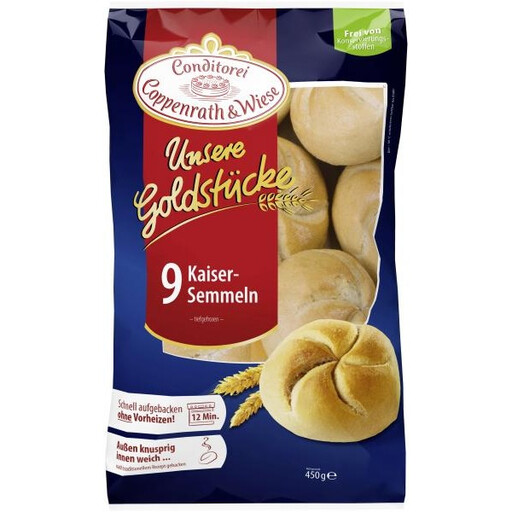
This frozen product may suit you if you want to take rolls from the freezer as needed and allow enough time to bake them before breakfast.
 No image available
The pack contains 9 rolls and weighs 450 g, so you can spread them across several breakfasts. This frozen product must be baked thoroughly before eating, following the instructions on the pack. Afterwards, check that the size and texture are suitable for your child.
Look for a clear wholemeal label, or ask about the wholemeal content if you’re buying loose rolls. According to Germany’s consumer advice centres, “multigrain” doesn’t automatically mean wholemeal, and colour alone isn’t enough to tell.
For regular breakfasts, Germany’s Federal Centre for Nutrition instead recommends wholemeal bread or rolls with fruit or vegetables and dairy products. Don’t assume sweet pastries are equivalent to rolls just because they’re easy to hold.
Adjust the size and texture of the pieces to suit your child’s chewing and eating abilities. kindergesundheit-info gives bread cubes as an example of pieces that can soften quickly with saliva. If your child has particular swallowing difficulties, it’s important to seek individual professional advice.
Check the allergen information for the specific roll and ask if you can’t find it at the counter. In Germany, Section 4 of the Food Information Implementing Regulation sets out how relevant information must be provided for non-prepacked foods. For packaged products, check the current label on the pack.
Follow the storage and preparation instructions for the specific product. Thawing or baking may take extra time before breakfast. Don’t serve part-baked products contrary to their preparation instructions.