When choosing a roll for your toddler’s breakfast, it’s worth checking the ingredients, allergen information and texture – rather than relying on a dark colour or a “multigrain” label. Also check whether it’s easy to split and how much salt it contains per 100 g. Fresh rolls don’t need baking; if you’re buying part-baked rolls, factor the preparation instructions and the time you have in the morning into your decision.
Which criteria matter to different families?
Families looking to introduce wholegrain
If your child is still getting used to a different texture, both clear wholegrain labelling and whether they enjoy it at breakfast matter. The German consumer advice centre recommends wholegrain bread and rolls for children, and suggests introducing them gradually.
Families short on time in the morning
A ready-to-eat roll saves you the time it takes to bake one. If you’d rather keep a supply at home, check what preparation the specific product requires before buying and whether it fits into your morning routine.
Households that need to check allergens
When choosing, check the information for the specific variety, including for loose rolls. Depending on the roll, allergens that must be declared may include more than just cereals containing gluten. The Federal Ministry of Agriculture, Food and Regional Identity explains the requirements for allergen labelling.
What should you look for when buying?
First, check the ingredients and allergen information for the specific variety. Then consider whether the texture and how easy it is to split are right for you, and whether a ready-to-eat roll or part-baked rolls will fit better into your morning routine.
| Criterion | What to check when buying | Who it matters most to |
|---|
| Wholegrain and texture |
Check the wholegrain label and ingredients; see whether the roll is easy to split. |
If my child is still getting used to a coarser texture, I want to choose a clearly labelled variety that they’ll enjoy too. This is the top priority for around 40% of consumers. |
| Preparation in the morning |
Check whether the rolls are ready to eat or need baking; if the latter, read the baking instructions. |
If breakfast needs to be on the table quickly, I need to know whether the rolls have to be baked first. This matters most to around 30% of consumers. |
| Ingredients, allergens and salt |
Check the allergen information for the specific variety and, if provided, the salt content per 100 g. |
If I need to avoid certain ingredients or compare similar rolls by their nutritional information, I need up-to-date product details. This check takes priority for around 30% of consumers. |
Common mistakes when choosing
-
Assuming “multigrain” or a dark colour means wholegrain
The German consumer advice centre points out that “multigrain” usually doesn’t mean wholegrain, and that a dark colour can also come from malt extract.
Check the wholegrain labelling and ingredients, or ask if you’re buying loose rolls. Also make sure your child likes the texture.
-
Looking only at freshness
Freshness doesn’t tell you how much salt a roll contains. The German Nutrition Society lists bread and baked goods as sources of salt in the diet.
When comparing similar packaged products, use the salt information per 100 g for each one, rather than going by colour or variety name.
-
Only thinking about cereals containing gluten when buying loose rolls
Which other allergens are relevant depends on the variety. For example, Kamps lists soya as well as cereals containing gluten in one of its bread rolls.
If you need to avoid an allergen, check the current information for the specific roll and ask when buying loose, rather than assuming it has the same recipe as a similar variety.
-
Planning for part-baked rolls as if they’re ready to eat
Part-baked rolls and roll dough may need to be prepared according to the pack instructions before serving. Make sure you know whether the variety you’ve chosen is ready to eat.
Check the baking instructions and preparation time before you buy. If there’s no time for baking in the morning, a ready-to-eat roll may be a better choice.
Baking takes extra time and requires a suitable way to bake the rolls.
Brands and retailers to help you choose
REWE
REWE has a “Fresh from the bakery” category featuring a range of rolls and regional baked goods.
- You can browse the selection by location.
- The range varies by location; check the ingredients and allergens for the specific variety.
EDEKA / GUT&GÜNSTIG
EDEKA lists both rolls and products that need baking at home, with information about individual products.
- Nutritional information, allergens and preparation instructions are listed for some products.
- Information on product pages may differ from the packaging; always use the labelling on the product you buy to make your choice.
Lidl – Unser Brot
Under “Unser Brot”, Lidl describes its in-store baked goods, including spelt and multigrain options.
- A range of baked goods is available.
- A general description of the range doesn’t confirm the wholegrain content, ingredients or allergens of a particular roll.
ALDI
ALDI Nord describes fresh in-store baked rolls, while ALDI SÜD also sells breakfast rolls for baking at home.
- Depending on the product, you can choose between ready-to-eat rolls and ones that need baking.
- The range and product information vary by variety and location. ALDI SÜD also notes that one product may differ depending on the supplier.
Kamps
Kamps’ delivery service lists, among other things, bread rolls and multigrain rolls in its Krefeld range.
- Specific allergen information is available for the varieties listed there.
- The regional delivery range doesn’t tell you what’s available or what ingredients are used at every Kamps bakery.
Der Meisterbäcker
This Hesse-based business describes its own range of speciality breads and rolls.
- The business says it uses long fermentation and natural sourdough for these speciality products.
- These details apply to the business named here, not to other bakeries with similar names. Check the ingredients and allergens for the specific product.
Part-baked rolls at Joybuy
This product is a part-baked option. It could suit a breakfast you can plan ahead, provided you have somewhere to bake it and enough time in the morning. Check when serving whether the roll is easy to split as you’d like.
 No image available
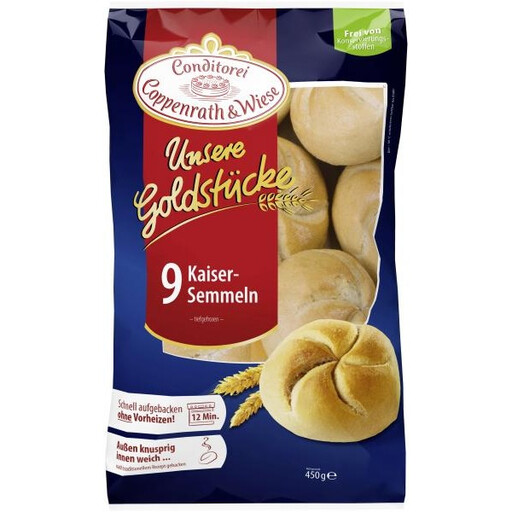
Coppenrath & Wiese Our Gold Pieces Kaiser rolls, 9 pieces, 450 g
A part-baked option if you can fit the preparation in before breakfast. The pack contains 9 Kaiser rolls, weighing 450 g in total. Check the current labelling for ingredients, allergens and salt, along with the baking instructions. You’ll be able to see whether the texture and how easy it is to split suit your child once the roll is prepared.
View at Joybuy
Frequently asked questions
Does a roll for a toddler’s breakfast have to be wholegrain?
The German consumer advice centre recommends wholegrain bread and rolls for children. If your child isn’t keen on the texture yet, introducing them gradually may help. The label “multigrain” alone doesn’t confirm that a roll contains wholegrain.
Where can I find allergen information for loose rolls?
Information about allergens that must be declared must also be available for loose goods, as explained by the Federal Ministry of Agriculture, Food and Regional Identity. If the details aren’t easy to find, ask the retailer for information about the specific variety.
Can I serve part-baked rolls without baking them?
It depends on the product. If it’s intended to be baked at home, follow the pack instructions before serving. When shopping, check whether the rolls are ready to eat or how long they take to prepare.
How can I compare the salt content of different rolls?
For similar products, compare the salt content per 100 g. The German Nutrition Society lists bread and baked goods as sources of salt in the diet; colour and variety name don’t tell you how much salt a roll contains.


