When choosing a cereal bar for a toddler, start by checking whether the specific product is suitable, rather than simply counting how many bars are in the pack. Look at the age guidance, texture, ingredients, allergens and serving instructions. A bar specifically labelled as suitable from one year gives you product-specific guidance, but it should still only be offered according to its serving instructions and as a planned snack. With classic multipacks, you’ll need to check each of these points for every variety.
Who is this choice important for?
Parents of one- to three-year-olds on the go
You’re looking for a handy snack and want to know, above all, what age the bar is intended for, how it should be served and whether its texture is right for your child. The HiPP oat bar described by REWE is labelled ‘from 1 year’ and comes with advice to serve it only under supervision and not while lying down.
Families buying snacks to keep in stock
You compare the number and weight of individual portions with how much you actually use. A larger pack can help with stocking up, but only if the specific variety is suitable after you’ve checked its ingredients and texture.
Households that need to check allergens
You check the ingredients and allergen information for each variety, rather than assuming it’s the same as other bars from the same brand. The Federal Ministry of Agriculture, Food and Home Affairs lists cereals containing gluten among the allergens that must be declared.
What should you look for when buying?
First, check whether the specific bar is suitable for your child’s age and eating situation. Then compare the ingredients, nutritional information and portion sizes; pack size alone won’t answer these questions.
| What matters |
What to check |
Who it matters most to |
| Age and texture |
Check the age guidance and serving instructions for the specific variety; look out for small or hard pieces. |
When my toddler has a bar on the go, I want to assess whether its texture is suitable and supervise them while they eat. This is a priority for around 42% of consumers. |
| Sugar and ingredients |
Compare the sugar per portion and per 100 g; read the ingredients list even when the product says ‘no added sugar’. |
I want to know what’s in the portion my child will actually eat and how the bar fits in with their other snacks that day. Around 33% of consumers prioritise this. |
| Portions and stocking up |
Check the number and weight of the individual bars and consider whether the pack suits how much you plan to use. |
When buying a larger pack, I want to work out how many portions we need without assuming the bar is suitable for my child. This is the most important buying consideration for around 25% of consumers. |
Which mistakes can you avoid?
-
Treating a cereal bar like a portion of muesli
The name tells you little about what’s in it. According to REWE, the ja! Muesli Bar Chocolate contains 24,5 g of sugar per 100 g, or 6,1 g per 25-g bar.
Read the ingredients and nutritional information for the portion your child will actually have. Plan the bar as a snack rather than adding it on top of their other snacks.
-
Assuming ‘no added sugar’ means suitable for children
That claim alone tells you neither the recommended age nor what’s in the bar. REWE states that the ja! Muesli Bar Chocolate with no added sugar contains 8 g of polyols per 25-g bar; the Verbraucherzentrale generally does not consider sweeteners and sugar substitutes a suitable alternative for children.
Check the ingredients and nutritional information for the specific variety, as well as the front of the pack.
-
Stocking up before checking the texture
Even if a pack contains lots of individual bars, you still need to check whether the specific texture is suitable for your child. Kindergesundheit-info.de notes that small or hard foods such as nuts and seeds can pose a choking risk for toddlers.
Check the age guidance, ingredients and size of the pieces for the current variety before planning to buy larger quantities.
If a bar isn’t suitable for your child, you could end up with an unused stockpile.
-
Assuming allergen information is the same across varieties
Ingredients vary from one variety to another. According to REWE, the ja! Muesli Bar Chocolate contains wheat, barley and peanuts, among other ingredients. The Federal Ministry of Agriculture, Food and Home Affairs lists cereals containing gluten among the allergens that must be declared.
Check the current ingredients list and allergen information on the specific pack for every flavour.
Brands to help guide your choice
These examples show how individual bars labelled with an age recommendation differ from classic multipacks. Information about one variety does not automatically apply to the rest of a brand’s range.
HiPP
REWE describes the HiPP Organic Oat Bar Strawberry & Raspberry as a pack of five portions, labelled ‘from 1 year’.
- This bar comes with advice to serve it only under supervision and not while lying down.
- The age guidance doesn’t replace checking the ingredients, allergen information and texture for your own child.
Corny
The REWE range includes Corny bars in different pack and portion sizes, including Corny Chocolate 6 × 25 g and Corny Free White Chocolate 6 × 20 g.
- You can compare the listed formats by the number and weight of the individual bars.
- Being part of the range doesn’t mean a bar is labelled as suitable for toddlers; check each variety individually.
ja!
REWE stocks classic ja! cereal bars in packs of eight 25-g bars, as well as a chocolate variety with no added sugar.
- For the ja! Muesli Bar Chocolate, REWE lists the ingredients and nutritional information per 100 g and per 25-g bar.
- According to REWE, the chocolate bar contains 6,1 g of sugar per bar, as well as wheat, barley and peanuts. The no-added-sugar variety contains 8 g of polyols per bar.
GOLDEN BRIDGE
ALDI SÜD lists a GOLDEN BRIDGE Muesli Bar Chocolate in a pack of eight 25-g bars.
- The listed portion size makes it easier to plan how much to stock up on.
- When choosing a snack for a toddler, the age guidance, ingredients and texture on the specific pack are what matter.
Suitable products at Joybuy
This product selection features an age-labelled cereal bar in a multipack. Compare its portion size and serving instructions with your child’s needs; these details don’t tell you whether the bar is soft.
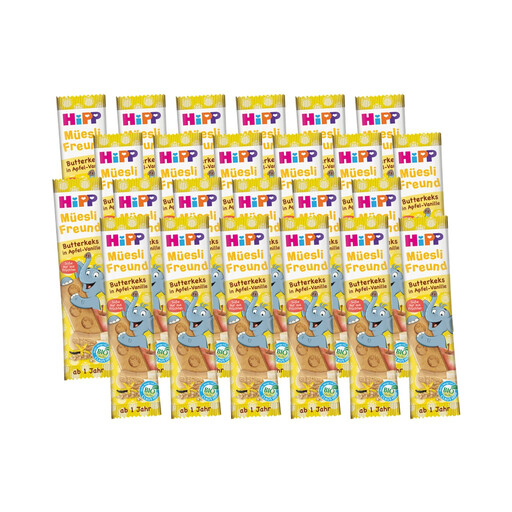 Image unavailable
HiPP Organic Cereal Bar Butter Biscuit Apple-Vanilla, 24 × 20 g, from 12 months
For families looking for an age-labelled bar in an individually portioned multipack.
The pack contains 24 bars of 20 g each. Offer the bar only under supervision, not while your child is lying down or walking, and check before buying that its texture is suitable for your child.
View at Joybuy
Frequently asked questions
Is a classic cereal bar from a multipack an everyday snack for toddlers?
A multipack doesn’t make a classic cereal bar a standard daily snack for toddlers. The Verbraucherzentrale recommends including sweets and snacks in the total amount of snacks eaten each day. For the specific bar, also check the age guidance, ingredients and texture.
Is a bar with no added sugar automatically more suitable for toddlers?
No: ‘no added sugar’ on its own tells you nothing about the recommended age or texture, and it doesn’t mean the bar is sugar-free. REWE states that the ja! Muesli Bar Chocolate with no added sugar contains 8 g of polyols per 25-g bar. The Verbraucherzentrale generally does not consider sweeteners and sugar substitutes a suitable alternative for children.
How can I identify cereals containing gluten in a packaged bar?
Check the ingredients and allergen labelling on the specific pack. The Federal Ministry of Agriculture, Food and Home Affairs lists cereals containing gluten among the allergens that must be declared on food; ingredients can vary between flavours.
What should I look out for when my toddler is eating a bar?
Make sure the texture is suitable for your child and supervise them while they eat. The HiPP Organic Oat Bar Strawberry & Raspberry described by REWE specifically comes with advice not to serve it while lying down. Kindergesundheit-info.de also highlights the choking risk posed by small or hard foods such as nuts and seeds.


