
Lieferung heute & morgen

Qualitätsgarantie

Willkommens-Angebote freischalten: KOSTENLOSE Lieferung | Bis zu 80 % RABATT | Kostenlose 30-Tage-JoyPlus-Testphase
App herunterladen
Choosing a kids' scooter can be a challenge given the overwhelming number of models and features. Many parents and relatives want to find a safe, durable, and fun gift for boys and girls, but are often faced with misleading product descriptions. This guide will help you identify the crucial features and avoid common purchasing pitfalls.
As a Joybuy Product Recommendation Officer, my job is to filter through market information and provide you with objective, practical advice so you can make an informed decision.
Before we dive into the important features, it's helpful to know the most common issues that can lead to disappointment.
To avoid a bad purchase, you should focus your attention on three core aspects that are crucial for safety, durability, and riding fun.
For children aged three and up, a 3-wheel scooter for kids is typically the more suitable choice. Unlike two-wheeled models that require an advanced sense of balance, scooters with three wheels (two in the front, one in the back) offer significantly greater stability.
Pay attention to the steering mechanism. Modern scooters for toddlers use a lean-to-steer system. The child steers by shifting their weight, which intuitively promotes the development of balance and coordination. Traditional bicycle-style steering can be overwhelming for beginners.
Kids grow fast. A height-adjustable kids' scooter is therefore not an option, but a necessity for use beyond a single season. A good scooter offers multiple locking positions that allow for an ergonomically correct posture over several years.
Another feature for maximum adaptability is a scooter with a seat. This allows even the youngest children to move around while sitting and slowly get used to the device. Once the child is more confident, the seat can be easily removed, and the scooter becomes a stand-up model.
The quality of the components is directly linked to safety and the riding experience.
Based on the criteria above, we have identified a few models that are suitable for different requirements and age groups.

Why this model fits: The removable seat and four wheels offer a very low barrier to entry and maximum stability. This is ideal for toddlers who are just beginning to develop their balance and familiarise themselves with the concept of riding.
This model directly counters the "Age Trap" with its integrated seat, making it genuinely usable for very young children. The high maximum load capacity of 100 kg counteracts the "Material Deception" and indicates a robust frame.
2-in-1 functionality (sitting and standing) and a high load capacity for long-term use. Also available in Green.

Why this model fits: This model is designed for longevity. With three adjustable height levels, it grows with the child from toddlerhood to early school age. The lean-to-steer system actively supports the development of motor skills.
It bypasses the "Feature Illusion" by focusing on a core practical feature: genuine, multi-level height adjustment. The sturdy deck and PU wheels counteract the "Material Deception."
Triple height-adjustable handlebar for long-term use and a robust design with a non-slip deck.
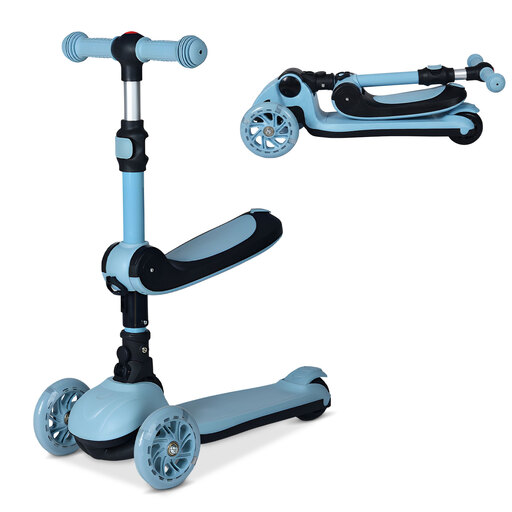
Why this model fits: This scooter combines practical features with high entertainment value, making it an ideal gift for boys and girls. The light-up wheels and illuminated deck are a major draw for children.
Although it has fun features like light-up wheels, it doesn't skimp on core quality. It includes a seat for beginners and a solid lean-to-steer mechanism, thus avoiding the pitfall of being just a gimmick.
A combination of riding fun thanks to the light-up wheels and deck, plus practical adaptability with the removable seat.
Some of the most versatile models come equipped with a seat to make getting started easier. We've compiled a list of products that meet these practical criteria.
The ideal handlebar height is between the child's waist and chest. When the child grips the handlebars, their arms should be slightly bent. A setting that is too high or too low can impair control of the scooter and lead to an unhealthy posture.
The transition to a two-wheeled scooter depends less on age and more on the child's individual development. As a rule, children are ready from around five to six years old, once their sense of balance and coordination are well-developed. Being confident on a 3-wheel scooter is a good prerequisite.
Yes, protective gear is strongly recommended. A well-fitting and certified helmet is essential to protect the head during falls. Knee and elbow pads offer additional protection against scrapes and bruises, especially during the learning phase. Safety should always come first.