Parents who pay attention to texture
When preparing breakfast for a toddler, texture matters more than pack size. The kindergesundheit-info.de information service notes that toddlers can easily choke on nuts, seeds and other small or hard foods.


A muesli sachet saves you measuring out a portion, but its pack size alone does not make it suitable for a toddler. If you want to tailor the texture and ingredients of breakfast, you can measure out a portion from a larger pack yourself. Whichever option you choose, check the specific recipe carefully, particularly for hard pieces, sugar content and allergens.
When preparing breakfast for a toddler, texture matters more than pack size. The kindergesundheit-info.de information service notes that toddlers can easily choke on nuts, seeds and other small or hard foods.
A sachet can save you measuring out a portion for one breakfast or when you’re out and about. But you still need to check its ingredients, texture and allergen information, just as you would with muesli from a larger pack.
If gluten, other allergens or sugar content are important when choosing a product, check the labelling for the specific variety. A claim such as ‘no added sugar’ does not mean the muesli contains no sugar.
For a toddler’s breakfast, the first things to consider are the specific recipe and how it is prepared. Only then is it worth asking whether a pre-portioned amount would make life easier.
A good choice if: You need a pre-portioned amount for one breakfast and the specific mix can be prepared in a way that’s suitable for a child.
Bear in mind: The sachet size says nothing about whether its ingredients are suitable. Depending on the variety, Seitenbacher’s 50 g sachets may contain whole nuts and seeds or chocolate.
A good choice if: You want to select the flakes and other ingredients individually for your child and prepare them appropriately.
Bear in mind: You’ll need to measure and prepare the portion yourself; it won’t already be individually packed for when you’re out and about.
| Criteria | What to check when buying | Who it matters most to |
|---|---|---|
| Age-appropriate texture | Look out for whole nuts, kernels, seeds and other small or hard pieces; check how the mix can be prepared. | If small or hard pieces could end up on the breakfast table, I’d put a suitable texture ahead of the convenience of a sachet. Around 36% of consumers would make this their top consideration when buying. |
| Ingredients and sugar | Compare the ingredients list and the ‘of which sugars’ figure per 100 g; take the amount actually served into account. | I want to know what the mix contains besides flakes and how much sugar there is in the portion served. This would be the top priority for around 29% of consumers. |
| Pre-portioned amount | Compare the weight of each sachet with the amount needed for one breakfast. | When we’re out and about, I don’t want to have to measure out muesli first, but I can split the sachet’s contents if needed. Around 21% of consumers would mainly be looking for this convenience. |
| Allergen information | Read the ingredients and precautionary allergen statements on the specific pack, especially if you switch products. | If anyone in my household needs to avoid certain allergens, I need clear ingredient and allergen labelling that suits their needs. For around 14% of consumers, this check would come first. |
The amount in a sachet is a pack size, not a recommended portion for a child’s breakfast. Seitenbacher’s 50 g varieties also differ in their ingredients.
Check the recipe and texture first, and choose the amount to serve based on the rest of the breakfast rather than assuming you should use the whole sachet.
Verbraucherzentrale distinguishes between these two claims. Kölln says its fruit and oat muesli with no added sugar contains 40% dried fruit, which naturally contains sugar.
Also read the ingredients list and check the ‘of which sugars’ figure in the nutrition information.
According to kindergesundheit-info.de, nuts, seeds and similar small or hard foods can pose a choking risk for toddlers. Seitenbacher says its Bergsteiger muesli sachet contains whole nuts.
Choose a mix only if its ingredients can be prepared appropriately for your child; otherwise, consider a softer combination.
Mueslis with similar names may contain different grains, nuts or precautionary allergen statements. The labelling for the specific variety you buy is what matters.
Check the ingredients and allergen information every time you switch products and whenever the recipe changes.
The following brands offer different product formats and recipes. A brand name alone won’t tell you whether the texture is suitable or what a particular variety contains.
Seitenbacher sells muesli in 50 g sachets and also offers advice on preparing flakes for younger children.
As well as muesli in larger packs, Alnatura sells a 100 g apple and raspberry muesli pouch, which the brand describes as suitable for children aged one and over.
Kölln offers fruit and oat muesli with no added sugar, which you can measure out yourself.
REWE’s ja! fruit muesli is an example of a larger pack from which you can measure out a portion yourself.
The Swiss brand Familia offers muesli in a range of recipes and pack formats, including snacks.
Brüggen describes mueslis with different combinations of fruit, nuts and chocolate, and also manufactures products for retailer own-label ranges.
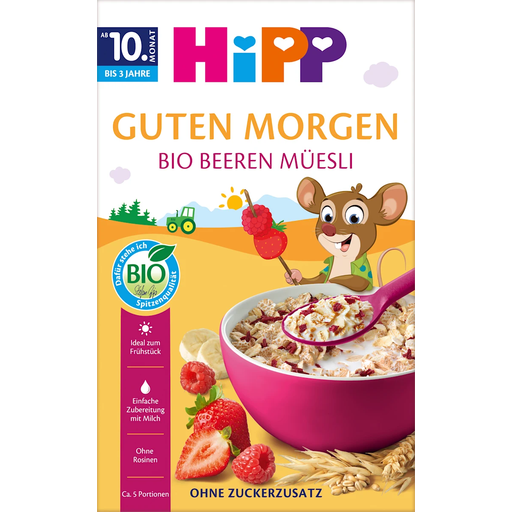
This product is an example of measuring out a portion yourself from a larger pack of muesli. Check the age guidance on the current pack, along with the ingredients, allergen information and preparation instructions, to make sure it’s suitable for your child.
 No image available
You can measure out a portion for one breakfast from the 200 g pack.
The minimum age is listed as ‘from 10 months’ in the product title and ‘from 12 months’ in the description, so check the information on the current pack. Also read the ingredients and allergen labelling before preparing it.
No, the sachet only determines the amount. Before serving, check the variety’s ingredients and allergen information, sugar content and preparation instructions, paying particular attention to any small or hard pieces.
The ingredients and allergen labelling for the specific muesli are what matter. Under Annex II of the EU Food Information to Consumers Regulation, cereals containing gluten are among the allergens that must be labelled. If gluten needs to be avoided, you can’t rely on the product category alone to make your decision.
No, the two claims mean different things. Ingredients such as dried fruit can contain naturally occurring sugar, so compare the ingredients list with the ‘of which sugars’ figure in the nutrition information.
For one-year-olds, Seitenbacher recommends fine melt-in-the-mouth flakes or cooked porridge oats rather than raw oats. Whichever type of flakes you choose, don’t serve nuts, seeds or other small or hard ingredients unchanged as part of a toddler’s breakfast.
Not necessarily. Alnatura describes its apple and raspberry muesli pouch for children aged one and over as a supplement or part of a snack. It’s a different product format from dry muesli mixed and prepared for a breakfast bowl.