
Lieferung heute & morgen

Qualitätsgarantie

Willkommens-Angebote freischalten: KOSTENLOSE Lieferung | Bis zu 80 % RABATT | Kostenlose 30-Tage-JoyPlus-Testphase
App herunterladen
A toddler trampoline with a handlebar offers a constructive activity for young children: it promotes motor skills, improves balance, and provides a way to burn off excess energy indoors. However, the market is crowded, and not every model delivers on its promises. Before you make a decision, it's crucial to understand the common pitfalls that often only become apparent after the purchase.
Many parents invest in an indoor trampoline for kids only to discover that it's too noisy for their apartment, the handlebar is wobbly, or the bounce is unsuitable for a toddler. This guide will walk you through the key features to look for to make a safe, durable choice and avoid a disappointing purchase.
The number of options can be overwhelming, and marketing terms often obscure fundamental flaws. Pay close attention to these three points to avoid disappointment:
To ensure the trampoline for toddlers is both fun and safe, you should carefully examine three technical parameters. These features determine the product's quality, safety, and durability.
The heart of any trampoline is its suspension system. For toddlers, the bungee cord trampoline has proven to be the superior choice.
Therefore, look for models explicitly equipped with a bungee cord system (often referred to as "bungee ropes" or "elastic bands").
The handlebar must be completely stable. Check how it attaches to the frame. A solid, multi-point screw connection is a must. A T-shaped handle often provides a better grip surface and more stability compared to a simple U-shaped handle.
Another important feature is height adjustability. Children grow quickly. A handle that can be adjusted to their height ensures they can use it safely and with correct ergonomic posture over a longer period.
A sturdy, powder-coated steel frame ensures durability and stability. The jump mat should be made of a tear-resistant and non-slip material like polypropylene (PP). A padded edge cover that completely conceals the bungee cords or springs is an essential safety feature to prevent feet from getting caught.
For families in urban apartments, storage is a key consideration. A foldable kids' trampoline can be quickly folded and stored compactly when not in use. Check how easy the folding mechanism is to operate.
Based on these objective criteria, we have identified models that are well-suited for specific user profiles.
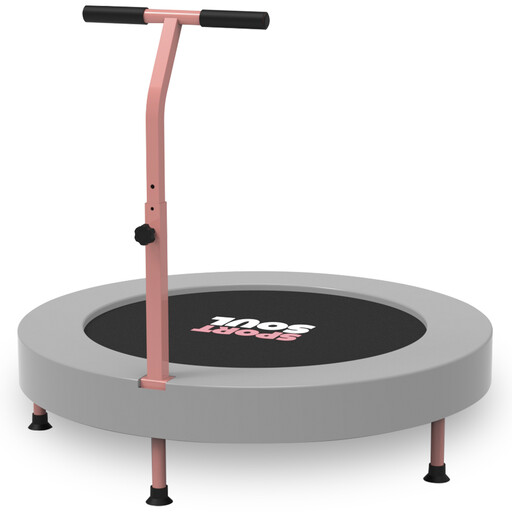
Why This Fits Their Persona: This model is aimed at parents who prioritise safety above all. The T-shaped handlebar is height-adjustable and offers stable support, while the bungee cord system ensures low-impact jumps.
It bypasses the pitfall of unstable handles with a solid T-bar design and avoids the risk of a harsh bounce by using 24 elastic bands instead of steel springs.
The maximum weight capacity is clearly specified for toddlers at 25 kg. The foam safety pad further minimises the risk of injury.
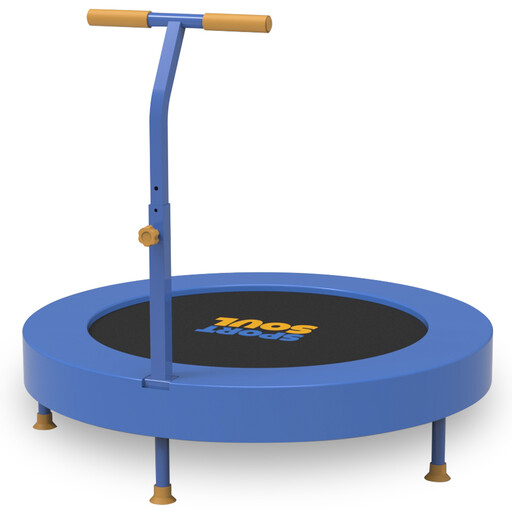
Why This Fits Their Persona: For families in apartments with limited space, storage is crucial. This model is designed as a foldable kids' trampoline and can be easily stored when not in use.
It solves the problem of bulky sports equipment permanently taking up valuable living space. Instead, it can be put away quickly and easily after playtime.
Key components like the bungee cords and jump mat come pre-assembled, which significantly simplifies and speeds up setup.
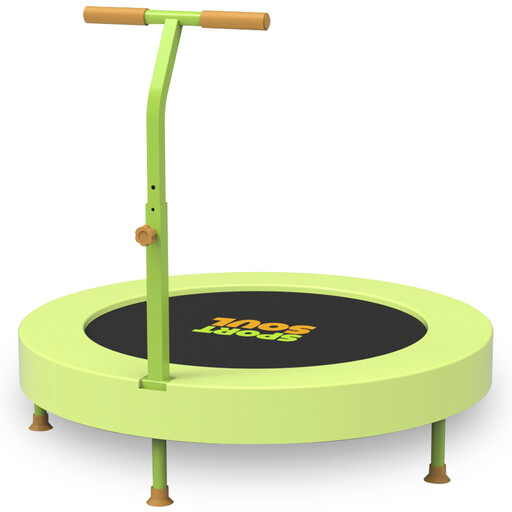
Why This Fits Their Persona: Those focusing on the playful development of coordination and balance will benefit from the gentle bounce characteristics of this bungee cord trampoline.
It avoids the risk of an overly powerful bounce, which can be unsuitable for toddlers on steel spring models. The gentle suspension helps build the child's confidence in their movements.
The polypropylene (PP) jump mat provides a durable, non-slip surface that ensures a secure footing even during energetic use.
We have compiled a complete, up-to-date list of products that fully meet these strict selection criteria and safety requirements.
A mini trampoline for kids with a handlebar is generally recommended for children aged two to three and up, once they have basic motor skills and stable posture. However, the manufacturer's specific age and weight recommendations are always the deciding factor. Continuous adult supervision is essential during use.
A bungee cord trampoline offers several safety advantages for toddlers. The suspension is softer and absorbs impact better, which reduces strain on the joints. Since there are no hard steel springs, the risk of children getting their feet or hands caught is eliminated, especially with a well-padded edge cover. Furthermore, its quieter operation prevents startling moments caused by loud noises.
Yes, many models are specifically designed for apartment use and are available as a foldable kids' trampoline. The folding mechanism typically allows the frame to be folded in half, so the trampoline can be stored under a bed or in a closet. Before buying, check the product description to ensure your desired model offers this feature and to understand how the folding process works.