Batch cooks preparing larger quantities
If you prepare lots of tomato slices for future meals, usable tray area and enough space for air to circulate are key.


For regularly preparing larger batches of tomato slices, a pull-out-tray dehydrator is an obvious choice if you have enough room for the appliance and its trays. What matters is the usable area, with enough space between the slices. For smaller, occasional batches, a stackable model may be a better fit if storage space is limited. With either type, a timer and temperature setting don’t replace checking how dry the slices actually are.
If you prepare lots of tomato slices for future meals, usable tray area and enough space for air to circulate are key.
If you’re drying tomatoes for future recipes, check the slices on different levels rather than relying solely on the set running time.
For smaller quantities, a more compact appliance that’s easier to store may be a good fit, as long as you don’t mind running additional batches if needed.
A good fit if: You regularly prepare larger batches and have room for a fixed appliance.
Trade-off: The appliance and trays need space both in use and in storage; a manufacturer’s stated area doesn’t guarantee a particular quantity of tomatoes.
A good fit if: You dry smaller batches or want to put the appliance away after use.
Trade-off: Less usable area may mean running several batches; in stackable models tested in 2024, warm air did not reach every level in the same way.
A good fit if: You only dry tomato slices occasionally and want to try it out before deciding whether a dedicated appliance is worthwhile for the quantities you prepare.
Trade-off: The Federal Centre for Nutrition describes oven drying as an energy-intensive method that requires moist air to escape.
Compare the surface area, space requirements and how easily you can check the slices together. A large stated drying area alone doesn’t tell you how many tomato slices will fit with enough space between them.
| Consideration | What to check when buying | Who it matters most to |
|---|---|---|
| Drying area and batch size | Compare tray dimensions and the number of trays; don’t use the area to estimate capacity in kilograms. | If you want to prepare your stored portions in as few batches as possible, the usable area with space for air to circulate matters. Around 28 % of consumers put batch size first. |
| Controlling the level of dryness | Check the temperature control and timer, and make sure you can access the trays to check the slices. | If you dry slices for future recipes, you’ll want to assess how dry they are on several levels. Around 22 % of consumers prioritise being able to control the drying process. |
| Safe storage | Check whether the trays can be removed for inspection, and plan for suitable storage containers. | If you prepare tomatoes for later, the batch needs to dry fully and be protected from moisture during storage. Around 22 % of consumers pay particular attention to safe storage. |
| Counter space and storage | Check the external dimensions and the space needed to open the appliance; for stackable levels, consider how much room it takes up when stored, too. | If your kitchen has limited space, you’ll want an appliance that’s easy to put away after drying, even if smaller batches may mean several runs. Around 17 % of consumers prioritise space requirements. |
| Cleaning and accessories | Check what’s included and the cleaning instructions for the exact model; consider whether replacement trays are available. | If you dehydrate regularly, looking after the parts you use and having the right accessories will matter to you. Around 11 % of consumers prioritise maintenance and aftercare. |
A stated area or an extra tier doesn’t tell you how many slices will fit on the trays with enough space between them. Overcrowded trays can restrict air circulation.
Compare the tray dimensions with the quantities you usually want to lay out in a single layer, with space between the slices.
If there’s less usable area, you may need additional runs and longer drying times for a larger batch to store.
The timer sets the running time, but doesn’t confirm that slices on every level have dried evenly. A 2024 test by Haus & Garten Test reported differences in the supply of warm air in the stackable models it examined.
Check slices on different levels and, if needed, plan to turn or move them around. Don’t assume that the test results from the time apply to every model.
The Federal Institute for Risk Assessment advises against making and storing homemade vegetables in oil for later use at home. A setting on the appliance or a timer doesn’t override this advice.
Plan to store fully dried tomatoes separately from recipes that use oil, and don’t treat an appliance setting as proof that a jar is safe for storage.
Rommelsbacher offers pull-out-tray models in different sizes, including the DA 650 and DA 900.
The Graef DA506 is a pull-out-tray dehydrator with six plastic mesh trays.
The DH 450 has stackable, height-adjustable levels, making it a suitable type of appliance for smaller batches or limited storage space.
The Steba ED 6 is a pull-out-tray dehydrator with a hinged door and stainless steel inserts.
The KÜCHENminis Dörrautomat Snack to go is a compact alternative for smaller quantities.
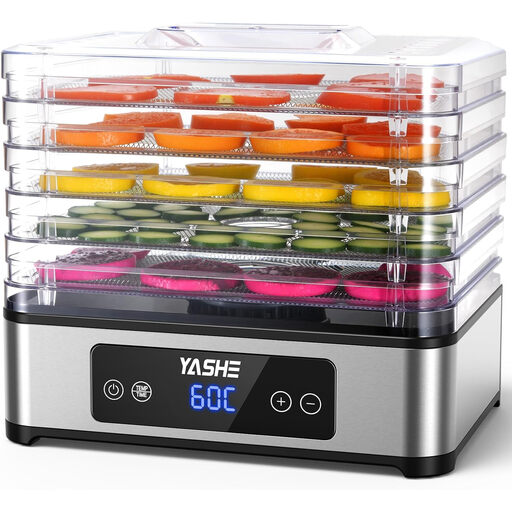
The following Joybuy appliances are multi-tier dehydrators for vegetables. When comparing them for tomato slices, the main things to consider are tray area, spacing and how easily you can check how dry the slices are.
 No image available
The stackable trays and adjustable settings are suited to smaller batches of vegetables if you want to put the appliance away after use.
Five stainless steel trays; temperature range 35–70 °C; timer from 1–48 hours; 360° airflow; 400 W.
 No image available
The ten trays offer several levels for batches of vegetables. Before choosing, check that the appliance’s dimensions and usable area suit your kitchen space and portion sizes.
Ten stainless steel trays; variable temperature control; timer up to 48 hours; ten presets; 850 W.
CASO gives around 60 °C as a guide for tomatoes in its DH 450 dehydrator. This doesn’t give you a set drying time: slice thickness and moisture content affect how long they take to dry. Check slices on different levels and follow your appliance’s instructions.
Slice the tomatoes as evenly as possible and arrange them in a single layer, leaving clear paths for air to circulate. Check them while they’re drying; fully dried tomatoes should be left to cool before packing and stored away from moisture.
The Federal Institute for Risk Assessment advises against making and storing homemade vegetables in oil for later use at home. Home preservation methods can’t rule out the formation of botulinum toxin in every case; a dehydrator or its timer doesn’t automatically make a jar of tomatoes in oil safe to store.
No. A timer limits the set running time, but doesn’t confirm how dry the slices are on every level. According to the Federal Centre for Nutrition, drying time also depends on the size and thickness of the food, so check slices from different areas of the appliance.