
Lieferung heute & morgen

Qualitätsgarantie

Willkommens-Angebote freischalten: KOSTENLOSE Lieferung | Bis zu 80 % RABATT | Kostenlose 30-Tage-JoyPlus-Testphase
App herunterladen
A tool cabinet with drawers should keep everything organised, make tools easy to access and make sensible use of the available space. In practice, unclear load ratings, unsuitable dimensions or stiff drawers often lead to disappointing purchases. With a wheeled tool cabinet in particular, it is not just the number of compartments that matters, but also the castors, locking system, material and stability against tipping.
This buying guide explains which features matter before you buy and which model may suit different user profiles.
Having lots of drawers can seem appealing. However, the key question is whether the internal height suits your tools. Shallow compartments are suitable for bits, socket sets or spanners. Cordless drills, sets of pliers or larger machines need at least one taller compartment.
You should therefore check:
A tool cabinet with castors is mobile, but it must remain stable at the workplace. Universal castors make the cabinet easier to move, but they do not replace locking brakes. On a slightly sloping floor or when several drawers are opened, an unbraked tool trolley can move unexpectedly.
At least two castors with brakes are recommended. On uneven floors, you should also check whether the frame stands securely and whether the castors are designed to support the total weight.
According to the product information, powder-coated steel can improve resistance to wear and corrosion. This does not mean that a tool cabinet is permanently waterproof. For example, the first model is explicitly stated to be not water-resistant.
For garages and workshops, you should therefore:
Cold-rolled steel is a common material choice for many metal tool chests and tool cabinets. It provides a sturdy construction that can be suitable for everyday use. However, the stated total load capacity must match the actual load.
The AIRAJ Rolling Tool Chest is stated to have a load capacity of 550 lb, or approximately 249 kg. This figure should be considered as a total capacity. It does not automatically indicate how much each individual drawer can hold. Heavy tools should be stored as low down as possible to keep the centre of gravity low.
Ball-bearing runners can allow drawers to open and close more smoothly. The following details are also important for everyday use:
A lockable tool cabinet can restrict access to sharp, valuable or potentially dangerous tools. However, the lock is no substitute for safe positioning and responsible storage.
Before ordering, measure the intended space, including the area needed to move around it. In a garage, you need to consider not only the width and depth, but also passage widths, door openings and the distance from vehicles.
A mobile tool box or a small tool box with drawers may be sufficient for a single workstation. For a large workshop, a multi-part tool cabinet with castors, a side panel and additional work surface is often more practical.
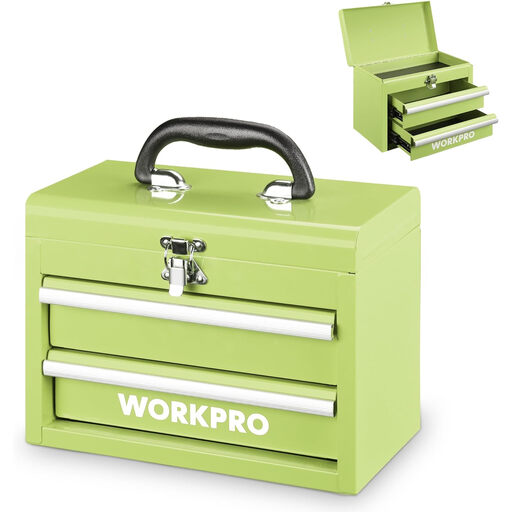
Why this product suits this profile: This compact metal tool box is suitable for smaller tool collections, a desk or an individual repair station.
Its manageable size prevents you from buying a cabinet that is too large and whose storage space would not be needed in everyday use.
Two drawers, additional storage space, carrying handle and PVC liners; dimensions according to the product description: 27,43 × 14,99 × 20,83 cm.
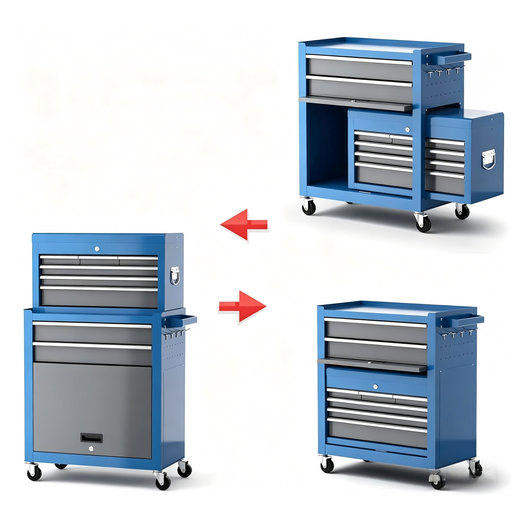
Why this product suits this profile: This model combines cold-rolled steel with several drawers, castors, a work surface and perforated side panels for an organised workshop.
Brakes on the rear castors help prevent the cabinet from moving. The liners and organiser dividers also reduce rattling and untidy storage.
Stated total load capacity of 550 lb, ten removable hooks and ten compartments; according to the description, the product is not water-resistant.
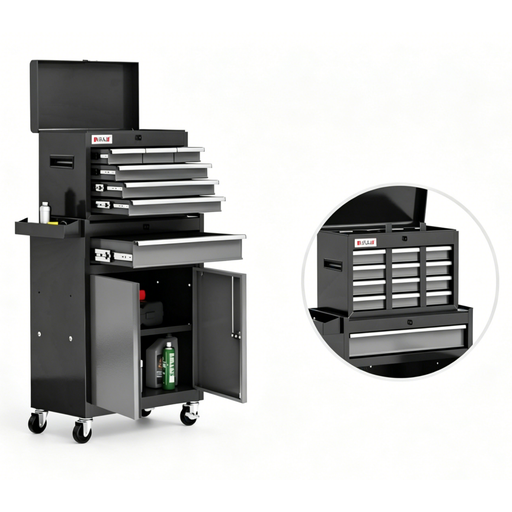
Why this product suits this profile: For workshops, garages and work areas containing several types of tools, this model combines drawers, a cabinet section and a lock.
The lockable double-door design goes beyond a simple drawer solution and allows larger or sharp items to be stored separately.
One large, three medium and three small drawers, plus four castors with brakes according to the product description.
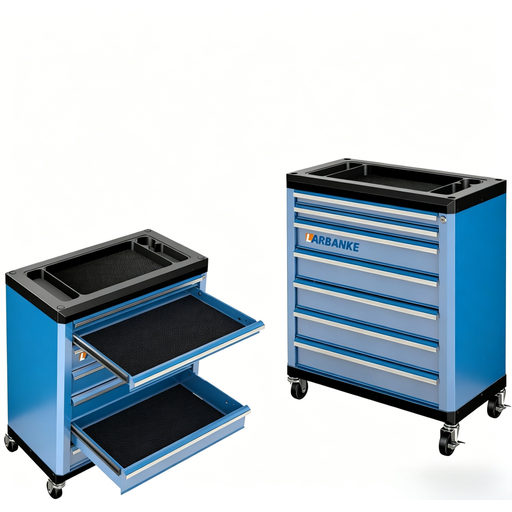
Why this product suits this profile: This modular design is suitable for users who may want to expand their tool storage later or switch between mobile and stationary use.
The different drawer heights and anti-tip mechanism reduce poor organisation and the risk of drawers sliding open.
Seven drawers, four castors with two brakes, removable wheels and a modular connection option according to the product description.
Another option for a stackable solution is the 4-Drawer Portable Steel Tool Box from LARBANKE. It offers four drawers, a unified locking system across the range and connecting elements for a modular set-up. For a compact workshop organiser with a portable design, the red WORKPRO Metal Drawer Box with two drawers and an upper storage compartment is also available.
We have put together a complete, regularly updated list of products that fully meet these strict selection criteria and the safety regulations applicable in the EU.
That depends on the number of tools you have and the available space. Measure the area, doors and passageways. You should also leave enough room around a wheeled tool cabinet to open the drawers fully and move the trolley.
Castors with locking brakes improve stability when the cabinet is stationary. Heavy items should be stored in the lower compartments. Unless a model is explicitly designed for this, avoid opening several fully loaded drawers at the same time.
Keep the surface dry and regularly remove metal swarf or oil residue. Check the castors, brakes, handles and drawer runners at suitable intervals. If you notice visible paint damage, inspect it promptly to prevent the affected area from spreading further.