
Lieferung heute & morgen

Qualitätsgarantie

Willkommens-Angebote freischalten: KOSTENLOSE Lieferung | Bis zu 80 % RABATT | Kostenlose 30-Tage-JoyPlus-Testphase
App herunterladen
A well-organized workspace is the foundation of efficiency and safety, whether in a professional workshop or a home garage. A tool chest promises order and mobility, but not every model delivers on its promise. Before you invest, it's crucial to understand the typical weak points that often only become apparent after a few months of use, turning a supposedly good purchase into a source of frustration.
As your Joybuy Product Recommendation Officer, I'm here to help you distinguish quality from subpar options. We'll highlight the three most common design flaws that cause problems in budget models and show you what to look for to find a durable and functional solution for your tool storage needs.
Many tool chests look robust at first glance, but the devil is in the details. Pay close attention to these three critical points to avoid a bad purchase:
mobile tool cabinet thus becomes an immovable obstacle. Even more problematic are unreliable locking brakes that give way on uneven floors, posing a significant safety risk.tool storage.lockable tool trolley suggests security. On many models, however, the lock is more symbolic than functional. Thin locking plates and simple cylinder locks offer little protection and can be easily pried open. A central, robust locking system is essential for protecting valuable tools.To avoid the problems mentioned above, you should base your purchasing decision on objective technical features. These three parameters are decisive for the longevity and functionality of your tool chest.
The foundation of a sturdy tool chest is its material. Models made from cold-rolled steel offer significantly higher strength and torsional rigidity than those made from simple sheet metal. Look for a powder coating on the surface. This is not only more scratch-resistant than a simple paint job but also provides effective protection against rust and corrosion—a must in any workshop environment.
A good rolling workshop cart needs suitable casters. Look for rubberized universal casters, as they run more quietly and absorb shocks better than hard plastic ones. At least two of the four casters should swivel and have locking brakes to position the cart securely. Check the specified maximum load capacity of the cart and individual drawers to ensure it is sufficient for your tool collection.
The quality of a tool chest with drawers is evident in its mechanism. Ball-bearing full-extension slides are the standard for high-quality models. They allow for smooth, easy opening and closing even under heavy loads and provide access to the entire contents of the drawer. An anti-tip mechanism, which prevents multiple drawers from being opened simultaneously, further enhances stability and safety.
Based on these quality criteria, we have compiled a selection of models for different user profiles.
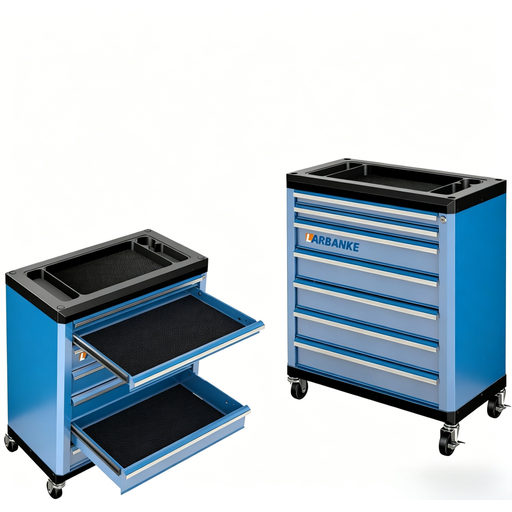
Why This Fits Their Persona: Ideal for users whose tool collection is growing. The modular design allows it to be combined with other units in the same series to create a customized and space-saving storage system.
The anti-tip mechanism prevents drawers from sliding out unintentionally and increases stability. The unified locking system simplifies management when using multiple units.
Stackable, modular system; quiet-rolling universal casters with brakes; drawers with PE foam liners to protect tools.
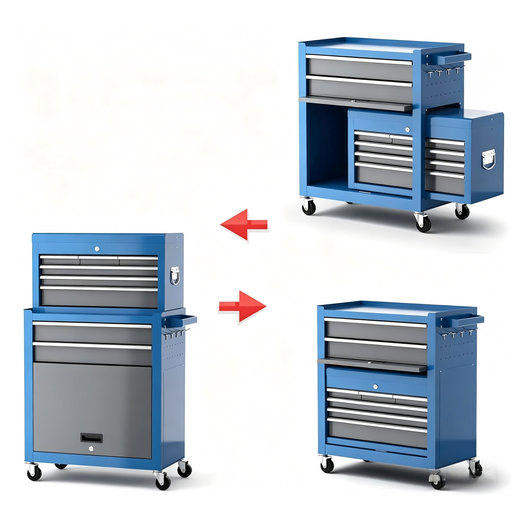
Why This Fits Their Persona: Designed for demanding use in workshops and garages where high load capacity and maximum organization are required. The side pegboards offer additional, quickly accessible storage space.
The cold-rolled steel construction and high load capacity of 550 lbs (approx. 250 kg) prevent bending or breaking under load. The robust locking casters ensure a secure stance.
High load capacity; side pegboards with 10 hooks for quick access; drawers and work surface are lined with protective mats.
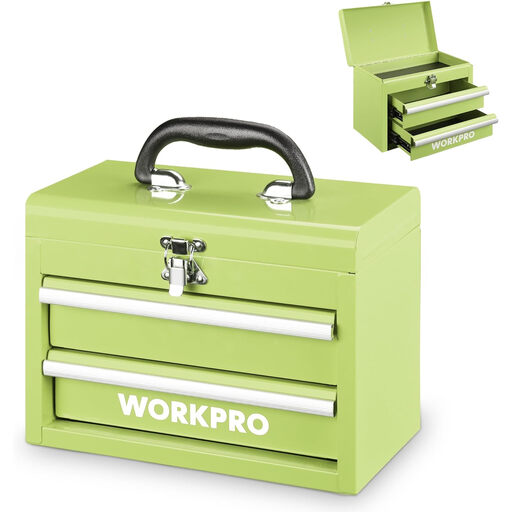
Why This Fits Their Persona: Perfect for hobbies, the office, or for essential tools that need to be portable. Its compact design and carrying handle make it a versatile storage solution, even outside the workshop.
Instead of being a large, unstable cart, this model focuses on quality on a smaller scale. The high-quality ball-bearing slides are uncommon in this size and prevent drawers from jamming.
Compact, portable design with a sturdy handle; ball-bearing drawer slides for smooth operation; removable PVC mats to protect contents.
We've compiled a complete, up-to-date list of products that fully meet these strict selection criteria and rigorous safety regulations.
Ball-bearing drawer slides use small steel balls to minimize friction when opening and closing. This results in very smooth and quiet operation, even when the drawers are heavily loaded. Unlike simple slide rails that can bend or jam under load, they ensure long-lasting, reliable function and often allow for full extension, so you can easily access the entire contents of the drawer.
The material thickness, usually specified in millimeters, is a direct indicator of the cart's stability and load capacity. A body made of thicker, cold-rolled steel is more resistant to deformation and dents. It significantly contributes to the overall maximum load capacity of the cart and ensures that the structure remains stable even when fully loaded and in motion. A greater material thickness is a clear quality feature for a long service life.
On most high-quality tool chests, the casters are bolted on, not welded. This allows for replacement if a caster gets damaged or if you want to upgrade to a different type of caster (e.g., for particularly uneven floors). On some models, like the featured LARBANKE tool chest, the removable design of the casters is an explicit feature, allowing the chest to be used as a stationary cabinet, which increases its flexibility.