
Lieferung heute & morgen

Qualitätsgarantie

Willkommens-Angebote freischalten: KOSTENLOSE Lieferung | Bis zu 80 % RABATT | Kostenlose 30-Tage-JoyPlus-Testphase
App herunterladen
A well-organised workshop is the foundation for efficient and safe work. When tools are scattered, you not only lose valuable time searching for them but also your focus on the task at hand. A tool chest provides a structured solution by keeping tools securely stored and readily mobile. This guide will help you understand the key features to consider when selecting the right model for your garage or professional workspace.
The right tool cabinet for you depends on your specific needs for capacity, materials, and functionality. The following points will help you make an informed decision.
The durability of a tool chest is largely determined by its materials. Models made from cold-rolled steel offer high stability and resilience against the daily demands of a workshop. A powder-coated finish provides additional protection against rust and scratches. Pay close attention to the maximum load capacity to ensure the cabinet can safely support the weight of your tool collection. This is especially critical if you plan to store heavy equipment.
A tool chest with drawers is the core of your organisational system. Key features include:
A well-designed drawer system is crucial for efficient tool storage in your garage or workshop.
The ability to roll a tool cabinet is one of its core functions. The quality of the casters is therefore critical. Smooth-gliding universal casters, ideally made from a low-noise material, provide effortless mobility. At least two of the casters should be equipped with locking brakes to securely position the cabinet at your workstation. For securing your contents, a lockable tool chest is an essential feature, especially in shared or unsupervised environments. Some models offer unified locking systems, which simplify the management of multiple cabinets.
Based on the criteria mentioned, we have selected a few models that stand out for their specific features and are suited for various applications.
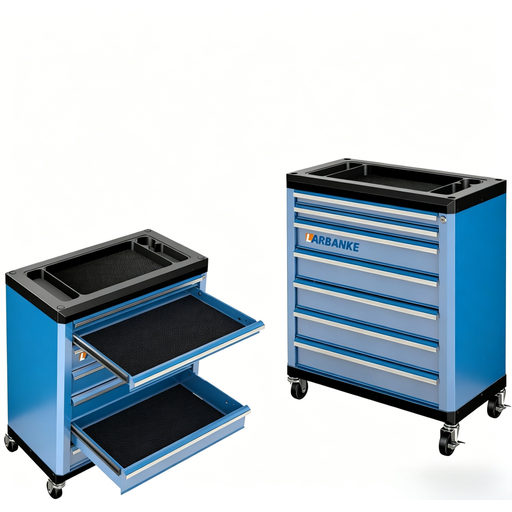
What makes it stand out: This model combines high storage capacity with thoughtful security features. Its seven drawers, in two different heights (3.5 cm and 7.9 cm), allow for the systematic organisation of tools and small parts. Each drawer is lined with PE foam to protect the contents from impact. The anti-tip mechanism and full-extension slides enhance user safety and convenience. A special feature is the multifunctional plastic tabletop, which is waterproof and includes practical compartments for frequently used tools.
Advantages:
Who is it for? Users looking for an expandable and customisable storage system. Ideal for workshops where multiple cabinets are in use and unified management is desired.
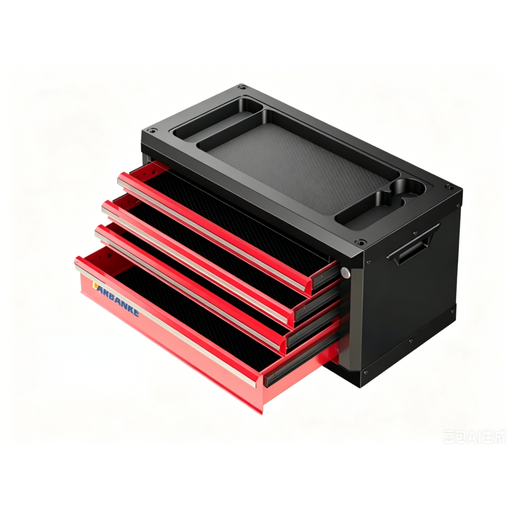
What makes it stand out: This compact tool box is designed as part of a modular system. With four drawers—three shallow and one deep—it offers clear separation for different-sized tools. The steel construction and waterproof ABS plastic worktop ensure durability. Like the larger model, this box also features ball-bearing, full-extension drawers with an anti-tip mechanism and a unified locking system compatible with other products in the LARBANKE series.
Advantages:
Who is it for? Perfect for tradespeople and DIY enthusiasts who want to expand their tool storage incrementally. It can be used as a top chest for an existing rolling tool cabinet or as a standalone, portable unit.
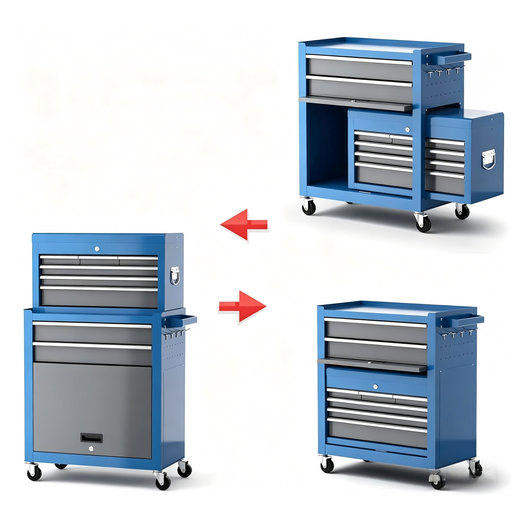
What makes it stand out: This model is designed for heavy loads and maximum storage capacity. Made from cold-rolled steel with a powder-coated finish, it offers a load capacity of up to 550 lbs (approx. 250 kg), according to the manufacturer. A unique feature is the perforated side panels (pegboards) with 10 removable hooks, creating extra space for frequently used tools like pliers or wrenches. Protective liners in all drawers and on the work surface reduce noise and wear.
Advantages:
Who is it for? Professional users and ambitious DIYers who need a very robust, high-capacity solution with maximum storage space for a large tool collection.
A rolling tool chest is an excellent choice for mobile tool organisation. However, if you are looking for stationary shelving, smaller organiser cases, or other containers, you will find a wider selection in our category.
Discover more storage boxes with lids and wheels and find the perfect solution for your needs.
1. What is the most efficient way to organise tools in a tool chest? A proven method is to organise by tool type or workflow. Place frequently used tools in the top, easily accessible drawers. Use dividers or foam inserts to sort small parts like screws, bits, or sockets and prevent them from shifting.
2. What should I look for in the casters of a tool chest? Pay attention to the diameter and material of the casters. Larger casters roll more easily over small obstacles like cables or uneven floors. Rubber or plastic casters are quieter than all-metal ones. Locking brakes on at least two casters are essential to securely park the cabinet and prevent it from rolling away.
3. What is the advantage of a modular tool system? A modular tool system offers maximum flexibility. You can start with a base unit, such as a rolling cabinet or a tool box, and expand it as needed with additional modules (e.g., extra drawer units). This allows for a space-saving storage solution that adapts to your growing tool collection and changing needs.