
Lieferung heute & morgen

Qualitätsgarantie

Willkommens-Angebote freischalten: KOSTENLOSE Lieferung | Bis zu 80 % RABATT | Kostenlose 30-Tage-JoyPlus-Testphase
App herunterladen
A tool set should make repairs easier, rather than becoming an untidy collection of unsuitable parts after just a few uses. Many buyers initially focus on a high piece count or a shiny finish. However, the included sizes, drive types, materials and practical storage case are much more telling.
Typical purchasing problems arise from three common pitfalls:
For household tasks, bicycle maintenance and smaller assembly jobs, a 1/4-inch drive is often practical. It is suitable for smaller sockets and bits. A 3/8-inch drive covers many medium-sized fasteners, while 1/2 inch is intended for larger nuts and higher loads.
A versatile case should clearly specify, wherever possible:
For vehicles, machinery and certain furniture fittings, a Torx key set may be more useful than a general bit assortment. With safety-critical fasteners, the profile must sit fully inside the screw head to prevent the edges from rounding off.
Hand tools are often made from chrome vanadium steel (Cr-V), chrome molybdenum steel (Cr-Mo) or S2 steel. These specifications describe the choice of material, but they do not replace checking whether the tool is suitable for the intended use.
Chrome plating or black phosphating can help protect the surface. However, this does not automatically make a tool suitable for outdoor use or wet conditions. After use, metal parts should be wiped dry and stored in a dry place.
According to product specifications, a 72-tooth ratchet often requires a small return swing angle of around 5 degrees. This is helpful in confined spaces, such as inside an engine compartment or around bicycle components. A flexible head can provide additional access, but it does not replace a suitable extension.
A torque wrench set is useful when the manufacturer specifies a particular tightening torque for an assembly. Important factors include:
The maximum value stated on the tool must not be exceeded. The MoveCrab set, for example, is specified as covering a range from 5 to 220 Nm; this should not be equated with a bicycle torque wrench designed for finer values.
The right combination depends on how you intend to use it. A homeowner needs different components from someone who regularly services bicycles or works on vehicles.
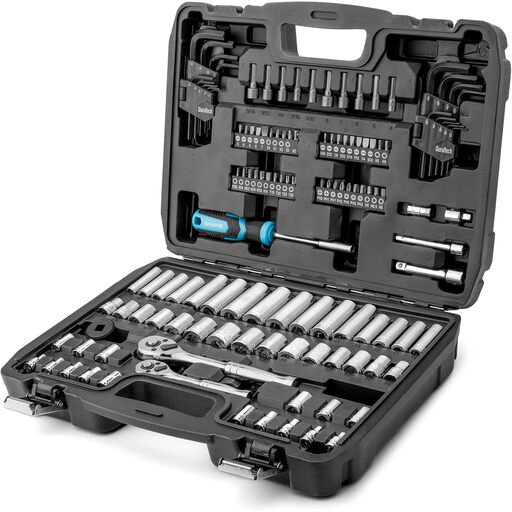
Why this product suits this profile: This set combines sockets, bits, hex keys, two ratchets and a storage case for typical repairs around the home, on bicycles or on vehicles.
The specifications clearly list the included metric and SAE sockets, bits and drive sizes. This makes it easier to compare the contents with your own requirements before buying.
121 pieces, Cr-V steel, 1/4- and 3/8-inch ratchets, plus a case with marked holders.
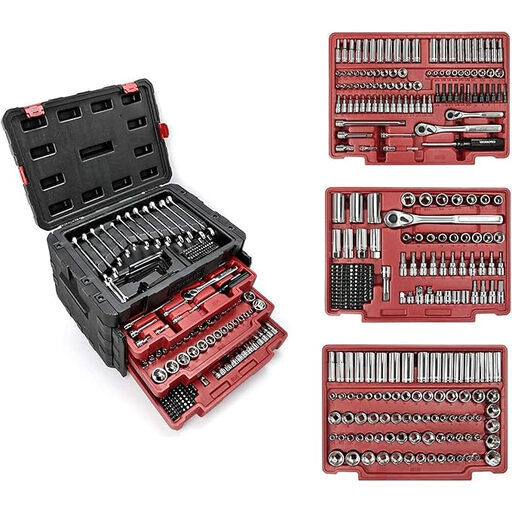
Why this product suits this profile: For workshop users and regular repairs, this case offers several drive sizes, metric and SAE sockets, as well as additional hand tools.
The four-part case keeps the components organised in fixed positions. This reduces the risk of storing individual sockets loose or overlooking particular sizes.
450 pieces, Cr-V steel, three drive sizes and a case with four inserts and locking clips.
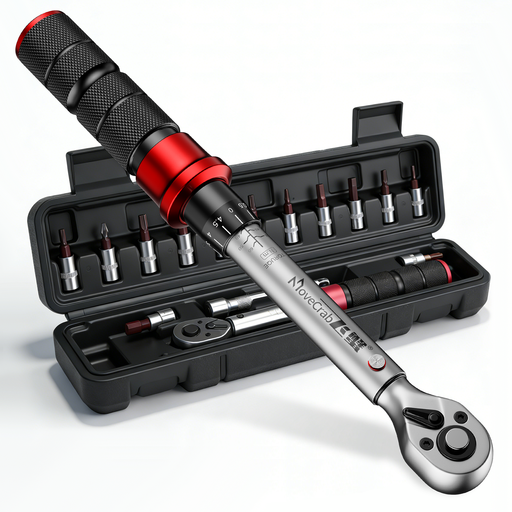
Why this product suits this profile: This set is designed for bicycle work and finer fasteners, where a defined torque range matters more than a large selection of universal sockets.
The range from 2.0 to 20.0 Nm and fine adjustment down to 0.2 Nm are clearly specified. This allows you to check whether it is suitable for your bicycle components in advance.
1/4-inch drive, bidirectional ratchet and 11 bits with hex, Phillips and Torx profiles.
Before buying, check the tools you already have and make a note of any missing sizes. For a tool case kept in the car, compact dimensions and a secure closure are important. In a workshop, broad size coverage and replacement components available to buy individually are more valuable.
Also pay attention to the following points:
We have put together a complete, regularly updated list of products that fully meet these strict selection criteria and the safety regulations applicable in the EU.
For both areas, a set with 1/4-, 3/8- and 1/2-inch drives, metric sockets, bits, extensions and a ratchet is a sensible choice. Also check whether it includes Torx profiles and larger sockets.
Its service life depends on the materials, load, care and storage conditions. Overloading, rust, incorrect profiles and using tools as levers can place considerably more strain on them than the handwork they were designed for.
A torque wrench is useful when a specific Nm value is prescribed for a connection, for example with bicycle components or certain vehicle parts. The measurement range must match the specified tightening value; a wider range alone does not mean greater suitability.