
Lieferung heute & morgen

Qualitätsgarantie

Willkommens-Angebote freischalten: KOSTENLOSE Lieferung | Bis zu 80 % RABATT | Kostenlose 30-Tage-JoyPlus-Testphase
App herunterladen
A well-chosen tool set saves space and makes repairs, assembly work and maintenance much easier. However, a high piece count does not automatically mean a sensible selection. Some toolboxes contain many rarely needed parts while important sizes are missing. Other sets look high-quality thanks to shiny surfaces, but give little information about material, fit or storage.
That is why concrete data matters when choosing: what jobs are coming up? Which sizes will you need? Are the tools easy to access and securely stored? The following tips will help DIY enthusiasts, cyclists, car owners and households avoid common buying mistakes.
A large number of pieces can be misleading. Several nearly identical bits or rare specialist attachments increase the count without covering typical jobs around the home or on a vehicle. For simple assembly tasks, the right screwdrivers, sockets and pliers are often more important than the longest possible list of accessories.
So check before you buy:
'Steel' is a general statement and tells you very little about actual durability. More meaningful details include chrome vanadium steel, carbon steel, heat treatment or a descriptive surface finish. Even these details do not replace proper use: a tool must not be used beyond its intended load limit.
With a combination spanner set or ratchet spanner set, the sizes, tooth count and required swing angle should also be stated. A 72-tooth ratchet with a 5° swing arc can be more practical in tight spaces than a model with a larger movement radius.
A toolbox is only helpful if the parts sit securely and are easy to find. Loose inserts rattle, can get lost and make it difficult to check that everything is there. For a small set, a rigid case can be sensible; for longer spanners, a labelled roll-up pouch is a good option.
Look for:
For occasional jobs around the house, a handy tool set with a ratchet, bits and small sockets is often sufficient. For furniture assembly, repairs to fittings or regular maintenance, a more comprehensive set can make sense. A tool set for DIY enthusiasts should be judged not just by the number of pieces, but by the tasks it actually covers.
For bicycles, specialist tools are essential. A bicycle repair kit might include tyre levers, chain tools, crank pullers and various socket or open-end spanners. These components are not automatically included in a general toolbox.
A screw head or nut should fit the tool as precisely as possible. An attachment that is too large or the wrong shape can slip and damage the fastener. For sockets, the size in millimetres is especially important. This also applies to a ratchet spanner set: the range must match the fasteners you have.
For hard-to-reach areas, flexible heads, short designs or a small swing angle are useful. A short spanner profile can be an advantage in tight engine bays, while longer tools give more leverage. These features depend on the application and are not universally suitable for every job.
Chrome vanadium steel is listed as the material for several of the sets featured here. For pliers, plastic or TPR handles are also used. A coated surface can make cleaning easier and reduce contact with moisture, but does not replace dry storage.
When using tools, you should:
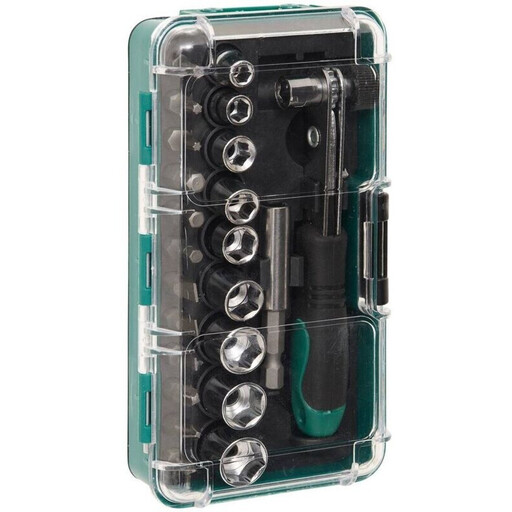
Why this product suits the profile: This compact set weighs 0.375 kg and includes 11 bits, 9 sockets from 4 to 12 mm and a magnetic adapter. It is ideal for small repairs, furniture assembly and general household use.
The range and included sizes are clearly stated. The rigid case prevents small attachments from lying loose in a drawer.
1/4-inch ratchet drive, magnetic adapter and compact dimensions of 8.5 × 3.5 × 15.5 cm.
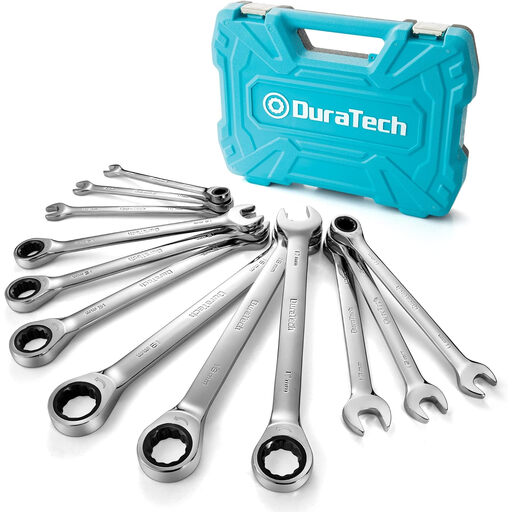
Why this product suits the profile: This set is aimed at users who regularly work on vehicles, machinery or structures and need a clearly defined metric size range.
All 12 sizes from 8 to 19 mm and the 72-tooth ratchet are specified. This means you can check the actual range of use before buying.
Chrome vanadium steel, 180° flexible head, 5° swing arc and labelled roll-up pouch.
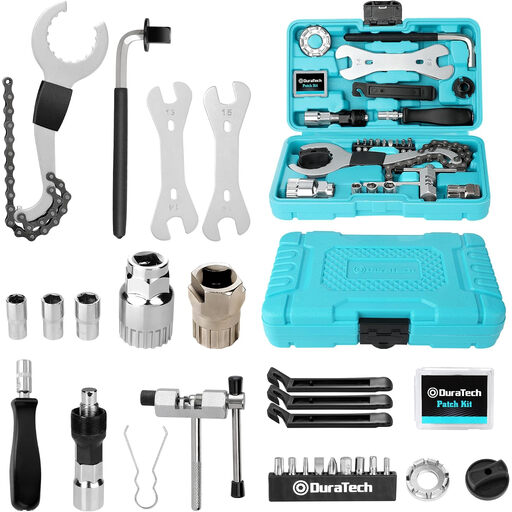
Why this product suits the profile: Cyclists get a set designed for bike maintenance, with tools for tyres, chain, crank and pedals.
The contents are described as 31 pieces with individual bicycle tools. This makes the specialist purpose clearer than with a general set.
Chrome vanadium steel, portable case and tools for chain, tyre, crank and pedal work.
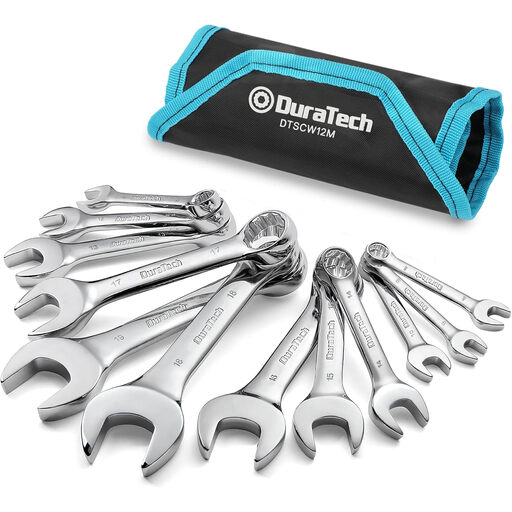
Why this product suits the profile: The short design is intended for fastenings in confined spaces, such as in vehicles, on machinery or on hard-to-reach structures.
The compact form is explicitly stated as a design feature. The size range of 8 to 19 mm can be checked against your own requirements in advance.
Heat-treated chrome vanadium steel, 12-point ring end, 15° offset and roll-up pouch.
We have put together a complete, regularly updated list of products that fully meet these strict selection criteria and the safety regulations in force in the EU.
For typical household jobs, a compact set with a ratchet, bits, sockets, screwdrivers and a combination or water pump pliers is practical. What matters are common sizes, clear storage and a secure fit. For regular bike work, a separate bicycle repair kit is usually more suitable than a general toolbox.
The lifespan depends on the material, load, care and frequency of use. Tools should be cleaned dry after use and checked for damage. Ratchets and plier joints need particular attention. If tools are used for the wrong purpose or overloaded, their life can be shortened regardless of the material specification.
The price depends on the number of pieces, material, mechanism, storage and specialisation. A small set for occasional assembly work may be sufficient, while a comprehensive combination spanner set or bicycle repair kit offers a wider range and specialist components. So compare the actual contents with the jobs you have planned before you decide based on price alone.