
Lieferung heute & morgen

Qualitätsgarantie

Willkommens-Angebote freischalten: KOSTENLOSE Lieferung | Bis zu 80 % RABATT | Kostenlose 30-Tage-JoyPlus-Testphase
App herunterladen
A tool set often appears cheaper at first glance than buying several individual items. In practice, however, it is not the number of components that matters, but whether the sizes, materials and areas of use match the job you have planned. This applies equally to DIYers, carpenters, plumbers and vehicle mechanics, as well as motorists looking for practical accessories.
A set containing numerous pliers or clamps is not automatically versatile. Pipe connections require different jaw widths from small furniture repairs. A water pump pliers set should therefore specify the maximum opening, the jaw teeth and the different lengths. If this information is missing, it is difficult to assess whether the set is suitable.
Clamps and cramping tools are sometimes advertised solely on the basis of a high clamping force. What matters, however, is whether that force applies to the particular size and how deep the clamping jaw reaches. For woodworking, protective pads are also important, as hard or sharp-edged jaws can damage delicate surfaces.
Hose clamp pliers are designed for flexible lines. They are not a substitute for tools intended for hard, reinforced or high-pressure lines. A water pump pliers should not be used as a replacement for a torque wrench either. The product description must match the actual task.
For metal pliers used regularly, chrome vanadium steel with heat treatment is a meaningful material specification. It describes the material base and intended load range, but is not on its own proof that the tool is suitable for every application. A rust-resistant coating can make maintenance easier; tools should still be cleaned and stored somewhere dry after contact with water or chemicals.
For hose clamp pliers, a non-conductive material such as reinforced PA6 nylon is relevant when fluid lines need to be clamped off during maintenance work. These pliers are intended only for flexible hoses. Fuel, brake, coolant and gas hoses must also be checked for their condition and suitability for clamping before use.
With water pump pliers, the maximum jaw opening and the adjustment increments are key considerations. A set containing 180- and 250-mm pliers will generally cover different grip sizes, but it does not replace a specialist tool for very large pipe diameters.
With an F-clamp set, clamping range and throat depth must be considered separately. A clamp with a 150 mm clamping range may be suitable for small strips, while 300 mm provides more room for larger panels. Throat depth describes how far the clamping jaw reaches into the workpiece from its edge.
One-handed clamps, quick-release clamps and spreading clamps can save time during assembly work, provided the mechanism moves smoothly and the jaws are guided securely. Soft TPU or plastic pads are recommended for clamps used in woodworking. With screw clamps, controllable force is also important: overtightening can press into wood fibres or deform components.
Before buying, you should also check whether the clamp can be converted from clamping to spreading. This dual function is practical, provided the conversion process is clearly explained in the description.
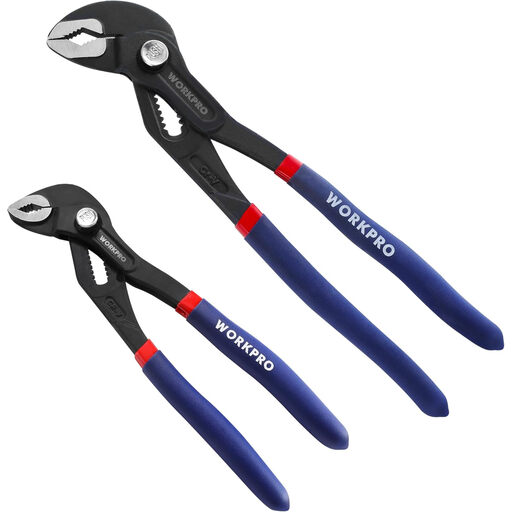
Why this product suits the profile: Two sizes cover small repairs, plumbing work and general maintenance tasks without requiring an extensive selection of pliers.
The 180 and 250 mm sizes, along with maximum openings of 33 and 43 mm, are clearly specified. This makes it easier to check whether they are suitable for your needs before buying.
Chrome vanadium steel, push-button adjustment, resin handles and toothed jaws for round, flat, square and hexagonal workpieces.
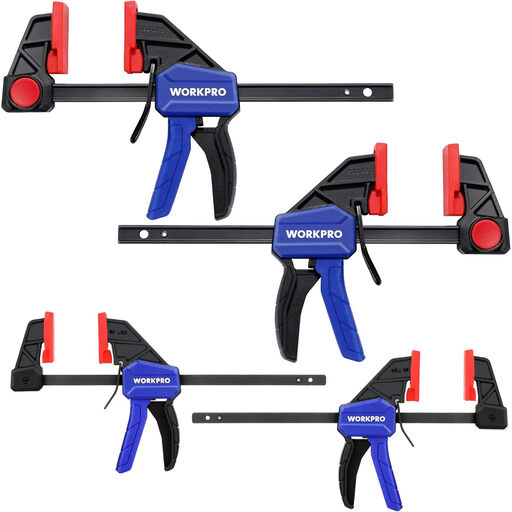
Why this product suits the profile: This set is aimed at users who want to work with control, protect surfaces and operate one-handed during woodworking and assembly tasks.
Soft TPU pads reduce the risk of pressure marks. The specified clamping forces of 23 and 68 kg help with realistic project planning.
Reinforced nylon body, black steel bar, one-handed operation and reversible jaws for different clamping directions.
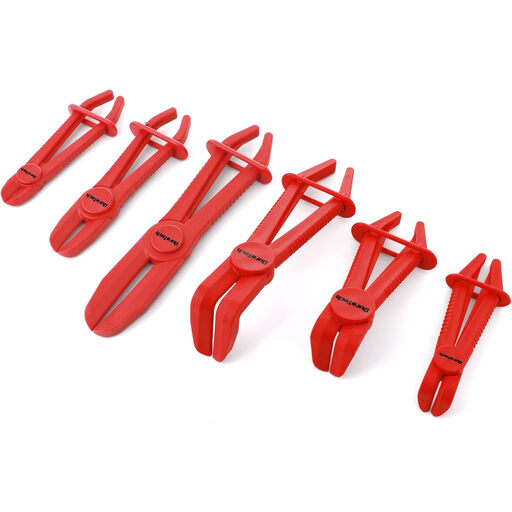
Why this product suits the profile: For maintenance work on flexible fuel, brake, coolant or radiator hoses, the set includes straight and 90° angled hose clamp pliers.
The six size ranges from 0–10 to 19–64 mm are listed. The manufacturer expressly states that the set is not intended for hard, reinforced or high-pressure lines.
PA6 nylon, rounded clamping jaws, non-slip handles and a safety lock to secure the pliers during use.
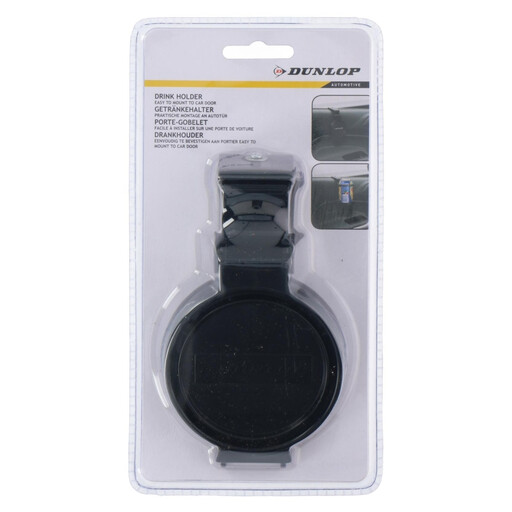
Why this product suits the profile: This car drinks holder is designed for vehicles without a built-in storage space and can be folded flat when not in use.
It is fitted using an adjustable door bracket. Before buying, check whether the door shape and available space in your vehicle are suitable.
Foldable design, removable construction and suitability for many vehicle models according to the product description.
For carpenters and DIY users, a screw clamp set with 150- and 300-mm versions can accommodate different workpiece sizes. The WORKPRO set specifies a throat depth of 80 mm and a clamping force of 272 kg. This should be understood as the maximum product specification; delicate materials should be handled with protective caps and controlled pressure.
If you need a wider clamping range for gluing or assembly work, you could also consider a convertible quick-release clamp with a 305 mm clamping range and a 440 mm spreading width. For metal or wooden constructions, it is essential to position the clamp at a right angle and avoid exceeding the permitted load.
A pliers set for plumbing work, on the other hand, should offer at least a range of jaw widths, secure adjustment and good-grip jaws. For confined installation spaces, angled pliers may be more useful than particularly long standard models.
We have put together a complete, regularly updated list of products that fully meet these strict selection criteria and the safety regulations applicable in the EU.
For typical repairs, water pump pliers, screwdrivers, socket wrenches, side cutters, a tape measure and a set of Allen keys are useful. For woodworking, add F-clamps or one-handed clamps. Your selection should be based on the tasks you plan to tackle, not simply the number of pieces.
Their service life depends on the load, maintenance, storage and area of use. Metal pliers should be cleaned after exposure to moisture and stored somewhere dry. Moving adjustment mechanisms can be lightly lubricated occasionally. Clamps must not be operated continuously above their specified clamping force.
No. The hose clamp pliers mentioned are intended for flexible hoses. Hard, reinforced or high-pressure lines may be damaged or may not be clamped off safely. Before any maintenance work, always follow the vehicle or equipment manufacturer’s instructions and check the condition of the line.