
Lieferung heute & morgen

Qualitätsgarantie

Willkommens-Angebote freischalten: KOSTENLOSE Lieferung | Bis zu 80 % RABATT | Kostenlose 30-Tage-JoyPlus-Testphase
App herunterladen
A rolling tool chest is a cornerstone of efficiency and organisation in professional workshops and sophisticated home garages. Designed as a mobile tool cabinet, it combines storage with mobility, providing rapid access to tools directly at the job site. Selecting the right model depends on specific requirements for material, capacity, security, and mobility. A well-structured tool trolley or service cart minimises search times and protects equipment from damage and unauthorised access.
The decision for a rolling tool chest should be based on an analysis of its technical features. The following criteria are crucial for functionality and durability.
The construction determines the tool chest's robustness and lifespan. Many models are made from cold-rolled steel, which offers high strength and dimensional stability. A powder-coated surface protects the metal from corrosion, scratches, and chemicals commonly found in workshops. The material thickness, often specified in millimetres, is an indicator of the load-bearing capacity of the body and drawers.
The functionality of a tool chest is largely defined by its drawers. Key aspects include:
The casters are the foundation of mobility. Four swivel casters offer maximum manoeuvrability, while a combination of two swivel and two fixed casters provides more stable straight-line tracking. Pay attention to the following features:
A lockable tool chest protects valuable tools from theft and unauthorised access. A central locking system with a cylinder lock, which secures all drawers simultaneously, is a common and practical solution. Some systems also offer the option to lock drawers individually.
Based on an analysis of technical specifications and practical utility, we present two models that stand out for their construction and functionality.
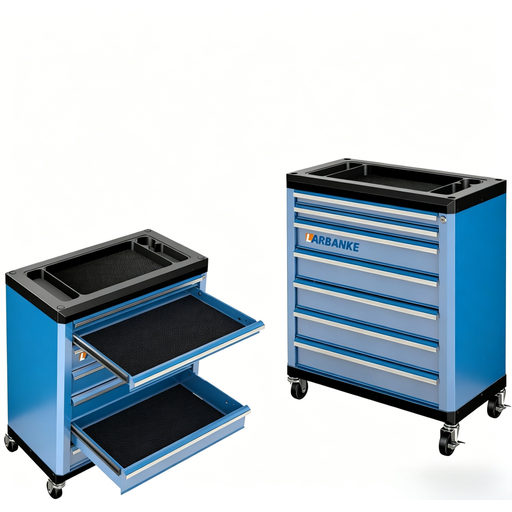
Why We Recommend This Product This model, measuring 62.5 cm (W) x 33 cm (D) x 73 cm (H), focuses on detailed organisation and security. The drawers, available in two different heights (3.5 cm and 7.9 cm), are lined with PE foam inserts that protect contents from impact. The anti-tip mechanism and full-extension slides allow for safe and complete access. The plastic worktop is waterproof and rust-resistant. A universal locking system allows keys to be interchanged if you own multiple carts from the same series. Furthermore, its ability to be stacked with other models in the series via connecting rods offers excellent flexibility.
Pros
Who It's For This model is ideal for users who require precise organisation of tools and small parts and value quiet mobility and an expandable storage solution.
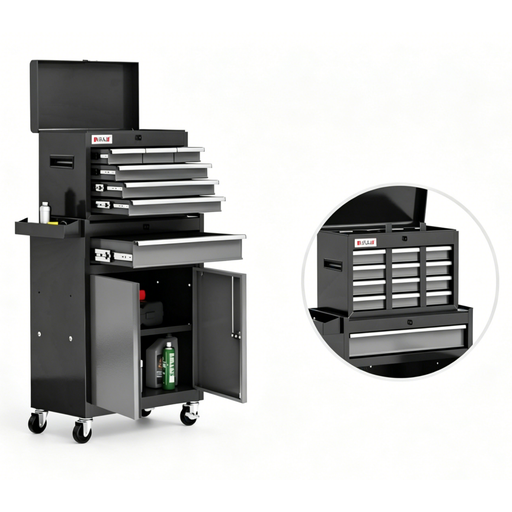
Why We Recommend This Product This model features a robust construction of high-strength, cold-rolled steel with a powder-coated finish for wear and corrosion resistance. Security is ensured by lockable double doors that control access to the internal compartments. The storage layout includes one large drawer, three medium drawers, and three small parts drawers, enabling systematic sorting by tool size and type. The 1-inch universal rubber casters reduce noise during movement, while locking brakes on the rear wheels ensure a secure stance.
Pros
Who It's For This model is designed for users seeking a particularly durable and secure storage solution, especially for sharp or valuable tools. The variety of drawer sizes supports a structured workflow.
If a mobile tool chest doesn't exactly meet your needs, or if you prefer a stationary solution, you can find a wider selection of modular and fixed systems for tool organisation in our Box Storage Cabinet category.
1. What is the difference between a workshop trolley and a service cart? Both terms are often used interchangeably. A workshop trolley is primarily for the organised storage and transport of tools within a workshop. A service cart is often designed more specifically for assembly tasks and may feature additional holders or a larger, more robust work surface, but it is essentially also a mobile tool cabinet.
2. How much weight can a rolling tool chest support? The maximum total load capacity varies greatly depending on the model, construction, and material. It typically ranges from 100 kg for lighter models to over 500 kg for heavy-duty industrial versions. The manufacturer's specifications for total load capacity and load capacity per drawer are crucial. These limits should not be exceeded to ensure stability and safety.
3. Why is a lockable tool chest a good idea? A lockable tool chest offers two key advantages. First, it protects expensive tools from theft, especially in shared workshops or commercial settings. Second, it enhances safety by preventing unauthorised individuals, including children, from accessing potentially dangerous tools (e.g., sharp blades or power tools).
Written by the Joybuy Product Recommendation Officer