
Lieferung heute & morgen

Qualitätsgarantie

Willkommens-Angebote freischalten: KOSTENLOSE Lieferung | Bis zu 80 % RABATT | Kostenlose 30-Tage-JoyPlus-Testphase
App herunterladen
A well-organized workshop is the foundation for efficient and safe work. Yet, valuable time and patience are often lost because the required tool is nowhere to be found, is scattered about, or gets damaged from improper storage. The right toolbox provides a solution by ensuring order, protection, and quick access.
This article serves as a guide. We will introduce various types of tool storage and explain the key criteria to help you make an informed decision for your individual needs—whether for the home garage, professional use, or mobile projects.
Choosing the right system depends on the size of your tool collection, your work environment, and your mobility requirements. The following points will help you narrow down the options.
The material is a crucial factor for the robustness and lifespan of your tool storage. A metal toolbox, usually made of sheet steel, offers high stability and resistance to the impacts and stresses common in a workshop. Plastic models are lighter and often more resistant to moisture, making them advantageous for mobile use or in damp environments. Combined systems often leverage the benefits of both materials, for instance, with a sturdy steel body and a durable ABS plastic worktop.
Consider where you need your tools.
A well-thought-out interior layout is essential for efficiency. A toolbox with drawers allows for the systematic sorting of tools by type or size. Ball-bearing drawer slides ensure smooth and full extension. For security, especially in shared workshops or households with children, a lockable tool trolley is a sensible choice. Central locking systems that secure all drawers simultaneously offer particular convenience.
Based on the criteria mentioned, we have compiled a selection of models that cover different requirements for size, mobility, and function.
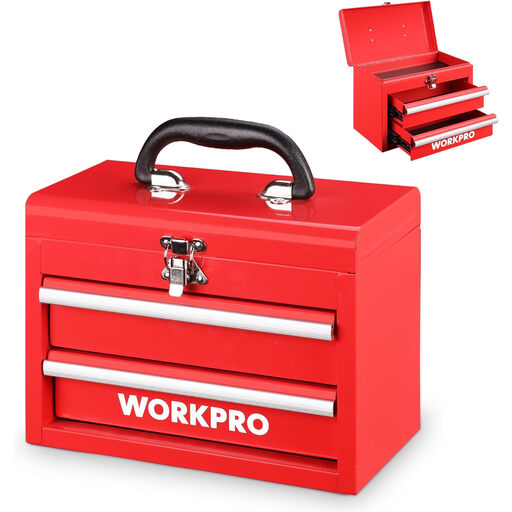
Why It Stands Out This compact box from WORKPRO combines a robust metal construction with a thoughtful design. The ball-bearing slides allow for exceptionally smooth opening and closing of the drawers. With its integrated carrying handle and a secure latch, it is designed for mobile use.
Advantages
Who Is It For? This model is suitable for DIY enthusiasts with a manageable tool collection, for organizing small parts on a desk, or as a mobile box for specific tasks.

Why It Stands Out The LARBANKE toolbox is part of a modular system. It can be used individually or combined with other units from the same series to create a custom storage tower. A special feature is the unified locking system, where one key fits all compatible modules.
Advantages
Who Is It For? Ideal for users looking for a flexible and expandable solution. Both DIY enthusiasts and professionals who want to gradually adapt their storage system to their growing tool collection will benefit from this concept.

Why It Stands Out This tool trolley from AIRAJ is a comprehensive solution for storing and transporting a large quantity of tools. It is made of cold-rolled steel and features a durable powder coating. The combination of drawers and a lockable double-door compartment offers versatile and secure storage space.
Advantages
Who Is It For? This model is aimed at ambitious DIYers and professional users in workshops or garages who need a mobile, spacious, and secure all-in-one solution for their entire tool set.
The products presented cover common use cases. However, the market offers an even greater variety of specialized solutions, from small organizer boxes to complete workshop systems. If you haven't found the right model yet or want to get a broader overview, it's worth taking a look at other alternatives.
Discover our entire range of industrial containers with lids and find the perfect solution for your needs.
A toolbox is typically a portable box designed for transporting a limited number of tools. A tool trolley is a larger, rolling piece of furniture with multiple drawers and compartments. It offers significantly more storage space but is intended for use within a fixed location like a workshop or garage.
A proven method is to group tools by their function (e.g., all screwdrivers together, pliers in another compartment). Frequently used tools should be placed in the upper, easily accessible drawers. Drawer inserts or foam inlays help to sort small parts and keep everything in its place.
Pay attention to the type of lock. A central lock that secures all drawers simultaneously is convenient. Check the stability of the locking mechanism and the housing. For modular systems, a single key for multiple units can be advantageous to simplify key management.