
Lieferung heute & morgen

Qualitätsgarantie

Willkommens-Angebote freischalten: KOSTENLOSE Lieferung | Bis zu 80 % RABATT | Kostenlose 30-Tage-JoyPlus-Testphase
App herunterladen
A toolbox should protect your tools, keep everything organised and be easy to carry around day to day. Yet unclear size information, overloaded drawers and missing safety features often lead to the wrong purchase. This applies to DIYers as much as professional tradespeople, workshop owners and parents looking for a children’s tool case.
Many listings give only the external dimensions of a toolbox. But the wall thickness, hinges and compartments all reduce the usable space inside. Always check both sets of measurements. A compact case with its internal dimensions clearly listed may be more practical than a larger-looking toolbox with little usable depth.
A toolbox with a carry handle is designed to be portable, but that doesn’t automatically make it suitable for heavy machinery or permanent stacking. For modular cases, check the stated maximum load. For a tool cabinet or trolley, you should also consider the load capacity of each drawer, the strength of the castors and the size of the base.
These terms don’t tell you much without specific details. Instead, look for:
A metal toolbox may look robust, but it’s usually heavier than a plastic one. A stackable toolbox can save space, provided the connectors and compatibility with the system are clearly described.
Shallow compartments or drawers are often enough for hand tools such as screwdrivers, pliers and spanners. Power tools, on the other hand, need more height and sufficient internal width. A toolbox with drawers makes it easier to sort your tools, while a traditional toolbox with a large main compartment can hold bulky items too.
Before buying, compare:
Plastic is usually lighter and well suited to taking on the go. According to the product details, the Makita MAKPAC Size 2 has a plastic case, a carry handle and internal dimensions of 377 × 277 × 124 mm. The recommended maximum load is 10 kg. The description states that the case is not waterproof, so an extra cover is a good idea if you’re storing it in a damp garage or transporting it in the rain.
Steel and metal offer a robust construction, but add more weight. The WORKPRO model has two drawers, an upper storage compartment and removable PVC mats to keep items separate. Ball-bearing runners help the drawers open and close smoothly. A locking mechanism prevents the drawers from moving unintentionally when you’re carrying the case.
A tool trolley should have sturdy castors. Locking brakes keep it in position at your workstation. An anti-tip feature is important when several drawers are open, as the centre of gravity shifts forwards. So when assessing a tool cabinet on wheels, look beyond the number of castors and check the brakes, drawer runners and overall base area too.
Children’s tool cases call for different considerations. A toy case should be suitable for the stated age, have no sharp edges and clearly identify any small parts. The Bosch Tool Case 1 is listed as suitable for children aged three and over. As it contains small parts, it must be used under adult supervision. This is a toy and is not intended for real repair work.
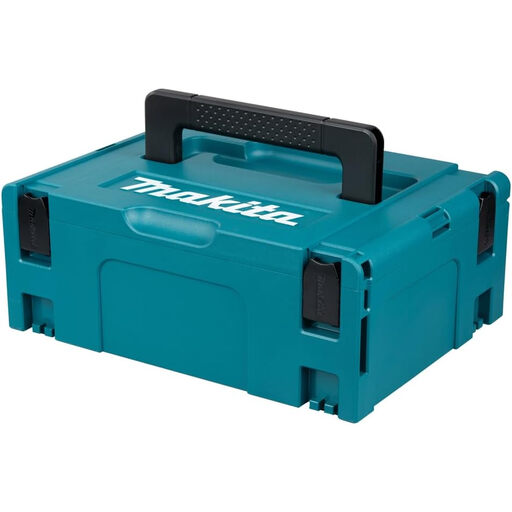
Why it suits this type of user: This compact plastic case is ideal if you want to store hand tools or accessories in a space-saving way and take them with you.
The internal and external dimensions are listed, along with a recommended load of 10 kg. This makes it easier to plan realistically how much you can store inside.
Stackable MAKPAC system, carry handle and internal dimensions of 377 × 277 × 124 mm.
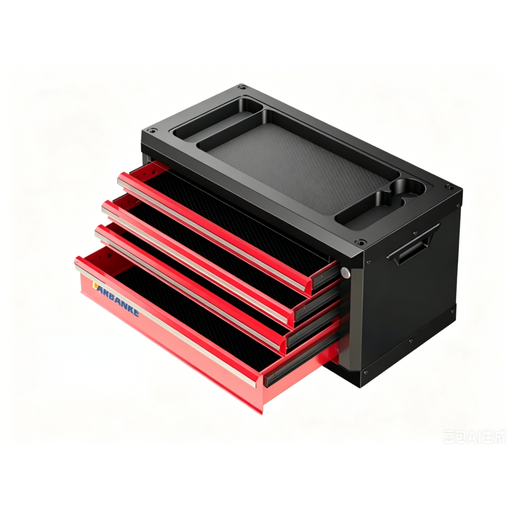
Why it suits this type of user: Four steel drawers and a modular connection make it easy to keep tools neatly separated in the workshop or garage.
Drawer heights, a uniform locking mechanism, ball-bearing runners and anti-tip protection are all clearly described.
Four drawers, steel construction, padded interior surfaces and the option to connect it to other LARBANKE modules.
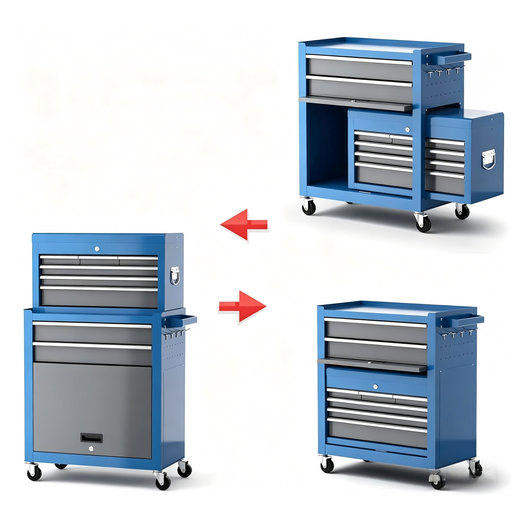
Why it suits this type of user: For larger workshops and frequent jobs, its wheeled design gives you access to several storage areas right where you’re working.
Braked castors, drawer liners and organiser dividers help keep everything safe and tidy while you work.
Cold-rolled steel, ten compartments, perforated side panels and a stated load capacity of 550 lbs.
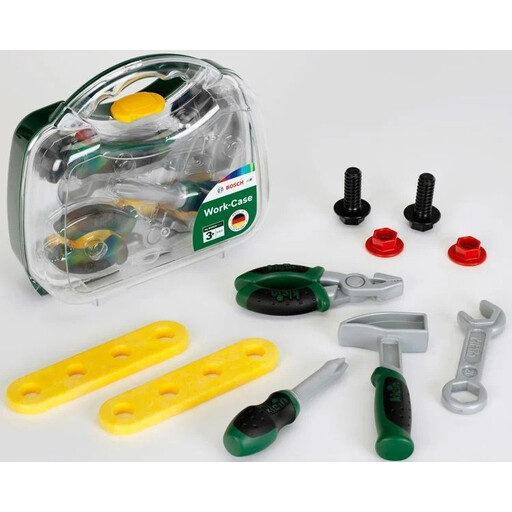
Why it suits this type of user: Designed for imaginative role play, this set includes a hammer, pliers, screwdriver, strips, screws and nuts, among other items.
The age recommendation and small-parts warning are clearly stated. Use the case in line with the labelling and under adult supervision.
Carry handle, transparent front and plastic toy tools for role play.
We’ve put together a complete, regularly updated list of products that meet these strict selection criteria and fully comply with the safety regulations in force in the EU.
Where possible, place heavier tools at the bottom and keep delicate items in padded compartments. Arrange frequently used tools so you can reach them without having to empty the whole case. Before storing them, make sure metal parts are dry and free from coarse dirt.
Its lifespan depends on the material, the load it carries, how often it’s transported and how it’s stored. Plastic cases are lightweight and practical for taking on the go. With proper use, steel and metal models can withstand greater mechanical stress, but they are heavier. Hinges, catches, drawer runners and castors also make a difference.
The cost mainly depends on size, material, mobility and features. A basic portable toolbox is enough for occasional repairs. For a permanent workshop setup, consider a tool trolley, tool cabinet or modular drawer system. Don’t just compare the purchase price: factor in any liners, spare parts and the space you have available.