
Lieferung heute & morgen

Qualitätsgarantie

Willkommens-Angebote freischalten: KOSTENLOSE Lieferung | Bis zu 80 % RABATT | Kostenlose 30-Tage-JoyPlus-Testphase
App herunterladen
As a Joybuy Product Recommendation Officer, I see countless products every day. My job is to separate the wheat from the chaff and give you practical advice so you can make an informed decision. The selection of educational toys for babies is vast, and not every product advertised as "educational" actually delivers on its promise. Before you make a purchase, you should be aware of the most common pitfalls.
1. The Overstimulation Trap: Flashing lights, loud melodies, and countless buttons seem impressive at first glance. However, they often lead to a baby or toddler becoming overwhelmed and unable to focus on a single learning task. In this case, less is often more.
2. The Short-Lifespan Trap: Many toys are designed for a very narrow developmental stage. A toy that is fascinating at nine months can become uninteresting by twelve months. This leads to unnecessary expenses and a surplus of unused toys.
3. The Mismatched Age-Rating Trap: While an age recommendation guarantees the product's safety according to legal standards, it doesn't ensure that it is developmentally appropriate. A toy designed for a three-year-old can frustrate a younger child instead of encouraging them.
To avoid these pitfalls, focus on a few core parameters that define the true value of an educational toy.
The most important characteristic of any baby toy is its safety. Always look for the CE marking, which confirms that the product meets EU safety standards. For toys, the EN 71 series of standards is particularly relevant. In practical terms, this means:
A good educational toy challenges a child without overwhelming them. It should spark curiosity and invite interaction.
A well-designed toy offers multiple ways to play or grows with the child. A set of simple wooden blocks can be used for stacking, sorting, building, and role-playing—and remains relevant for years. Before buying, ask yourself: Will this toy still be engaging in six months?
Here are some product recommendations tailored to different needs and age groups that meet the criteria mentioned above.
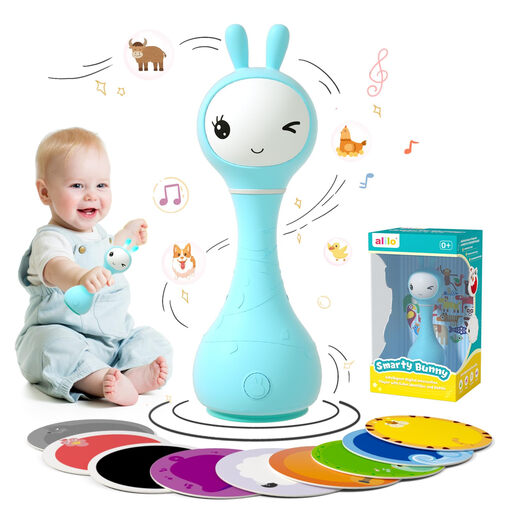
Why This Fits Their Persona: Ideal for babies who are beginning to discover their senses. The rattle is easy to grasp, the silicone ears are suitable for teething, and the combination of gentle sounds and lights promotes auditory and visual perception.
It avoids overstimulation through focused, simple functions. Instead of a chaotic barrage of stimuli, it offers clear feedback, such as a colour recognition feature and different music modes that don't overwhelm the child.
The integrated colour recognition function with the included cards offers long-lasting play value. The ears light up in the detected colour, which helps with learning colours.
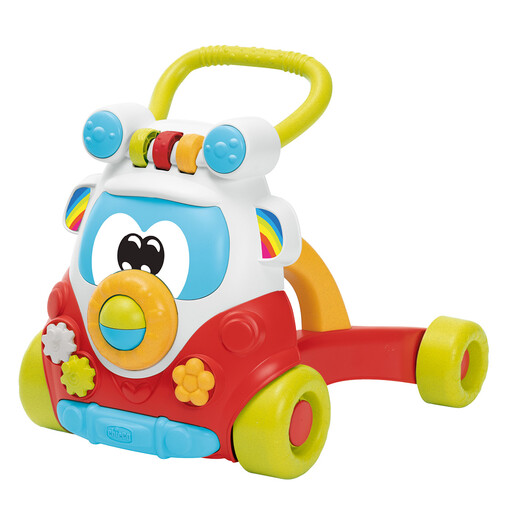
Why This Fits Their Persona: Perfect for children aged 9 to 24 months who are taking their first steps. It serves as a stable baby walker and doubles as an activity centre that promotes fine motor skills, even when the child is sitting. An ideal gift for a 1-year-old.
This 2-in-1 product avoids the short-lifespan trap. It stays relevant longer than a simple walker because the activity centre can also be played with while sitting. The activities are purely mechanical, promoting concentration without electronic distractions.
The four wide wheels provide high stability, giving the child confidence during their first attempts at walking. The five manual activities on the front specifically train fine motor skills and logical thinking.
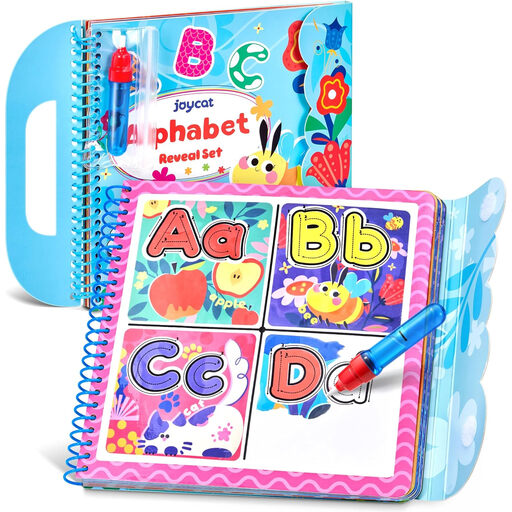
Why This Fits Their Persona: Ideal for children who are showing an interest in letters and colouring. It promotes proper pen grip and early letter recognition in a clean and repeatable way. Perfect for quiet time at home or as a travel companion in the car or on a plane.
This book is reusable, making it exceptionally durable. As soon as the water dries, the colours disappear, and the fun can start all over again. It focuses on a clear learning task (the alphabet) without distracting electronic elements.
It's completely mess-free, as only plain water is needed—no paint stains on clothes or furniture. The integrated carrying handle and pen holder make it a practical toy for on-the-go.
We have compiled a complete, up-to-date list of products that fully meet these strict selection criteria and UK/EU safety regulations.
The cleaning method depends on the material. Plastic toys without electronics can often be cleaned with mild soap and warm water. Wooden toys should only be wiped with a damp cloth and not submerged in water. For toys with electronic components, such as baby toys with music and lights, only the surfaces should be carefully cleaned with a slightly damp cloth. Always follow the manufacturer's care instructions.
Such toys can be interesting for babies from around six months of age, when they begin to purposefully reach for things and understand the principle of cause and effect. It is important that the stimuli are not overwhelming. Choose models with volume control and gentle light effects. A single button that triggers a short, pleasant melody is often more suitable for starters than a toy with dozens of functions.
In addition to the CE marking and the EN 71 standard, pay attention to the physical construction. The toy should not have any small, detachable parts. Battery compartments must be securely screwed shut so that a child cannot open them. Check the product for sharp edges or pointed corners. Also, trust your own judgment: if a part seems unstable or potentially dangerous to you, it is likely not suitable for a young child.