
Lieferung heute & morgen

Qualitätsgarantie

Willkommens-Angebote freischalten: KOSTENLOSE Lieferung | Bis zu 80 % RABATT | Kostenlose 30-Tage-JoyPlus-Testphase
App herunterladen
A new kettle might seem like a simple purchase. But the reality is often quite different: an unpleasant plastic taste in your tea, hard-to-clean corners where limescale builds up, or a temperature setting that's less accurate than a weather forecast. Such annoyances are not only frustrating but are often the result of clever marketing that masks fundamental flaws.
As your Joybuy Product Recommendation Officer, I'm here to help you spot these pitfalls. Instead of falling for exaggerated advertising claims, we'll focus on the crucial features that define a reliable and long-lasting kettle.
Before you buy a kettle, you should be aware of three common problems that often only become apparent after a few weeks of use:
To avoid purchase regret, you should base your decision on objective criteria. The following three parameters are crucial for the performance and durability of your new kettle.
The material of the water container directly impacts the taste of the water and the appliance's longevity.
The power, measured in watts, determines how quickly the water boils. Models with 2000 to 2400 watts bring water to a boil rapidly and are an efficient choice for most households. A standard capacity of 1.7 litres is ideal for families or for making several cups of tea or coffee. Smaller households can often manage well with 1 to 1.5 litres.
Not every feature is a must-have, but some make daily life significantly easier:
Here are some models that represent a considered choice for different needs, based on their objective features.
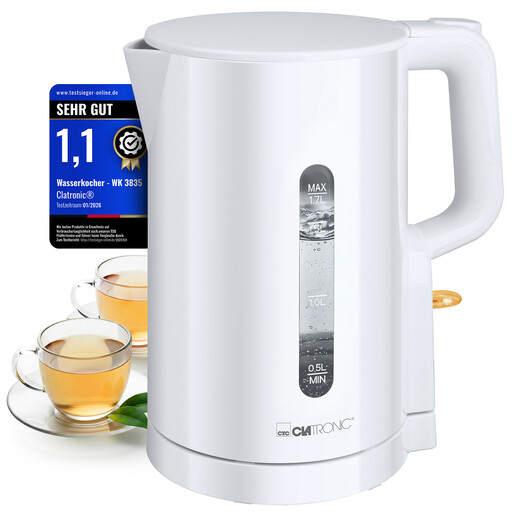
Why This Fits Their Persona: This model focuses on the essentials: boiling water quickly and safely. It's ideal for households looking for a reliable appliance without complex extra features.
The appliance is declared BPA-free, thus avoiding the plastic aftertaste trap. The concealed stainless steel heating element and removable limescale filter counteract the limescale trap.
2200 watts of power for rapid heating; 1.7-litre capacity and one-handed operation for high everyday convenience.
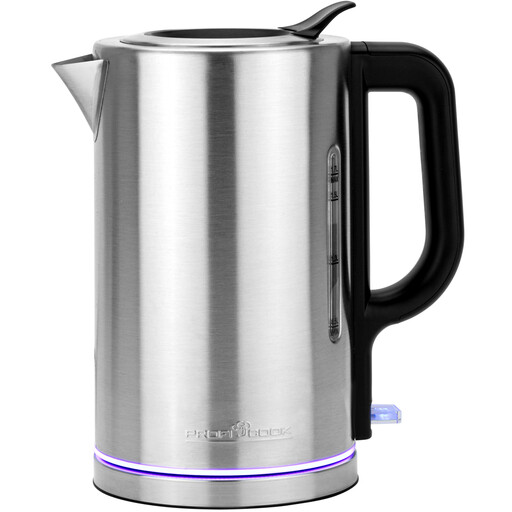
Why This Fits Their Persona: For anyone who values a high-end look and feel. The stainless steel body is not only durable and taste-neutral but also a visual highlight in the kitchen.
The stainless steel body prevents any plastic from coming into contact with the water, thus eliminating taste contamination. The design with a concealed heating element simplifies cleaning and prevents limescale issues.
Stylish 360° ambient lighting during the boiling process; self-closing filling lid for convenient one-handed operation.
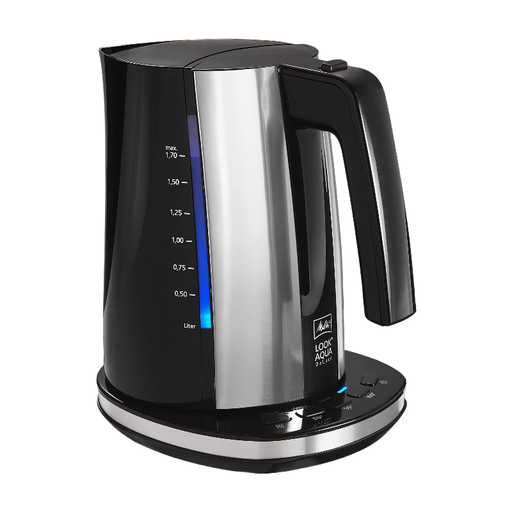
Why This Fits Their Persona: Perfect for users who need precise water temperatures. Whether for delicate sencha tea or the safe preparation of baby formula, control is the main focus here.
This model solves the problem of imprecise features with three clearly defined temperature settings (80°C, 95°C, 100°C). Its BPA-free construction also ensures safety and pure taste.
Practical keep-warm function for up to 30 minutes; high power of 2400 watts for extra-fast heating.
We have compiled a complete, up-to-date list of products that fully meet these strict selection criteria and all relevant safety standards.
The frequency of descaling depends on the water hardness in your area. With hard water, descaling every four to six weeks is recommended; with soft water, every three months is usually sufficient. Regular descaling ensures performance, reduces energy consumption, and extends the appliance's lifespan.
Both materials are excellent choices and superior to plastic when it comes to taste neutrality and hygiene. Stainless steel kettles are more robust and resistant to impact. Glass kettles score points for their appearance and the ability to easily see the water level and any impurities. The decision ultimately comes down to personal preference and how you handle the appliance.
Power consumption depends on the wattage and duration of use. A typical 2200-watt kettle takes about 3-4 minutes to boil 1.5 litres of water. This corresponds to an energy consumption of approximately 0.11 to 0.15 kWh. Although the power rating is high, the short operating time makes the kettle one of the most energy-efficient methods for heating water—significantly more efficient than a pot on the stove.